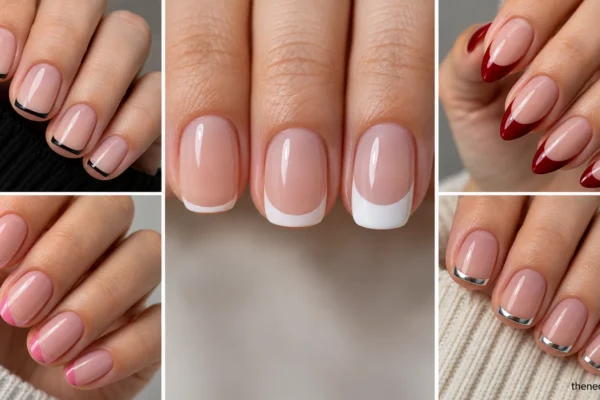
A French manicure can disappear under a thick band of polish when your nails barely reach your fingertips. Short french nails need a smaller design budget: a fine white seam, a side-loaded splash of color, or a narrow reflective edge can give you a recognizable French tip without requiring extra length. The 17 looks below are designed for genuinely short round, square, squoval, and shallow-oval nails—not long almond sets cropped to look short. Along with the ideas, you’ll find a practical guide to tip width, a quick shape comparison, and wording you can use at your next appointment.
How Much Tip Can a Truly Short Nail Hold?
For this guide, short means the nail ends at or near the fingertip, with no extension or only a small visible free edge. Treat about 0.5–1 mm for a micro line and roughly 1–2 mm for a small French cap as starting visual targets, not universal nail measurements. On the smallest nail plates, even 1 mm can look wide. If the colored tip hides much of the visible nail bed, make it finer or simplify its geometry.
| Your nail shape | French placement to try | What to keep small |
|---|---|---|
| Almost-flush round | Fine curved seam or sparkle rim | Smile-line depth |
| Soft square | Straight band or small diagonal corner | Tip-band height |
| Squoval | Split edge, double thread, or narrow cutout | Gaps between details |
| Shallow oval | Side hook or compact V | Sidewall sweep |
Short almond nails are possible only when there is enough free edge to taper without filing into the attached sides. If that length is missing, keep an oval instead. NeoGlow’s short-nail shape guide covers that structural choice; the ideas here keep the length constraint fixed.
Barely-There French Tips for Everyday Wear
1. Soft-White Perimeter Seam on Short Rounds
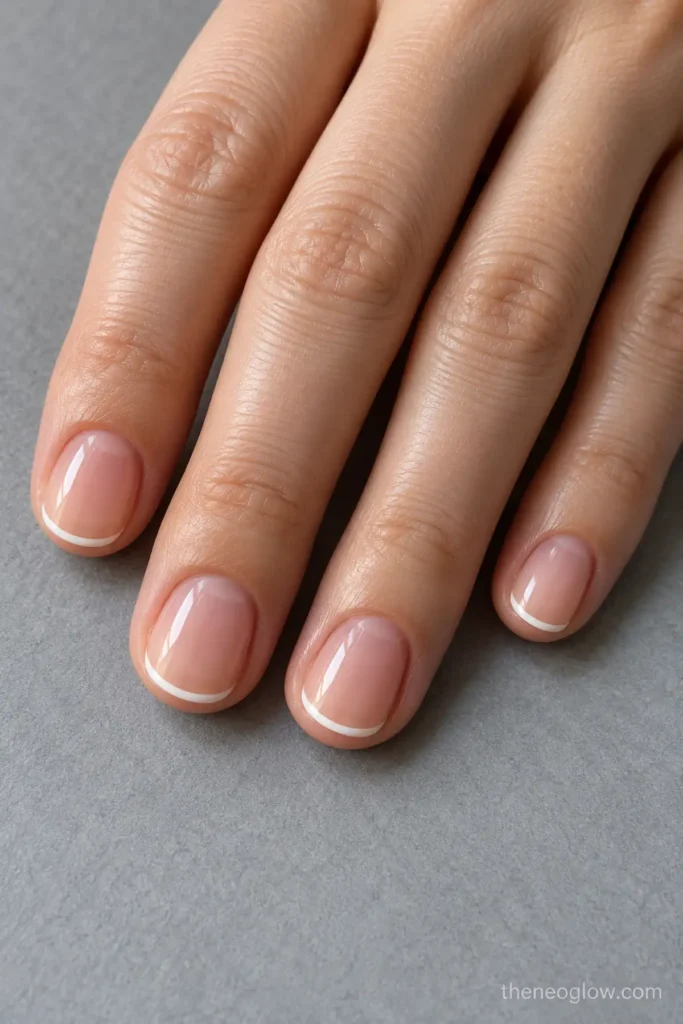
A translucent peach-pink base lets the natural nail show through. Trace its rounded outer edge with one continuous, opaque-white hairline, then finish with clear gloss. Keep the line near 0.5 mm when your nail is nearly flush with the fingertip. This is a complete classic French at miniature scale, with no accent art required.
2. Ink-Blue Ruler Edge on Soft Squares
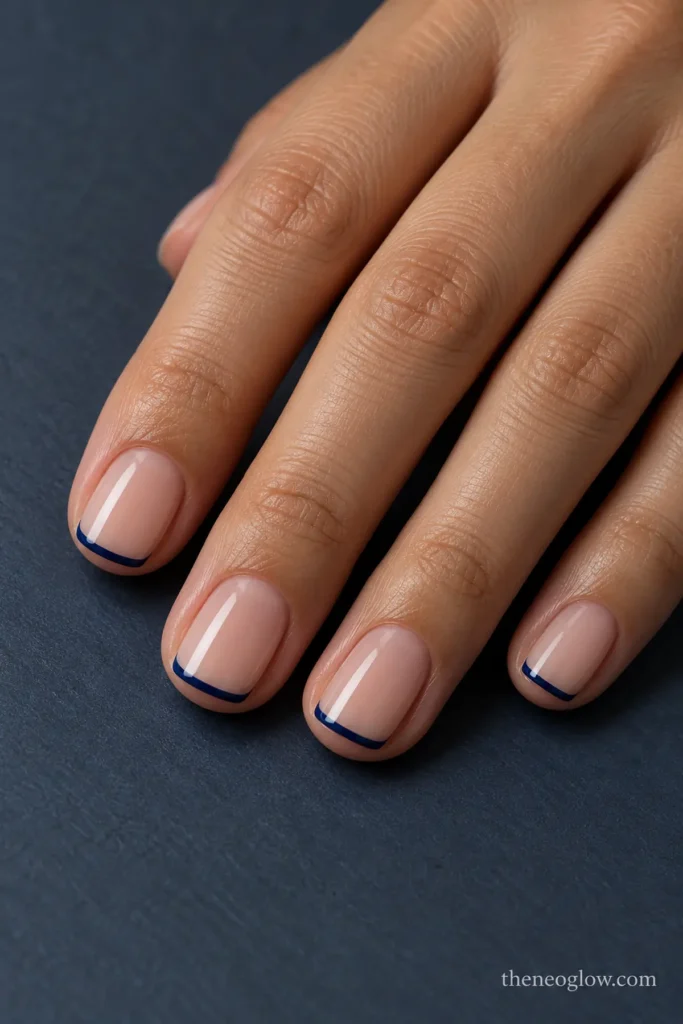
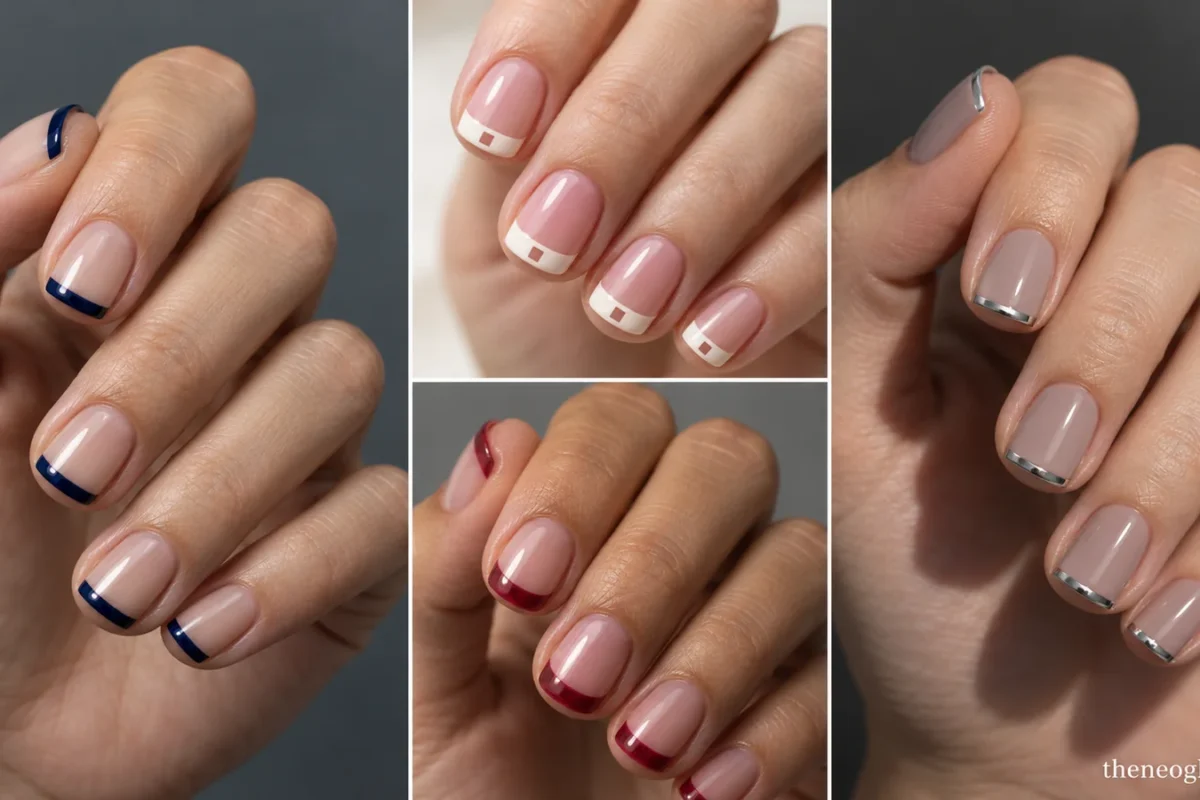
Instead of a curved smile, use a nearly horizontal, glossy midnight-blue strip across a short, softly squared free edge. A sheer neutral-beige base makes the clean navy band easy to distinguish. Limit the stripe to a sliver so the front edge looks crisp, not like a solid blue block. Keep both corners equally defined.
3. Rose-on-Rose Shallow Arch on Squovals
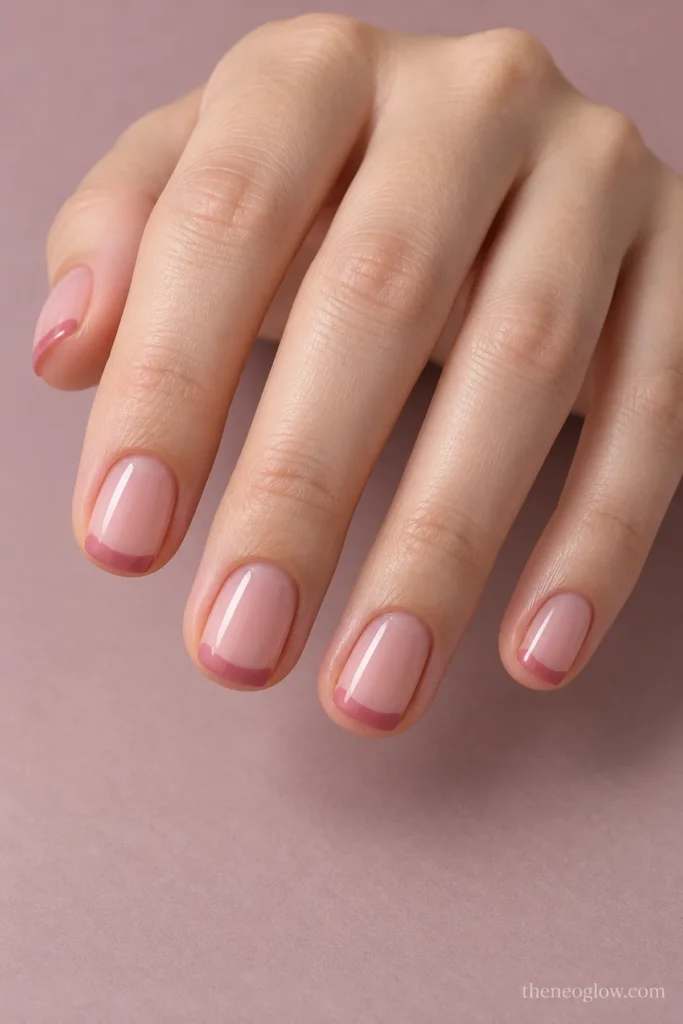
Pair a translucent warm blush base with a slightly deeper, cool rose-pink tip in a soft satin finish. The tip forms a shallow curve with ends that stop before running down the sides. Color contrast is deliberately low, but the change in opacity keeps the French boundary visible. It is a quieter alternative to opaque white.
4. Lilac Hook on the Outer Tip Corner
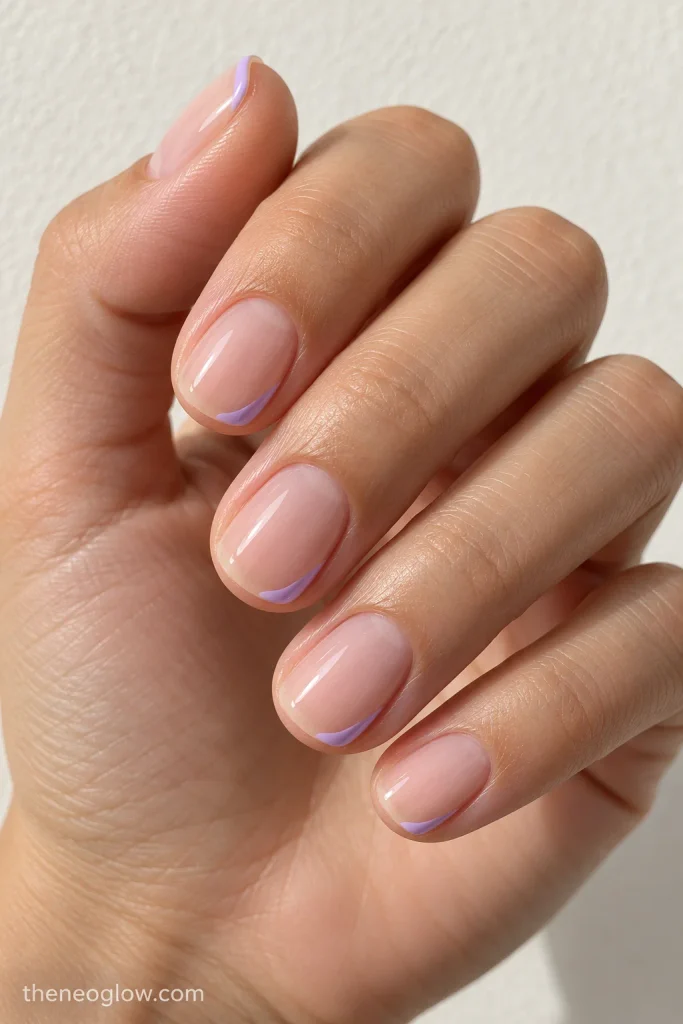
On short ovals, place glossy lilac on the right tip corner only. Let the fine colored line turn gently from the free edge onto the uppermost side, like a tiny hook, while the opposite corner remains clear. A pale beige-pink base leaves room for that asymmetry. Mirror the hook direction across the set or make it consistent finger to finger.
5. Tangerine Half-Cap on Short Soft Squares
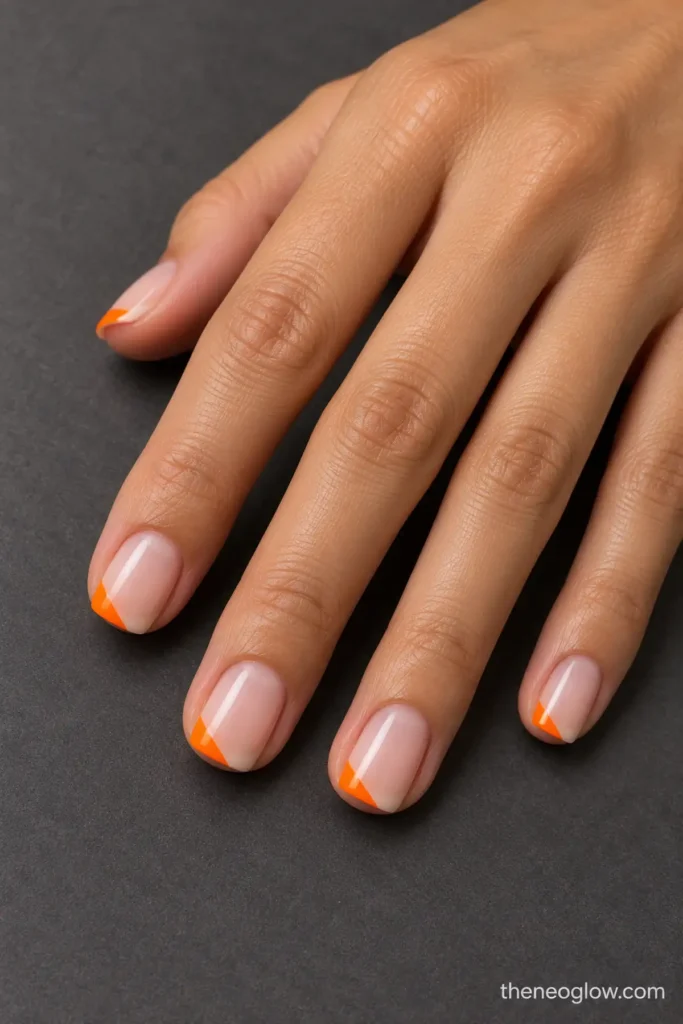
A compact, glossy tangerine wedge starts at one free-edge corner and angles toward the middle of the nail, stopping before it reaches the opposite corner. The rest of the front edge and the sheer ivory-pink base stay exposed. This is a diagonal French reduced to the outer half of a small nail, rather than a wide colored slash across the plate.
Graphic French Ideas That Do Not Require Length
6. Cobalt-and-Coral Center-Split Rim
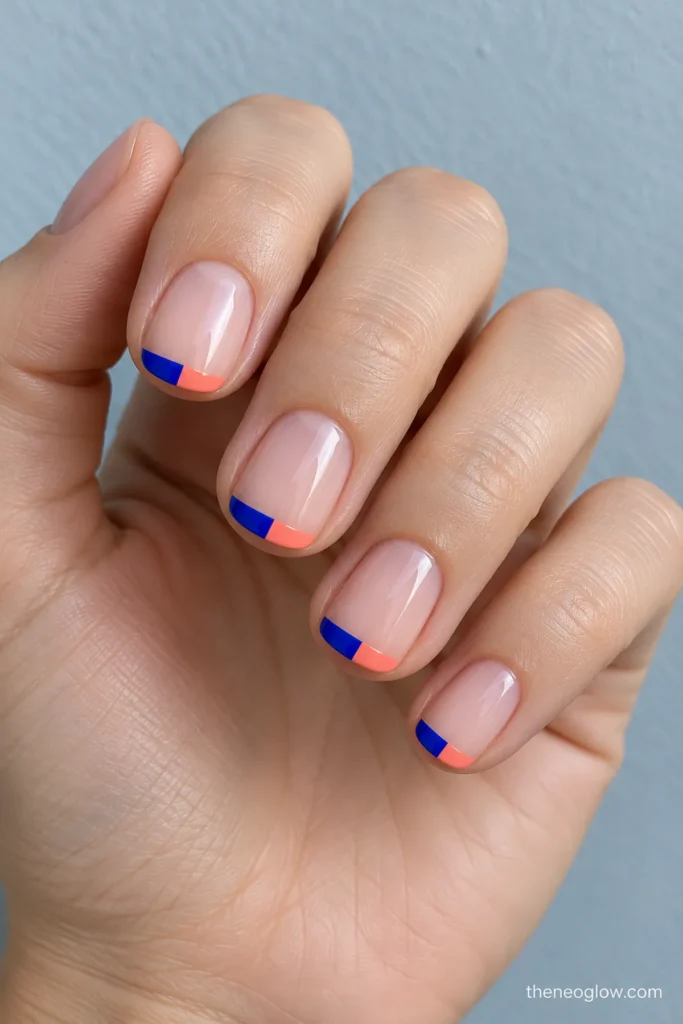
Divide the French edge of short squovals into two equal color segments: vivid cobalt on one half, warm coral on the other. Both colors touch the natural free edge and meet at a crisp vertical center join. Keep the translucent neutral base plain. The design reads as one slim, two-tone French boundary rather than two separate painted blocks.
7. Ivory Keyhole Cutout on Squovals
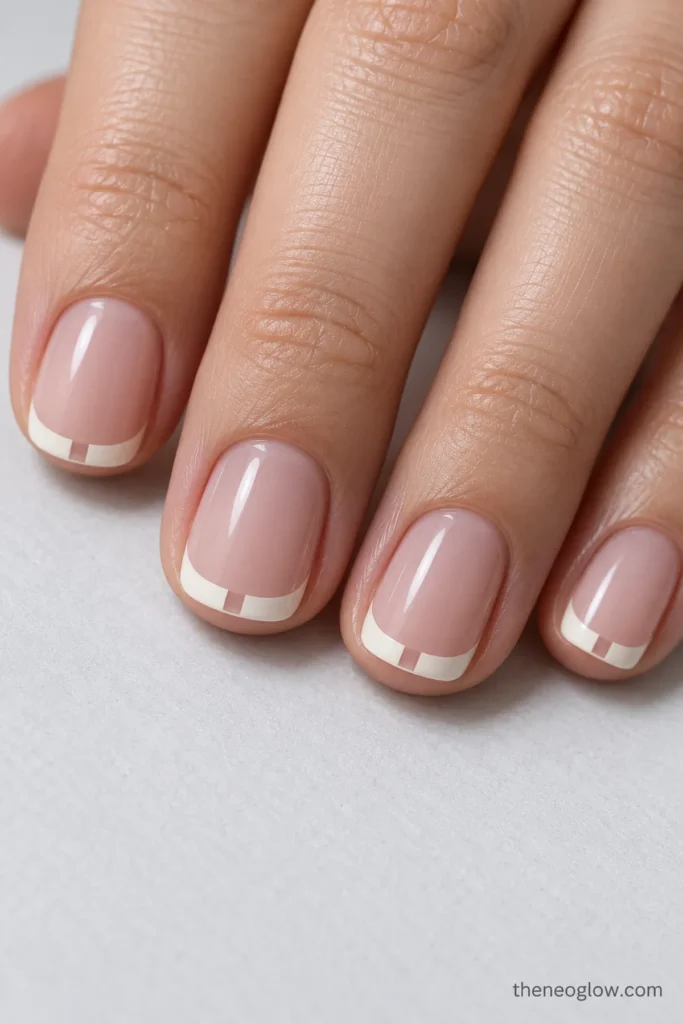
Paint a narrow, opaque ivory cap over a muted pink base. At the middle of the cap’s lower boundary, leave one tiny square notch showing the base beneath. Ivory still runs continuously across the actual outer edge. This small opening gives the tip a graphic identity; reserve it for nails with enough visible space that the notch will not collapse into a messy gap.
8. Two Blue Lanes With a Clear Gap
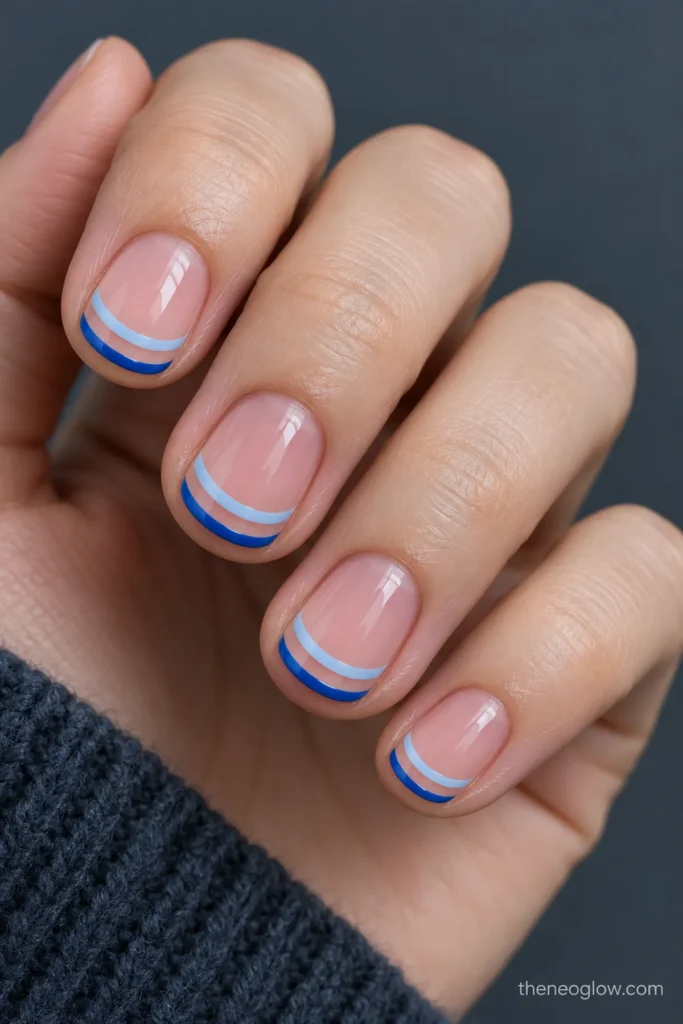
Two fine arcs follow the tip of each short round nail: a deeper blue thread at the outer edge and a powder-blue thread just below it. A sliver of translucent rosy base remains visible between them. The entire double-line design should occupy little more space than a modest classic French. If the two blues merge, simplify to one line.
9. Petite Jade Chevron on Short Ovals
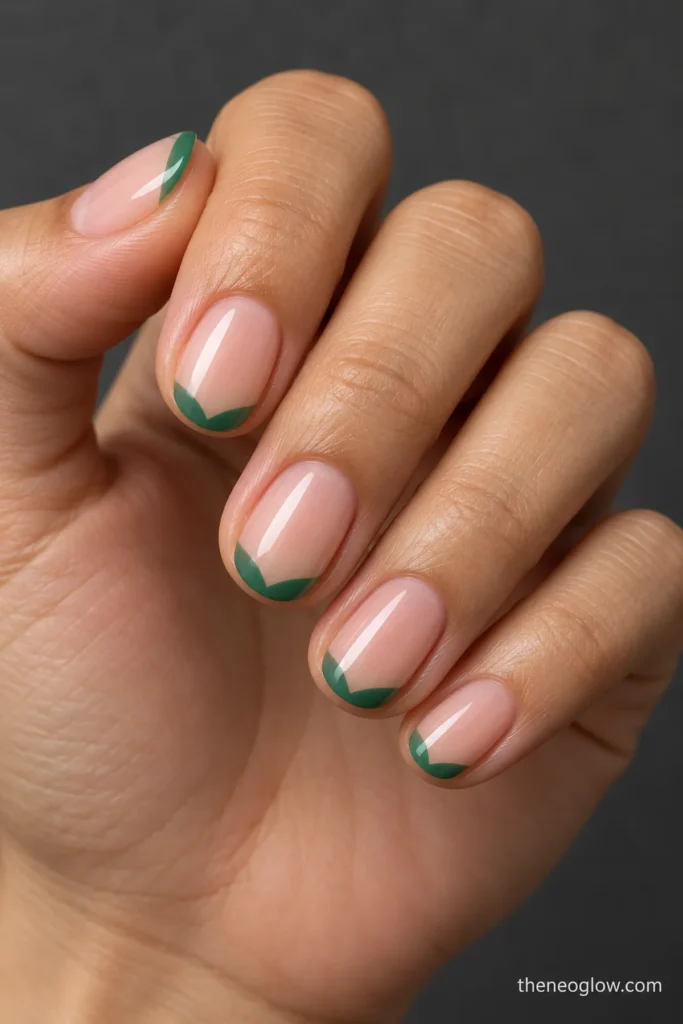
Paint a small, centered V-shaped jade-green tip over sheer peach. The two glossy green wings meet at the midpoint of the free edge without extending deeply toward the nail bed. This compact point changes the outline more than the area of color. A shallow V is intentional here; a long, sharp stiletto-style chevron would need nail length these ovals do not have.
10. Piano-Key French on Mini Squares
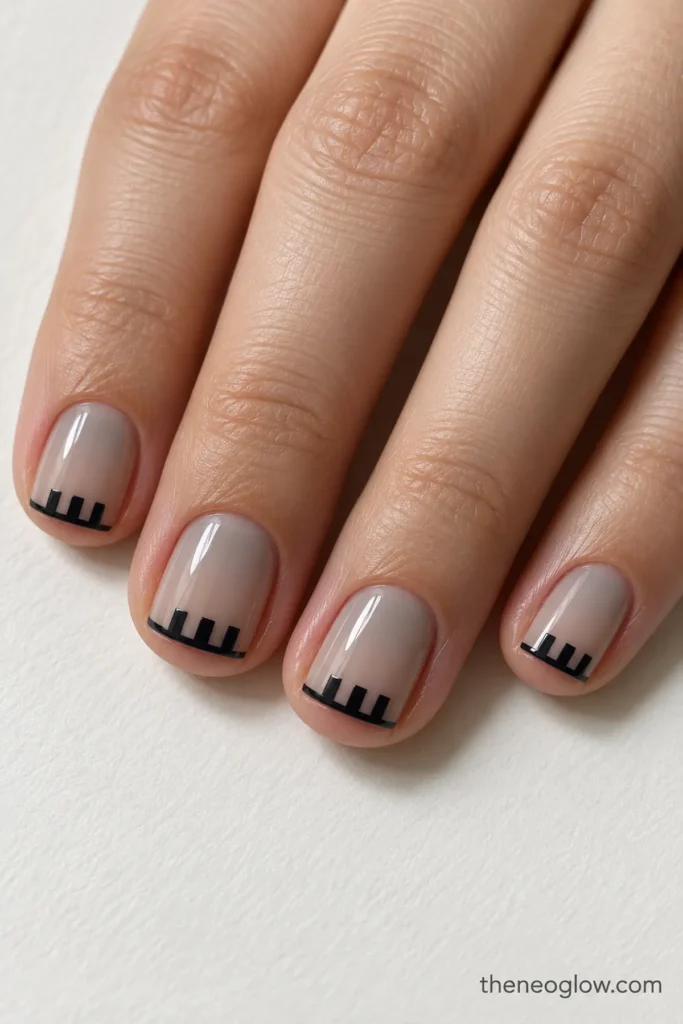
Start with a hairline charcoal front edge on a translucent gray-beige base. Add three short, evenly spaced black bars rising only slightly from that edge, like simplified piano keys. All bars stay within the top strip of the nail and do not reach the middle of the plate. This creates a recognizable patterned French while keeping the surface smooth and flat.
11. One-Row Aqua-and-Cream Mosaic
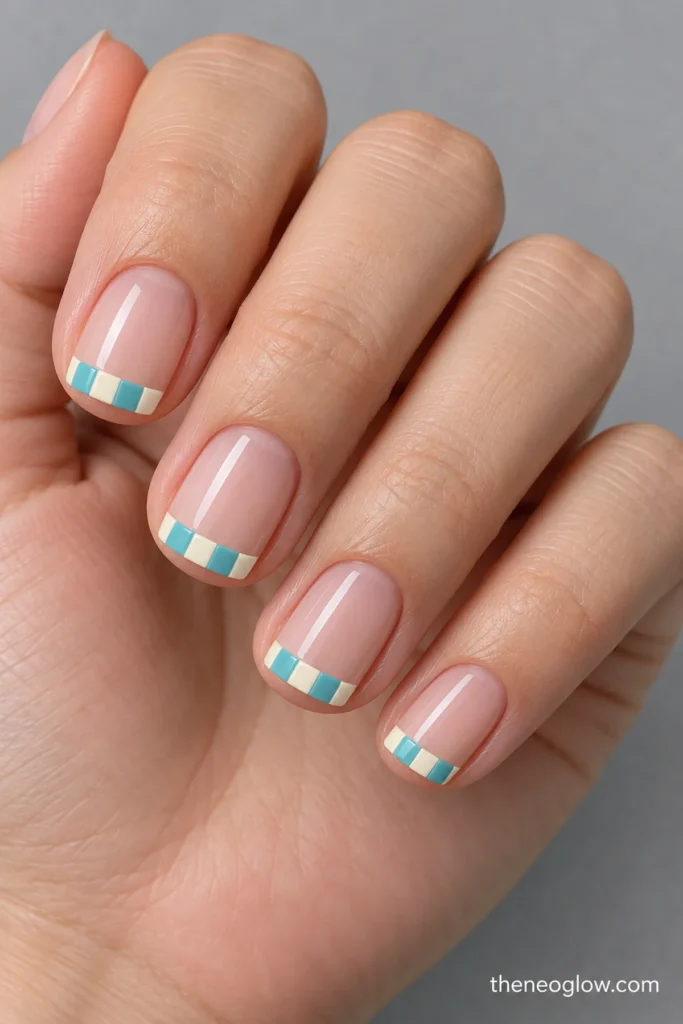
A tiny single row of alternating aqua and cream squares occupies the free edge of short square nails. The glossy blush base remains uninterrupted below the tiles. Unlike a checkerboard filling the tip in several rows, this version has only one compact strip of color. Make the tiles large enough to look square; if they become dots, a plain micro tip will read more cleanly.
Finish-Focused French Tips That Stay Small
12. Cherry-Glass Curved Tip on Short Ovals
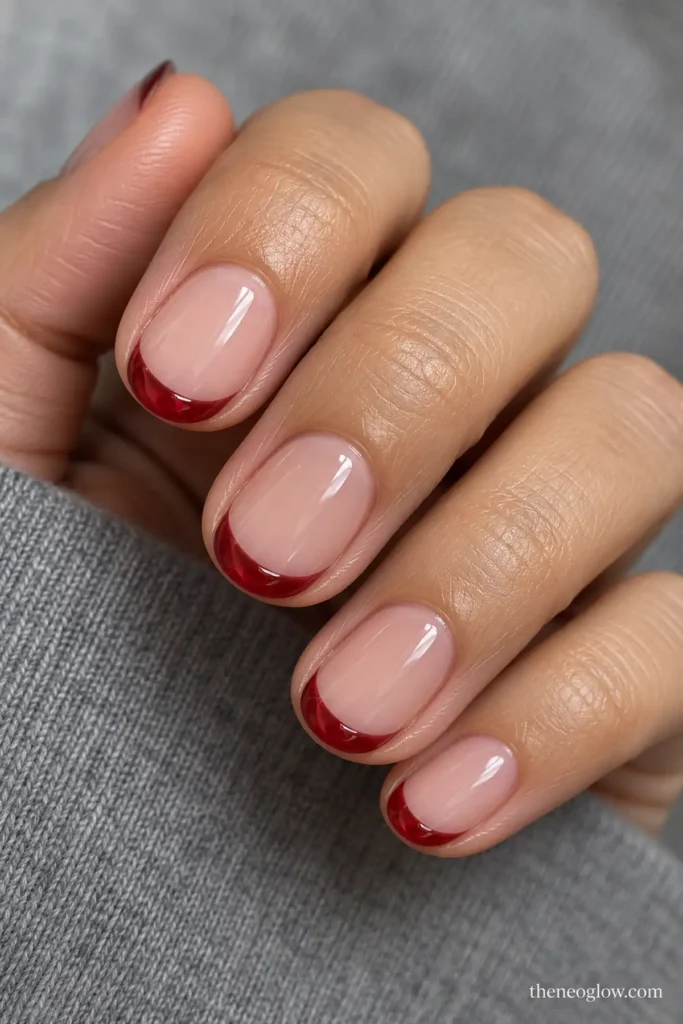
A translucent cranberry-red jelly polish forms one small curved band along a shallow oval tip. The clear beige-pink nail bed remains visible beneath a high-gloss topcoat. Unlike a cream-red French, the glassy band allows some light and base color through. Keep the jelly concentrated inside the French zone instead of tinting the entire nail.
13. Matte Cocoa Tip Against a Glossy Base
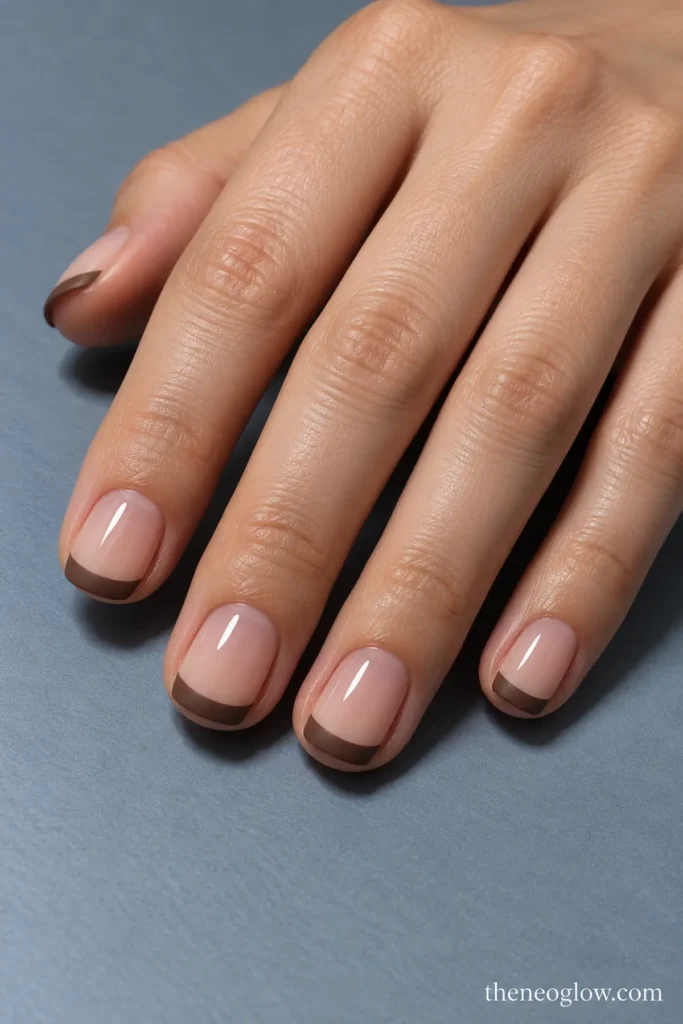
On short squovals, set a narrow, opaque cocoa-brown cap against a glossy, translucent pink-beige center. Finish only the brown edge matte so the manicure changes texture at the French boundary. The contrast is easier to see under angled light than in a flat color swatch. The edge should stay compact rather than becoming a deep brown half-nail.
14. Champagne-Dust Horizon on Short Rounds
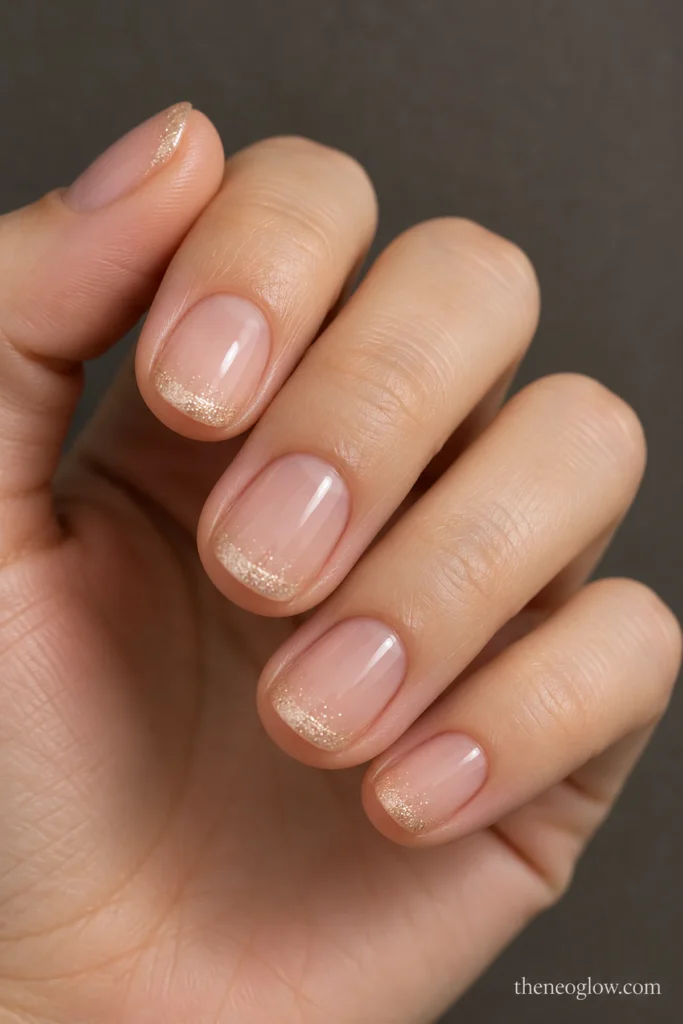
Fine champagne shimmer gathers in a narrow strip along each rounded free edge, with the densest sparkle at the outside and a softly diffused inner boundary. Keep the sheer blush base free of scattered glitter. The placement gives a French silhouette without an opaque painted smile line. Large glitter pieces are less useful here because the available tip space is so small.
15. Silver-Mirror Filament on Short Squares
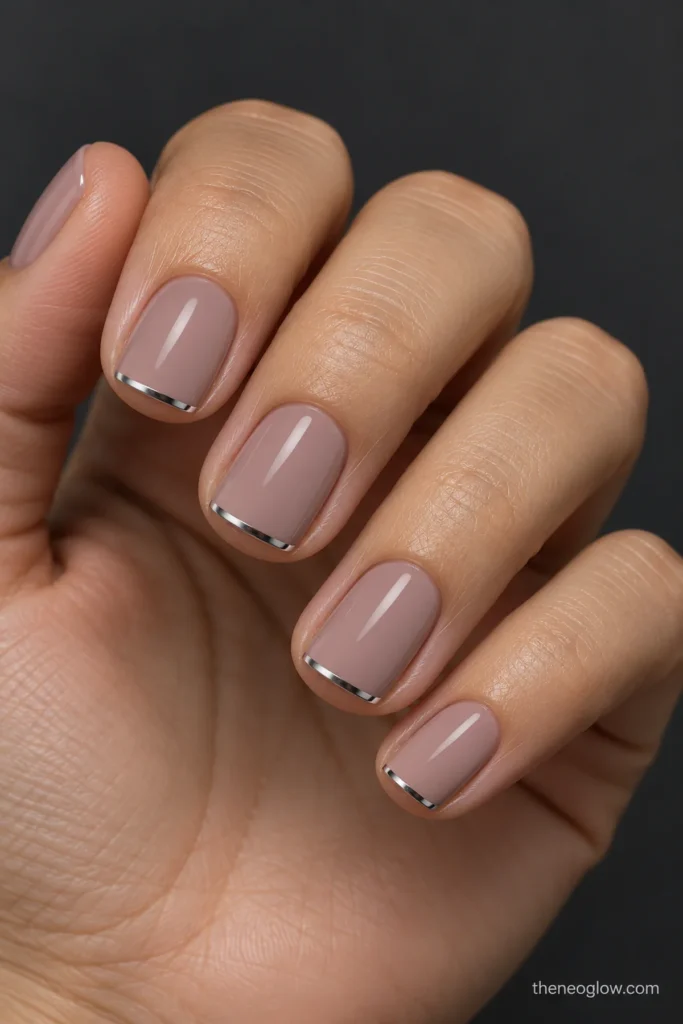
Use a cool mauve-beige cream base and a very fine metallic-silver chrome line directly at the short, straight edge. The mirror reflection—not extra band width—creates the contrast. Leave the rest of each nail smooth and nonmetallic. A narrow reflective rail looks deliberate; coating the entire nail in silver would turn this into a different manicure.
16. Icy-Blue Pearl Half-Crescent on Ovals
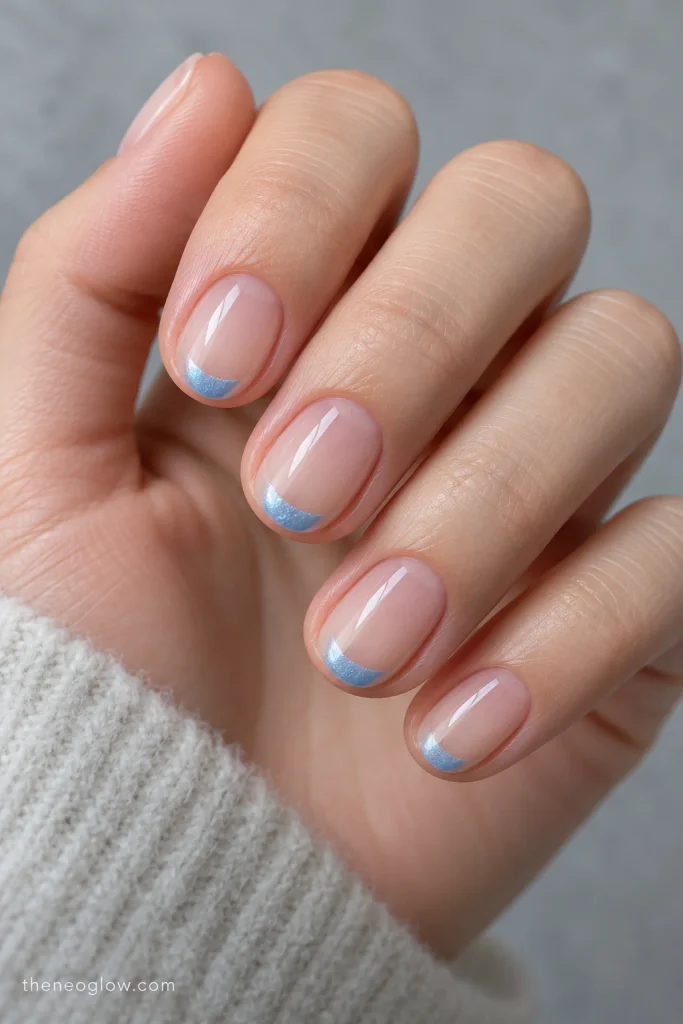
Paint a small, pearlescent ice-blue crescent only across the central portion of each short oval tip, leaving both outer corners visible through a neutral, sheer base. The centered curved cap has a luminous, shell-like finish but remains shallow and compact. This is not an all-over pearl glaze or a side-sweep: the glimmer sits in one small central tip zone.
17. Fuchsia Ribbon With a Clear Center Slit
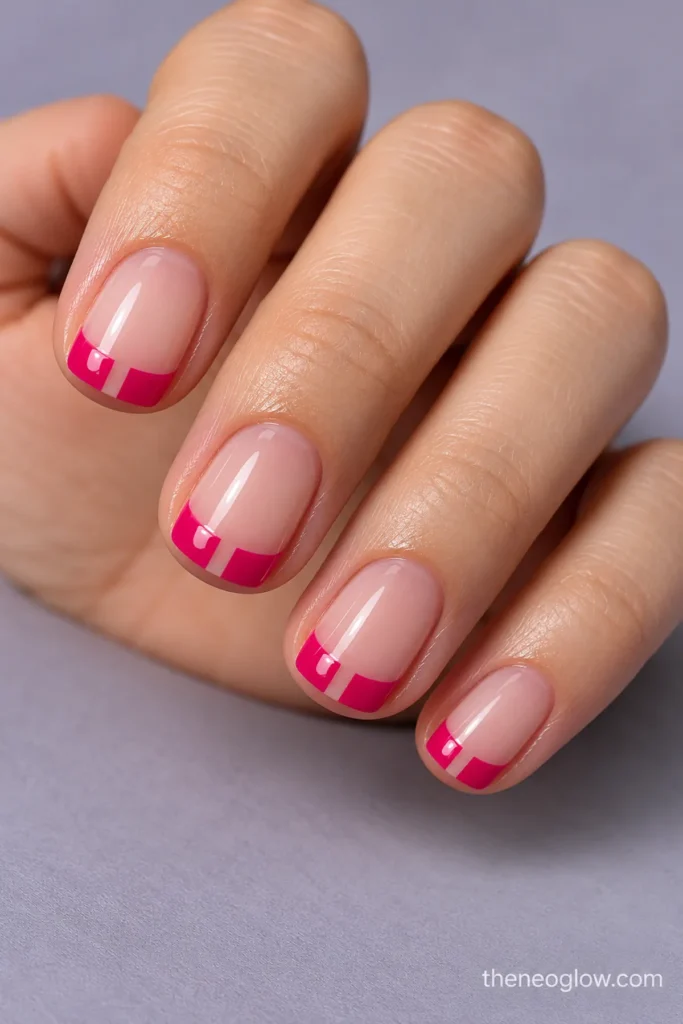
Finish short squovals with a slender glossy fuchsia French band. Cut one precise, narrow vertical line of transparent base through the center of that band, splitting the pink color into two matching sides. The line should open all the way to the free edge, making two clear fuchsia wings. Use this only when the free edge can hold a visible slit without widening the whole tip.
Translate the Photo Into a Short-Nail Salon Request
A salon reference is more useful when it specifies where the colored boundary stops. Try: “Keep my natural nails fingertip-length and softly squared. Use a sheer rosy base and a navy French line under 1 mm, nearly straight across the free edge, with glossy topcoat and no extension.” That describes Idea 2 without depending on a long-nail inspiration photo.
For side art, change the placement rather than adding length: “Short shallow ovals, sheer beige-pink base, glossy lilac hook beginning at the outer tip corner and stopping high on the side.” For Idea 7 or 17, ask whether the detail will remain clean on your shortest nail; if not, use the simpler neighboring design.
If you are choosing between a natural manicure and short french tip acrylic nails, separate the artwork from the application system. Acrylic may be used as a short overlay or small extension, but it is not necessary for a fine French line. NeoGlow’s short-nails guide explains the broader choices, including finish and daily practicality.
At-Home Application and Sensible Upkeep
For regular lacquer, paint the chosen base first, then build the French edge with a fine brush in small strokes. Keep a clear view of the fingertip: if the line grows wider as you correct it, remove that tip detail and start over instead of stacking more color. On nearly flush nails, protect the surrounding skin from accidental polish transfer while working. OPI’s step-by-step nail-polish application guide includes specific advice for coating the free edge of very short nails.
Different systems need different handling. Follow the manufacturer’s instructions for your exact lacquer, gel, lamp, or enhancement rather than treating all finishes as interchangeable. At the salon, ask about cleaned tools and leave cuticles intact. The American Academy of Dermatology’s manicure and pedicure safety guidance explains hygiene questions to ask and basic aftercare.
For wear, pay attention to the entire edge, not just chips. A strong-color micro line can look uneven once one corner wears away. Touch up a small defect only if you can preserve the original width; otherwise a clean repaint is less likely to produce a thicker, lopsided tip. Smooth any catching corner without filing away healthy attached sidewalls.
Save the French That Fits Your Free Edge
For nearly flush nails, start with the soft-white seam, blue ruler edge, or tonal rose arch. If you have a small but clear free edge, the center-split rim, keyhole, or fuchsia slit gives more graphic detail. Choose matte cocoa, jelly cherry, or silver mirror when finish matters more than complex geometry. Save one image of the exact length and shape you actually wear, together with the tip width and placement you want. For a wider range of French structures on longer shapes, continue to NeoGlow’s French Tip Nails guide.