The best nail shape for short nails depends on more than finger length. Your natural nail-bed proportions, sidewall direction, available free edge, breakage pattern, typing habits, and preferred visual effect all matter. Square can look crisp, squoval softens the corners, oval creates a longer-looking silhouette, and almond needs enough unsupported tip to form a real taper. This guide shows you how to measure what you have, compare the tradeoffs, and choose a practical shape without treating one option as universally flattering.
Quick Comparison: Square vs. Squoval vs. Oval vs. Almond
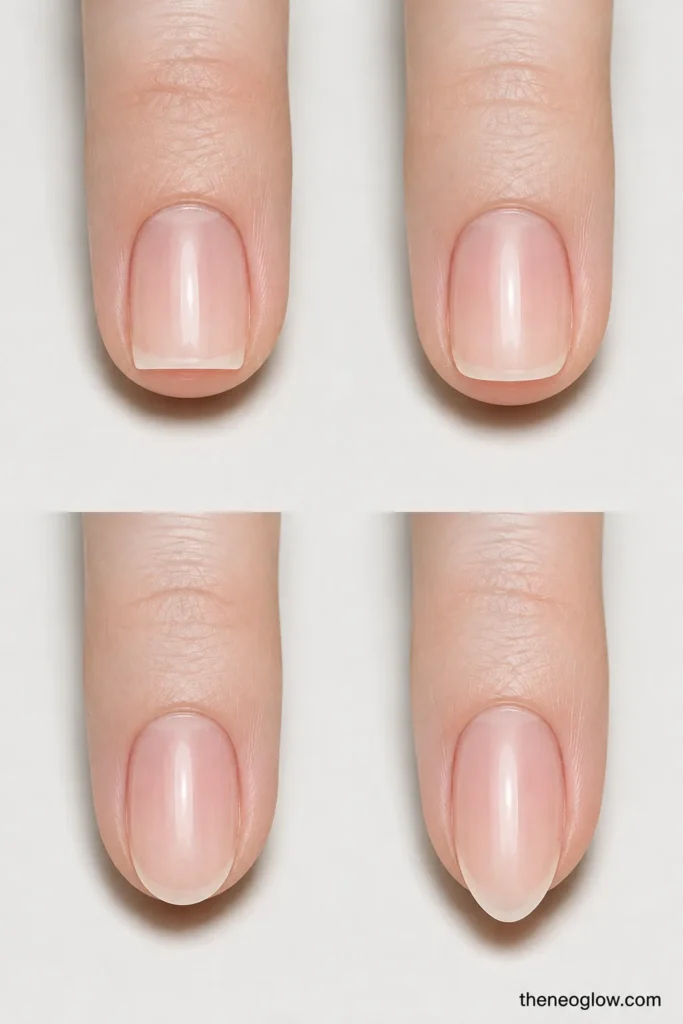
| Shape | Free Edge Needed | Sidewall Treatment | Everyday Practicality | Visual Effect | Maintenance |
| Square | Very little | Keep sides straight and parallel | Good, but corners may catch | Crisp, wide, structured | Low to medium |
| Squoval | Very little | Keep sides mostly straight; soften corners | Excellent for typing and busy routines | Balanced and polished | Low |
| Oval | A small visible edge helps | Taper gently, then round the tip | Good, with no sharp corners | Softer and more elongated | Low to medium |
| Almond | Enough length to taper without cutting into attached sidewalls | Narrow both sides toward a rounded peak | Variable; depends on length and strength | Most tapered and lengthening | Medium to high |
No row is a universal winner. A shape that looks elegant on one nail bed can feel unstable or visually compressed on another.
Measure Your Nail Bed Before Choosing
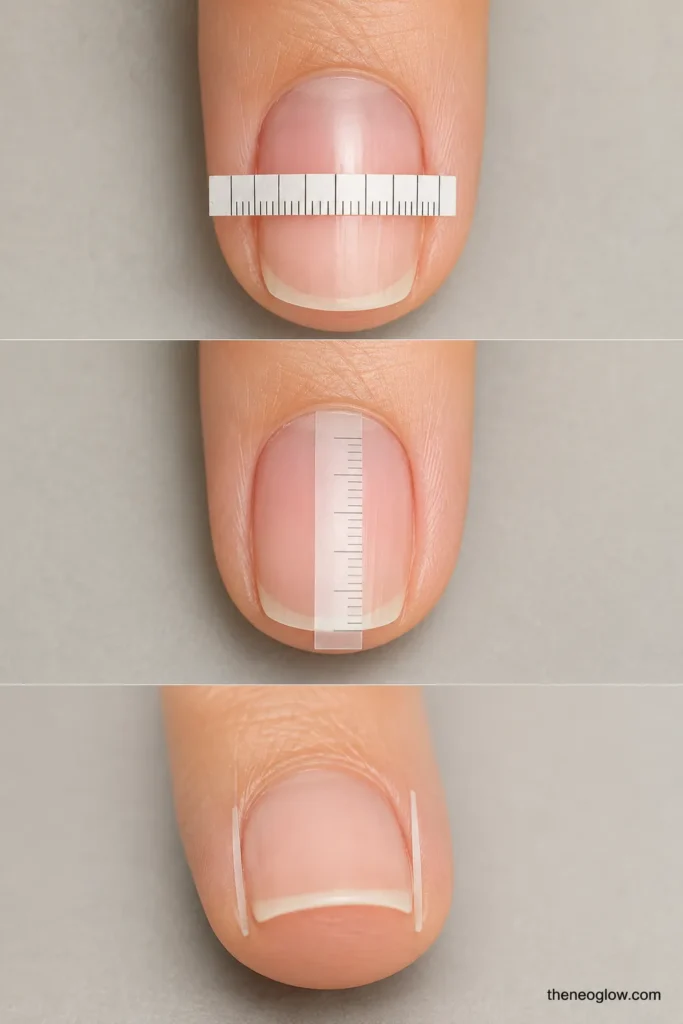
You do not need a perfect formula. You need four observations that you can compare across your own nails.
1. Measure the visible nail-bed width
Use a flexible measuring tape, a narrow paper strip, or a millimeter ruler. Measure the widest visible part of the nail plate from one side to the other without including skin.
Small differences between fingers are normal.
2. Measure the visible nail-bed length
Measure from the center of the cuticle line to the point where the attached pink nail bed ends and the free edge begins. Do not include the white free edge.
Compare length with width rather than chasing a universal ratio. A bed may look longer than wide, roughly balanced, or wider than long. These are descriptive categories, not beauty rules.
3. Check the sidewall direction
Look straight down at the nail. Do the side edges stay parallel, flare outward, or narrow naturally toward the tip?
Parallel sidewalls support square and squoval easily. Naturally narrowing sides can transition into oval with less filing. Flared nails may need careful corner softening, but aggressive narrowing can remove too much width.
4. Check the available free edge
Look at how much nail extends beyond the fingertip.
- No visible free edge: round, soft square, or squoval is usually the most realistic.
- A slim visible edge: square, squoval, and short oval become easier to define.
- Enough edge to taper both sides while preserving the attached sidewalls: a restrained almond may be possible.
Your shortest or weakest nail may set the practical shape for the full manicure.
Short-Nail Decision Tree
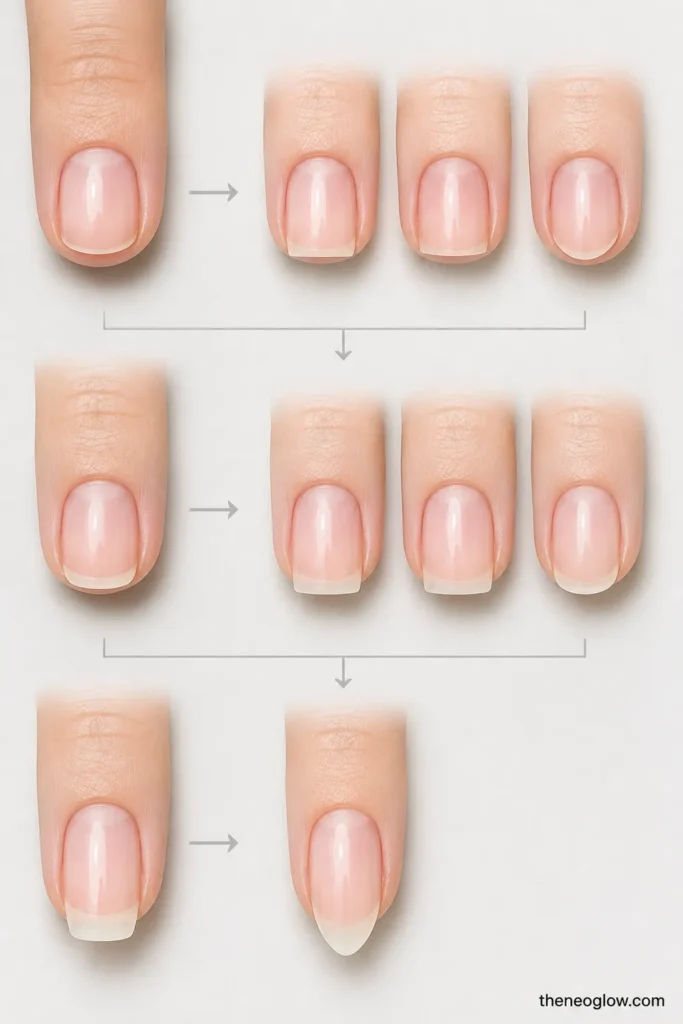
Start with your routine, then refine by nail structure.
Do your nails have almost no free edge?
Choose soft square, squoval, or round. Pick square for a crisp line, squoval for softened corners, or round when you want the edge to follow the fingertip.
Do square corners catch during typing, hair washing, dressing, or cleaning?
Move to squoval. You keep the straight visual structure while removing the sharpest contact points.
Do you want the nail plate to look narrower or longer?
Try oval if you have enough edge for a gentle taper. Keep the taper shallow when the nail is short.
Do you want almond?
Check whether the taper can begin beyond the attached sidewalls. If creating a point requires filing deeply into the supported sides of the natural nail, wait for more length or use a correctly fitted short-almond enhancement instead.
Square Nails on Short Natural Nails
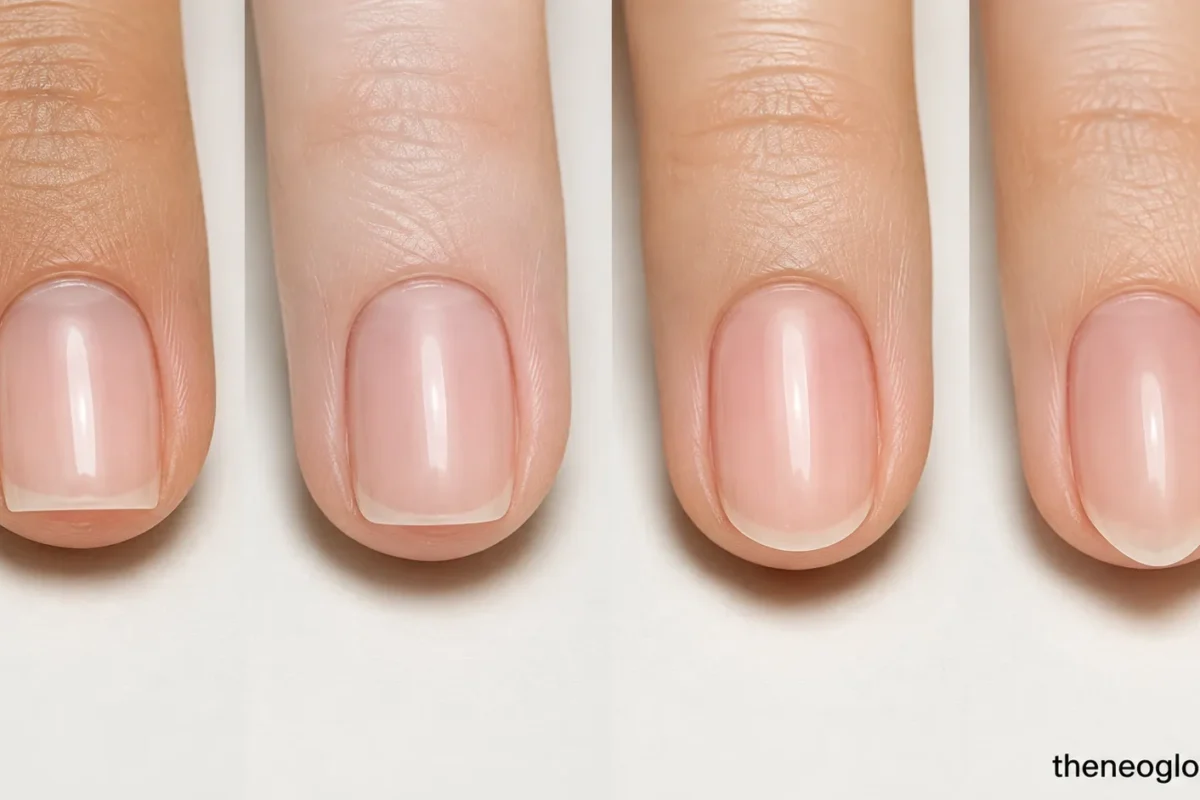
Square nails have straight sidewalls and a flat free edge. They can look especially clean on narrow or naturally parallel nail beds.
Pros
- Requires very little free edge
- Creates a sharp, modern outline
- Gives graphic polish and French tips a straight canvas
Cons
- Corners can catch, chip, or feel noticeable during grow-out
- Can emphasize width on a broad, short nail bed
- Uneven sidewalls become more obvious
- A perfectly sharp corner may be impractical for frequent typing
Square is a strong aesthetic choice when your natural sidewalls already support it. It is less convincing when you must force flared nails into narrow parallel lines.
Squoval Nails for a Practical Short Manicure
Squoval combines a mostly straight free edge with softened corners. It is often the easiest compromise in the square vs. squoval nails debate.
Pros
- Works with minimal length
- Keeps the clean structure of square
- Reduces sharp corners
- Comfortable for keyboards, phones, and daily chores
Cons
- Over-rounding turns it into oval
- Under-rounding leaves snag-prone corners
- Very flared nail beds can still look wide if the free edge remains broad
Choose squoval when you like a flat-looking tip but do not want true square corners. It is also a sensible reset shape while uneven nails grow to a matching length.
Oval Nails for Short Fingers or Wider Nail Beds
Oval nails taper slightly through the free edge and finish in an even rounded curve. The narrower tip can create a longer-looking vertical line, but the effect depends on having enough edge to shape.
Pros
- No sharp corners
- Can visually soften broad or short-looking nail beds
- Works well with sheer polish, solid color, and curved French tips
Cons
- Needs more free edge than a basic round shape
- Uneven taper can make the nail lean left or right
- Over-filing the sides can reduce useful width
- Very short ovals may simply read as round
For oval nails on short fingers, aim for a subtle egg-like outline rather than a narrow point. The goal is a gentle taper, not an almond compressed onto a short tip.
When Short Almond Is Structurally Realistic
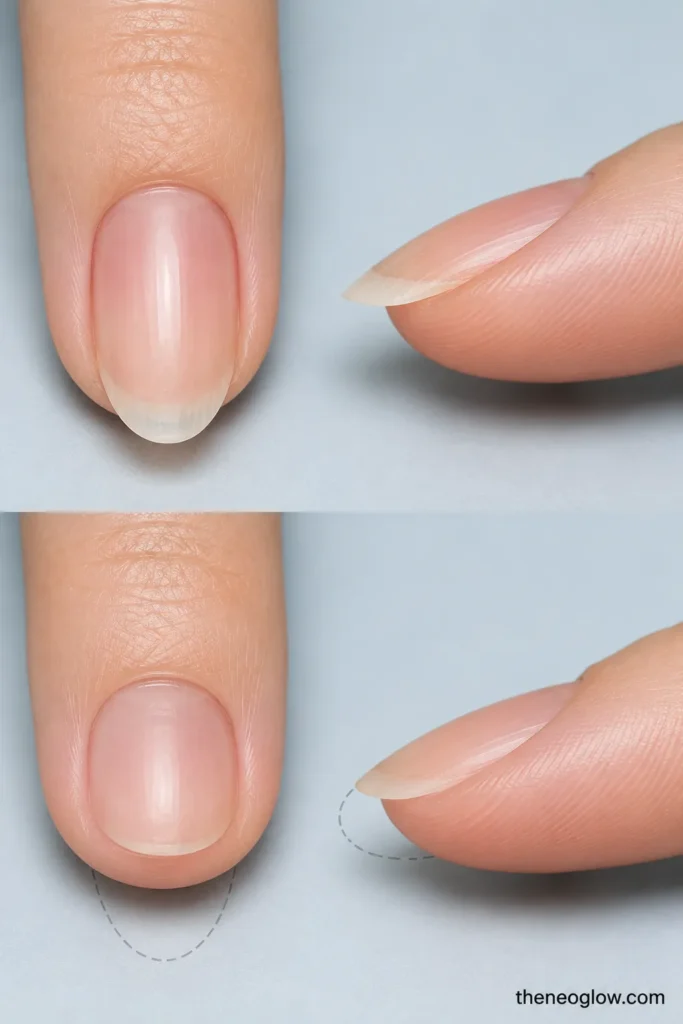
A true almond shape has tapered sides that meet at a softened peak. OPI’s professional shaping guide describes almond as better suited to medium or long nails, which reflects the amount of free edge needed to create that taper without cutting into the attached nail.
“Short almond” is realistic when:
- The nail bed is relatively long
- A visible free edge extends beyond the fingertip
- Both sides can taper symmetrically
- The peak sits beyond the supported nail bed
- The natural nail is strong enough for the narrower tip
It is not structurally realistic when the nail has no free edge, the nail bed is broad and very short, or the only way to create a point is to file deeply into the attached sidewalls. NailKnowledge’s explanation of sidewall over-filing warns that removing supported width can reduce plate strength and flexibility, so visual narrowing should never come from repeatedly thinning the supported sides.
In that situation, choose oval now and transition gradually as length grows. A short-almond press-on or enhancement is another visual option, but it should fit the natural nail correctly and should not be mistaken for the structure of an extra-short natural nail.
Shape Examples on Different Nail Beds
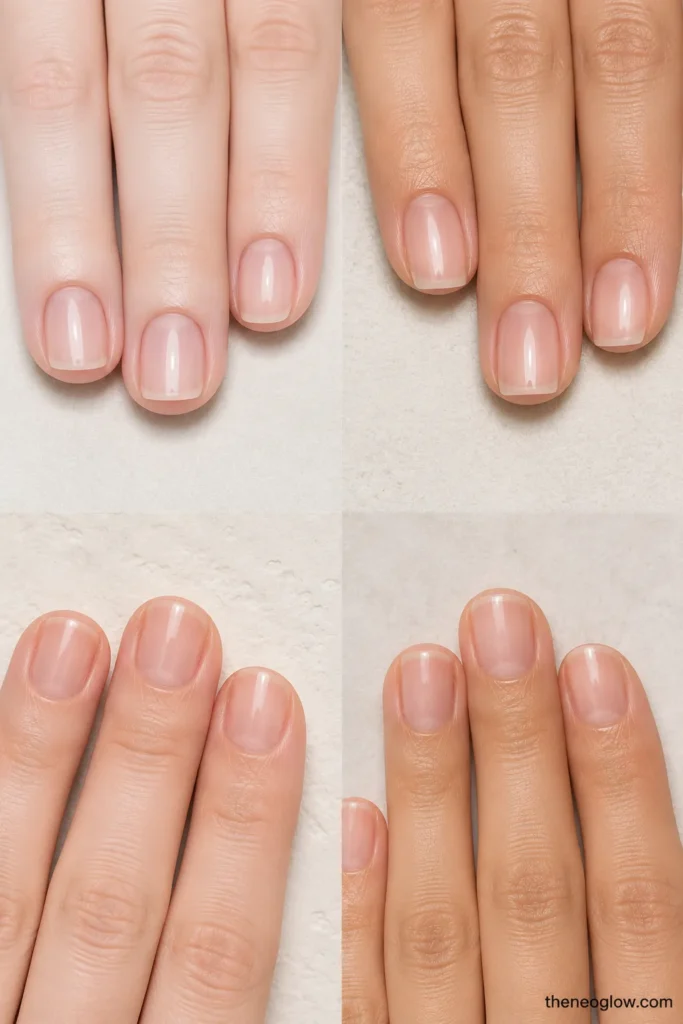
Short, wide nail bed
Try squoval when you want structure with less corner bulk. Choose a shallow oval when a small free edge is available and you want a softer, narrower-looking tip. Square is still valid if you enjoy a bold outline; it will simply emphasize the width rather than disguise it.
Long, narrow nail bed
Square can look proportionate even at a short length because the bed already supplies vertical space. Squoval gives a softer everyday version. Oval also works, but taper lightly so the nail does not become overly narrow.
Flared nail bed
Begin with squoval or soft square. Keep the attached sides intact and concentrate shaping on the free edge. An oval can work after some growth, but do not chase a narrow tip by cutting into the widest supported area.
Mixed nail beds across one hand
Match the overall family, not an identical geometric template. For example, use squoval on every nail but allow the thumb a slightly broader edge and the little finger a softer curve. Consistency should look natural, not mathematically forced.
How to Shape Short Nails Safely at Home
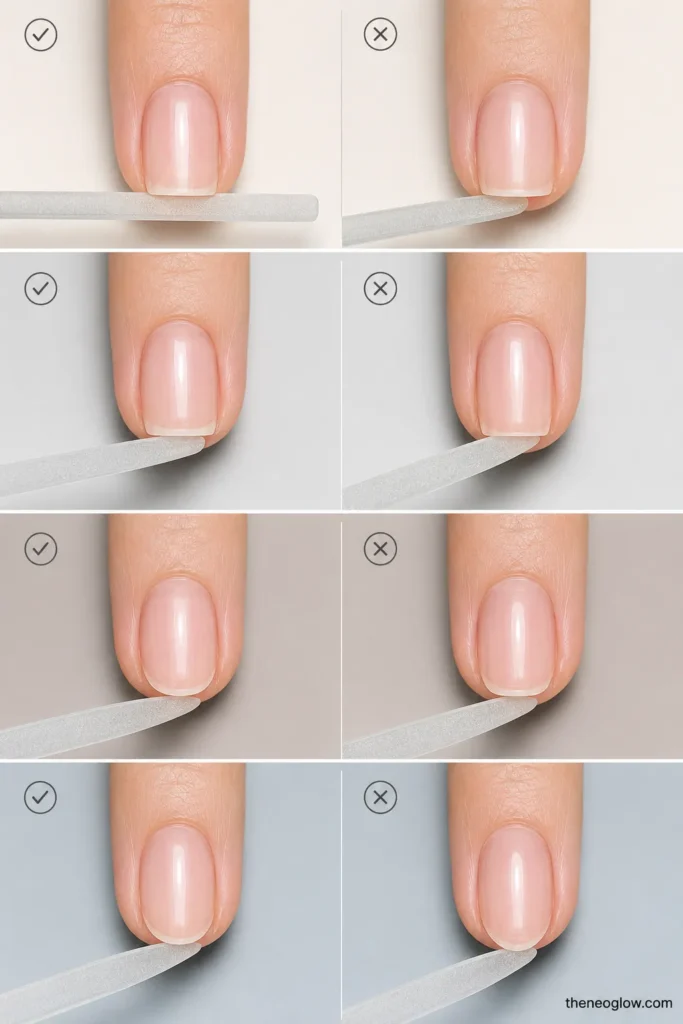
The American Academy of Dermatology recommends cutting fingernails almost straight across, slightly rounding the corners, and filing in one direction. Its nail-trimming guidance is a useful reference when you want a conservative grooming method.
- Remove polish so the sidewalls and free edge are easy to see.
- Decide the final length before shaping.
- Shorten excess length with small, controlled clips when needed.
- Establish the center of each nail.
- File one side, then the other, checking symmetry from above and from the fingertip.
- Use the lightest pressure near the sidewalls.
- Smooth frayed edges without thinning the top surface.
- Compare the full hand before making final corrections.
For square, file straight across. For squoval, soften only the corners. For oval, curve each side gently toward the center. For almond, taper only the free edge toward a softened peak. The OPI tutorial linked above shows these distinctions clearly.
Common Shaping Mistakes
Choosing from finger shape alone. Short fingers do not automatically require oval or almond. Nail-bed width, length, sidewall direction, and free edge matter just as much.
Calling every tapered short nail “almond.” Without enough space for a rounded peak, the result is usually oval or pointed oval.
Sawing aggressively with the file. Repeated rough motion can leave fraying and make symmetry harder to control.
Filing deeply into the sidewalls. Removing supported width to imitate a narrow inspiration photo can weaken the structure and irritate nearby skin.
Correcting one nail until it becomes the shortest. Shape gradually across the full hand and stop frequently to compare.
Forcing identical geometry. Thumbs, little fingers, and asymmetrical natural beds may need small adjustments within the same shape family.
Match the Shape to Your Routine
For heavy typing, frequent phone use, childcare, cooking, cleaning, or hands-on work, short squoval and round are usually the least intrusive. Short square can also work when the corners do not catch.
Choose oval when you want a softer, visually lengthened effect and can maintain a small free edge. Choose almond only when your natural structure and length can support the taper or when you prefer a properly fitted enhancement.
Once the shape is settled, use the short summer nails guide for designs scaled to small nail plates. For low-detail polish ideas, continue to natural summer nails, or browse simple nail designs that can be adapted to square, squoval, and oval tips.
Choose the Shape You Can Maintain
The best nail shape for short nails is the one that respects your current nail bed, leaves the sidewalls intact, suits your routine, and creates the effect you actually want. Start with measurements, test the shape on one or two nails, and make only small changes. Square gives structure, squoval balances structure and comfort, oval softens and visually lengthens, and almond becomes realistic only when enough free edge exists to build a true taper.