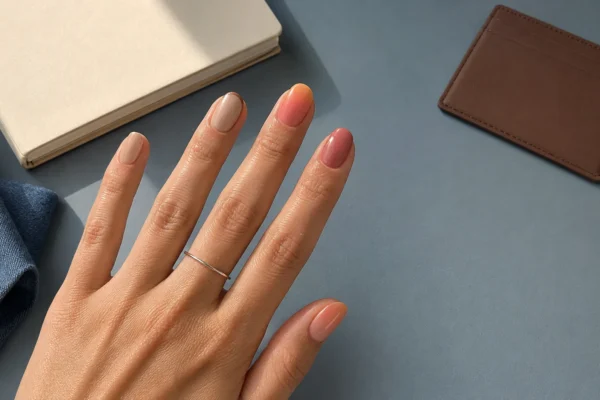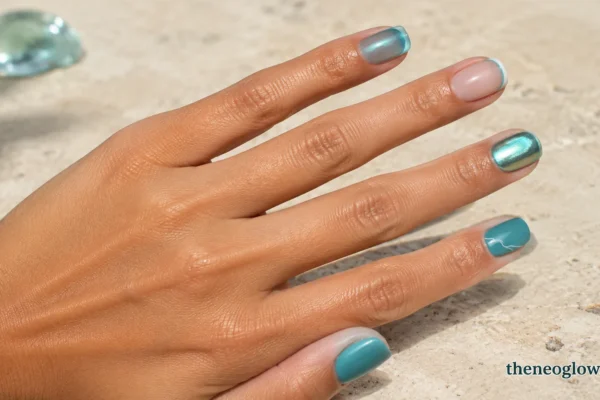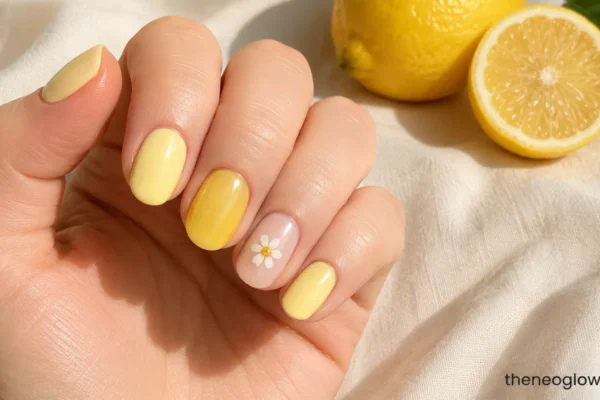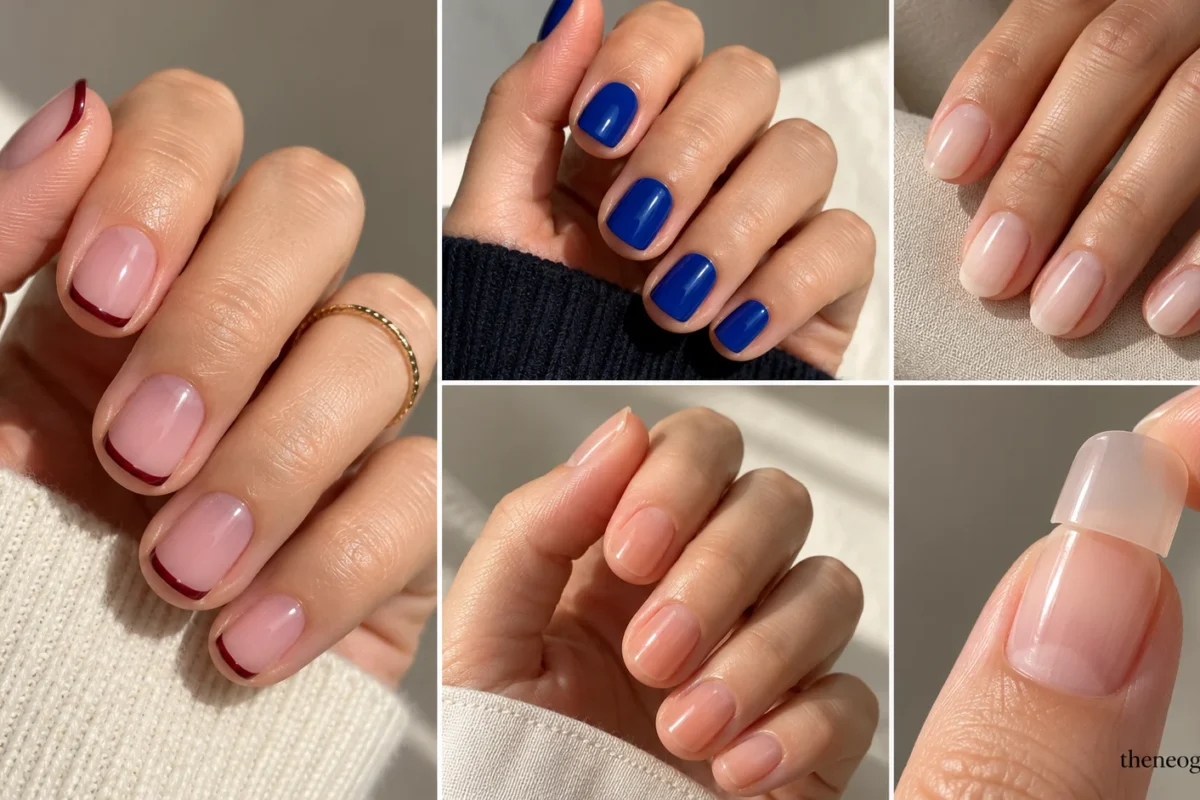
A short manicure stops being useful as a reference the moment it assumes length you do not actually have. Short nails can be glossy, colorful, minimal, graphic, or dressed up, but the choices work best when they respect your real free edge, nail-plate width, daily tasks, and tolerance for maintenance.
This guide is the evergreen starting point. Instead of giving you another long gallery, it helps you choose the right length, shape, finish, design density, and manicure system first. Then you can move to a specialist guide when you want deeper help with one shape, one season, typing, press-ons, acrylics, gel, or French tips.
Start With the Constraint That Matters Most
You do not need to decide color first. Begin with the factor most likely to make the manicure comfortable or inconvenient.
| Your main priority | Start with | A practical short-nail direction | Best next step |
|---|---|---|---|
| Daily typing or schoolwork | Free-edge length and thickness | Short round, squoval, or soft square with a smooth profile | Test the manicure on your real keyboard |
| Choosing a flattering, realistic outline | Natural nail width, sidewalls, and existing free edge | Compare square, squoval, oval, and only a genuinely short almond when enough tip exists | Choose shape before art |
| Low visual maintenance | Opacity and contrast | Sheer nude, milky pink, jelly, soft taupe, or one smooth cream color | Keep detail flat and limited |
| More personality without extra length | Design density | One micro tip, side detail, corner accent, dot, or small negative-space section | Give one area of the nail the visual job |
| Temporary shape or finish change | Nail system | A correctly fitted short press-on or another removable system suited to your routine | Check fit and removal instructions before application |
| A durable salon finish | Maintenance and removal commitment | Keep the profile short and ask what exact system will be applied and removed | Follow the product or salon system rather than mixing methods |
The useful order is usually length, shape, system, finish, then art. Changing one variable at a time also makes it easier to see why a manicure does or does not work for you.
Decide What “Short” Means on Your Hands
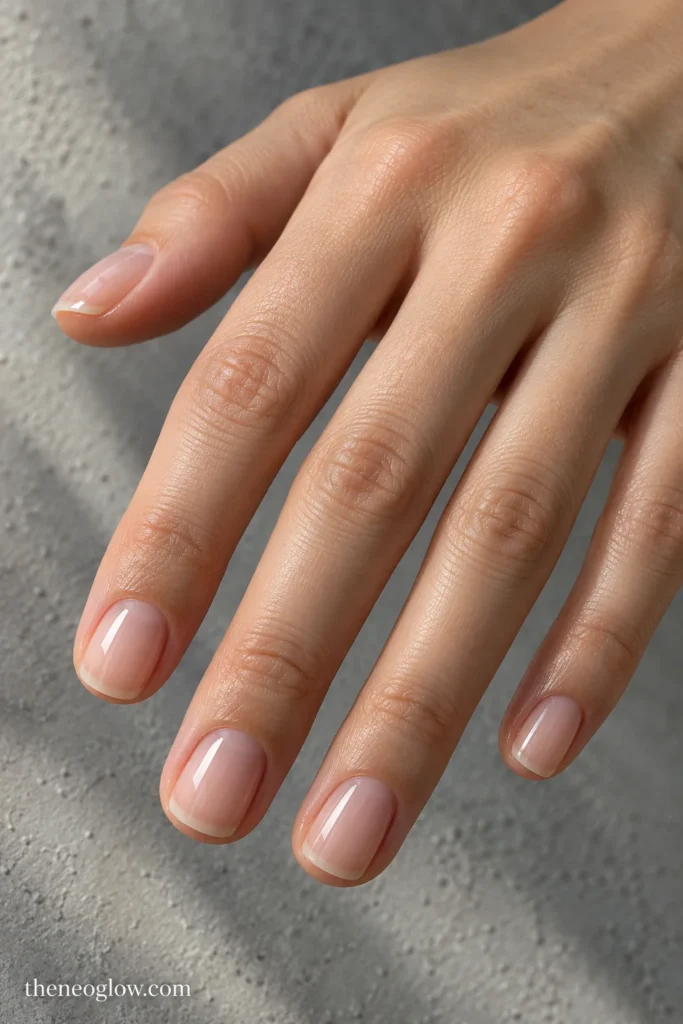
“Short” should describe the visible length, not the label on a product box or inspiration photo. For this hub, short nails end near the fingertip or extend only a small amount beyond it. A tapered set with a long point is not short simply because the product name says “short almond.”
Look at the nail from the side as well as from above. Two nails with similar visible tip length can feel very different if one has a bulky profile or a raised design. If your manicure needs to stay practical for work, childcare, cooking, sports, instruments, or frequent keyboard use, keep that side profile in the decision.
For detailed shape tradeoffs, use NeoGlow’s Best Nail Shape for Short Nails: Square, Squoval, Oval, or Almond? Open the short-nail shape guide. It owns the deeper shape comparison; this page only gives you the route.
Choose a Shape That Your Current Free Edge Can Support
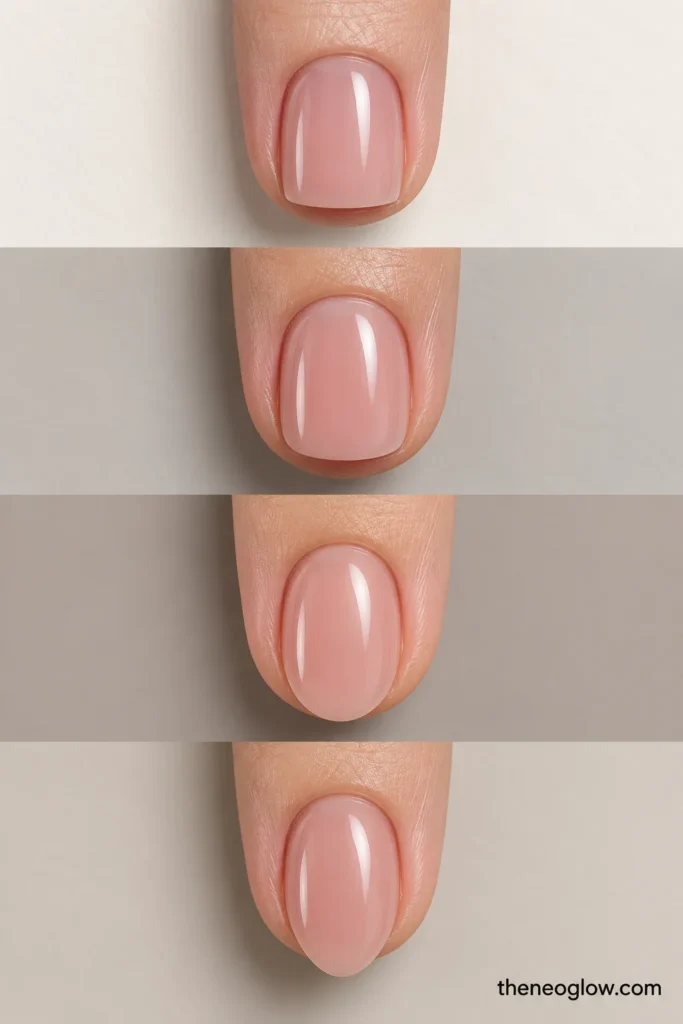
Soft square
Soft square keeps a fairly straight front edge while taking the sharpness off the corners. It works well when you like a crisp outline, solid colors, micro French edges, or simple geometry. On very short nails, softened corners are usually easier to live with than a rigid, sharp square.
Squoval
Squoval keeps the structure of a square but rounds the corners more noticeably. It is a strong everyday default when you want enough straight edge for polish and small designs without pronounced corners. It also adapts easily to sheer, cream, jelly, and minimal nail-art finishes.
Round or shallow oval
Round and shallow oval shapes follow a softer curve. They are useful when the side corners tend to catch or when you prefer a less graphic silhouette. A short oval needs some center length, but it does not need to become a medium almond.
Short almond
A true almond narrows toward the center. That taper needs enough free edge to shape without cutting aggressively into the sidewalls. If there is not enough tip to create a real taper, choose a short oval rather than forcing an “almond” label onto a rounded nail.
If you trim at home, the American Academy of Dermatology nail-trimming guidance recommends cutting fingernails almost straight across, slightly rounding the corners, smoothing rough edges with a file, and leaving cuticles alone. Read the AAD nail-trimming guidance That guidance is a useful baseline before you refine the cosmetic shape.
Pick the Manicure System Before You Pick the Design
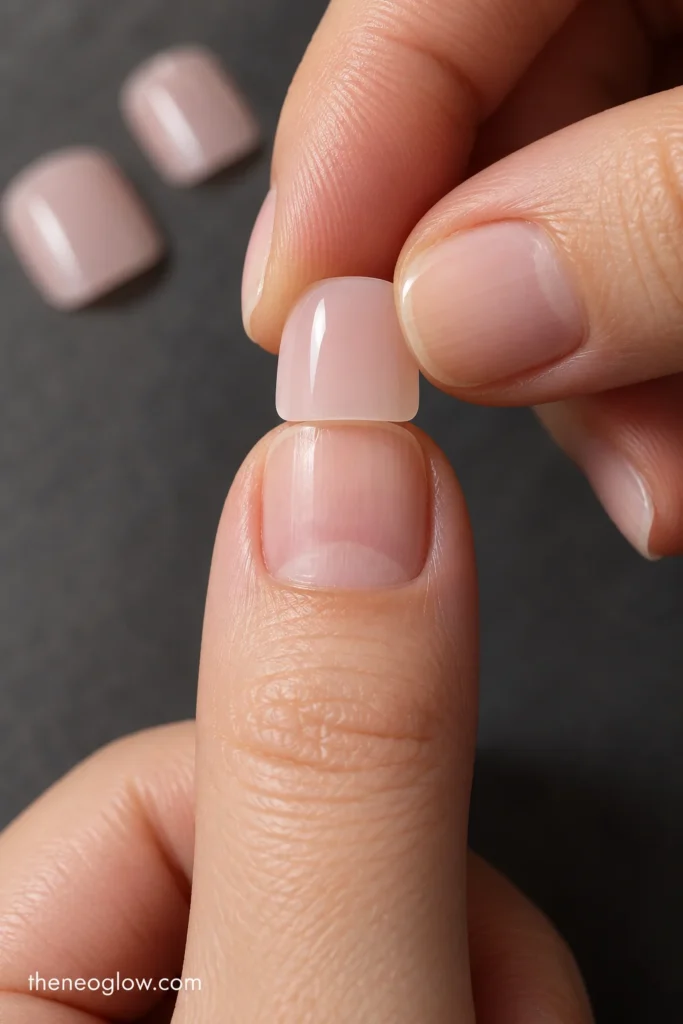
The same short-nail look can be created through different systems, but the upkeep and removal are not interchangeable.
Natural nails with regular polish are the simplest route when you like changing color and do not need an enhancement. They work especially well for glossy solids, sheer tints, jellies, micro French tips, dots, and flat accent art.
Gel polish can keep a smooth, glossy look while your natural nails remain short, but it brings curing and removal into the routine. Follow the instructions for the exact gel system and do not treat removal as an afterthought.
Acrylic, builder, dip, and other enhancement systems can add structure or change the profile, but this hub should not pretend those systems are identical. If you are choosing them for length, strength, or a specific salon result, use a dedicated system guide before deciding what maintenance you are willing to take on.
Short press-ons are useful when you want a temporary change in shape, finish, or art without making the design permanent. Fit matters more than the printed size number: the tip should cover the natural nail from sidewall to sidewall without pinching or overlapping skin. NeoGlow’s current sizing guide uses that same fit boundary and treats curve mismatch separately from width. If press-ons are your route, use a dedicated sizing guide before adhesive.
The AAD guidance on artificial nails is useful when you are weighing acrylic or other artificial-nail options against your natural-nail condition and maintenance tolerance. Read the AAD artificial-nail guidance It also explains why removal and repeated touch-ups deserve consideration before you choose a system.
Choose Color by Opacity and Contrast, Not by Nail Length
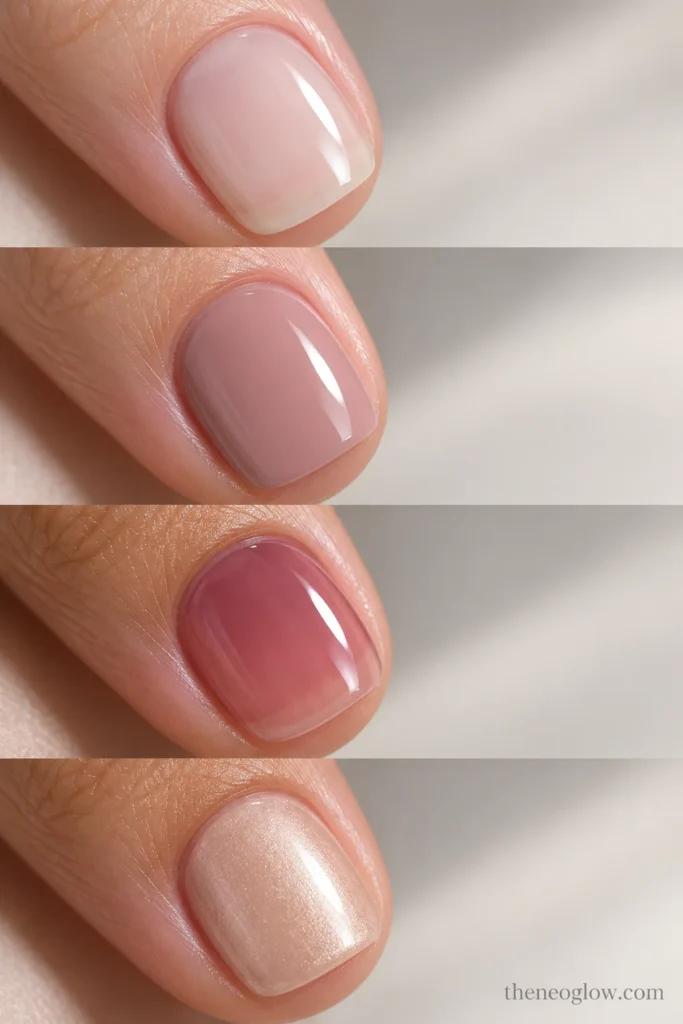
Short nails do not require pale polish. Dark brown, burgundy, navy, black, red, cobalt, olive, or bright pink can look just as intentional as beige or milky white when the shape and application are clean.
A better question is how much contrast and upkeep you want.
Sheer and milky finishes keep some natural nail visible. They create a softer transition as the nail grows and pair easily with a tiny tip or one accent.
Cream finishes make the color itself the design. A crisp cream can be one of the strongest choices for a short square or squoval because it does not need extra art to look complete.
Jelly finishes add transparent color and depth. They are useful when you want more saturation than a sheer nude but less visual weight than an opaque cream.
Fine shimmer, pearl, or restrained chrome can add light without taking up design space. Keep the surface smooth if the manicure needs to stay practical.
If you want a color-first reference with genuinely short examples, NeoGlow’s Solid Color Summer Nails for Short Nails guide is seasonal, but its opacity, undertone, finish, and short-shape examples are useful beyond one season. Browse the solid-color short-nail guide
Scale the Design to the Nail Plate
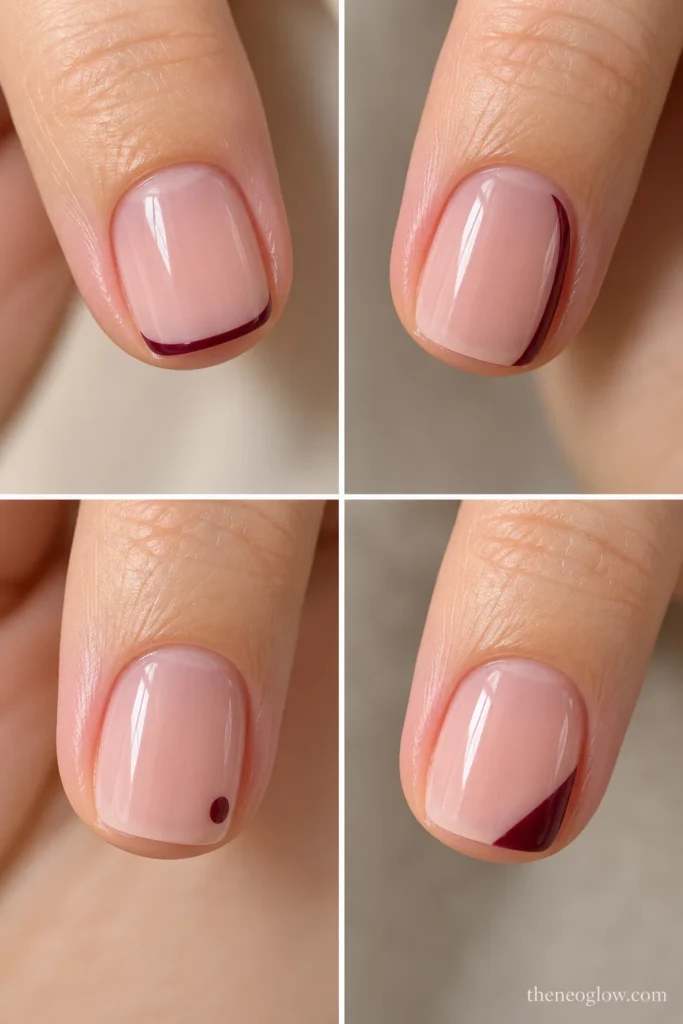
The easiest way to overcrowd a short manicure is to shrink a long-nail composition without editing it. Instead, choose one main zone: tip, sidewall, corner, cuticle area, or center.
A micro French tip uses a narrow line rather than a deep band. A side French or corner accent keeps more of the natural-looking base visible. One tiny motif can be clearer than five miniature objects on every finger. Negative space gives strong color or line art room to read.
Flat detail is usually easier to integrate into an everyday short manicure than stacked decoration. Dots, slim lines, small decals, low-density florals, color-blocked corners, and one accent nail can all create variety without requiring extra length.
This is also where restraint helps more than a “rule.” If you love a detailed design, place the most complex element on one or two nails and simplify the rest. The goal is not to make short nails look longer at all costs. It is to make the design legible at the scale you actually wear.
For a broader seasonal example set that keeps artwork on true short nails, see NeoGlow’s 22 Short Summer Nails That Look Cute, Polished, and Easy to Wear. Browse the short summer nail guide Use it for visual inspiration, not as the definition of what every short manicure must look like.
Make Work, School, and Typing Part of the Decision

If you type for hours, choose the manicure after testing how your fingers actually contact the keys. A nail that reaches the key before the finger pad, catches between keys, or makes you change your hand position is giving you practical feedback.
Length is only one variable. Thickness, sharp corners, raised charms, and an uneven underside can also change how a short manicure feels. Start with a smooth profile, then add visual detail without adding unnecessary bulk.
NeoGlow’s Nails for Typing: Best Shapes, Lengths, and Finishes for Work or School goes deeper on keyboard testing and free-edge decisions. Open the Nails for Typing guide Use that page when typing comfort is the main job; stay here when you are still choosing your overall short-nail direction.
Use Salon Wording That Describes the Result
“Short and cute” leaves too much open to interpretation. A useful salon request describes the physical nail first and the decorative layer second.
Try this structure:
Length: near the fingertip, with only a small visible free edge.
Shape: soft square, squoval, round, shallow oval, or genuinely short almond if the current free edge supports it.
System: regular polish, gel polish, press-on, or the exact enhancement you have chosen.
Finish: sheer, milky, cream, jelly, pearl, shimmer, chrome, glossy, or matte.
Design density: solid color, micro tip, one accent, side detail, corner art, or another clearly limited placement.
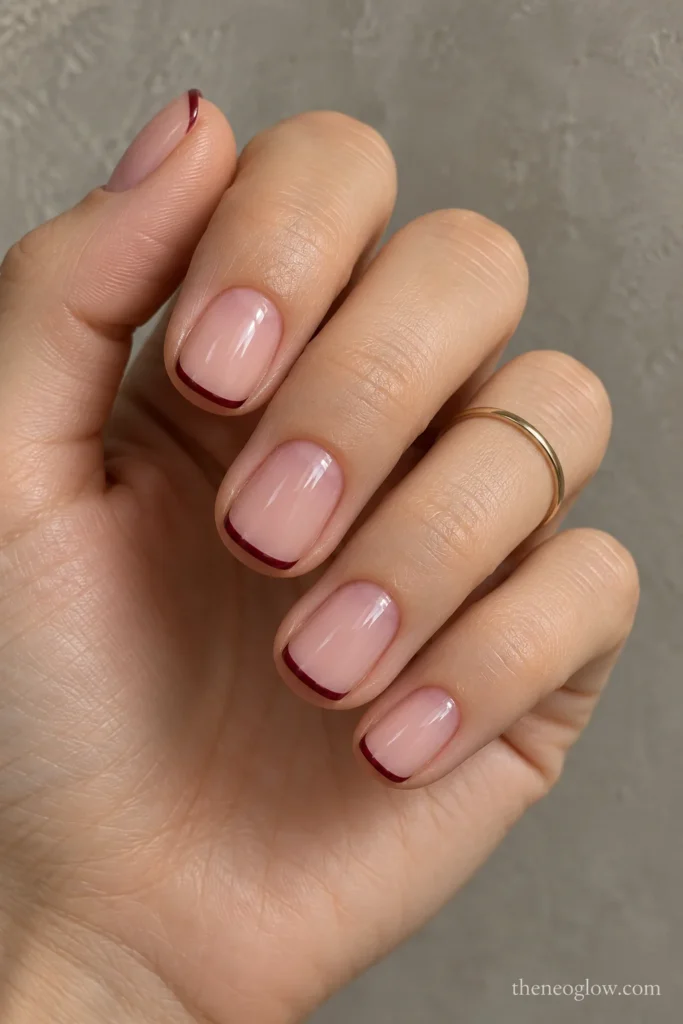
For example: “Keep the nails short and squoval, use a sheer rosy base, and add a very thin burgundy micro tip. I do not want added length or raised decoration.”
That wording tells the technician what must stay short, what shape you want, and where the visual emphasis belongs.
Know When This Hub Should Hand You Off
A broad short-nail guide should help you choose a route, not swallow every specialist topic.
| If this is your real question | Use a specialist guide next |
|---|---|
| Which short shape suits my current nail structure? | Best Nail Shape for Short Nails |
| What works when I type all day? | Nails for Typing |
| I want a seasonal gallery on genuinely short nails | A seasonal short-nail guide such as Summer, Fall, Halloween, or Christmas |
| I only want one-color options | A solid-color short-nail guide |
| I want acrylic, builder, dip, or gel-specific technique and removal | A dedicated system guide |
| I want French-tip proportions and variations | A dedicated short French-tip guide |
| I want temporary length or art with press-ons | A press-on sizing, application, and removal guide |
This separation keeps your decision simple. You can solve one problem at a time instead of treating “short nails” as one giant gallery containing every shape, season, color, and system.
Choose the Simplest Route That Still Feels Like You
Start with the constraint you cannot ignore: your available free edge, daily tasks, preferred maintenance, or desired system. Then choose one shape, one finish, and one design-density level.
If you are undecided, a short squoval or soft square with a smooth sheer or cream finish is an easy baseline to compare against more decorative options. From there, move to the specialist page that matches the next question you actually have—shape, typing, seasonal art, solid color, French tips, gel, acrylic, or press-ons.
Short nails do not need to imitate long nails to look finished. They need a shape, surface, and design scale that make sense together.