Korean skincare can look like a long checklist online, but you do not need a 10-step routine to use the ideas that make K-beauty appealing. A practical beginner version is much shorter: cleanse gently, keep skin comfortable with moisturizer, use sunscreen during the day, and add only the optional layers that solve a real need.
The useful question is not “How many Korean skincare steps should I do?” It is “What job does each step perform for my skin?” That approach keeps the routine flexible, product-neutral, and easier to troubleshoot if something starts to sting, feel too heavy, or simply does not add value.
Quick answer: start with the K-beauty principles, not the step count
Korean skincare is best treated as an approach rather than one official routine. In practice, the most useful ideas are gentle cleansing, comfortable hydration, consistent sun protection, and optional targeted products chosen for a specific reason. Cleveland Clinic’s dermatologist-reviewed overview of Korean skincare routines makes the same basic point: focus on the philosophy, not on completing every possible step.
That matters because “10 steps” can turn a flexible routine into a shopping list. More products are not automatically better, and a product being Korean does not guarantee that it will suit your skin. Formula, directions, texture, fragrance, active ingredients, and your own tolerance still matter.
Build the short routine before you add K-beauty extras
If you are new to Korean skincare, begin with the same foundation that supports any sensible routine. The site’s broader Skin Care guide explains the core jobs in more detail, but the short version is simple.
| Routine job | Morning | Evening | How to think about it |
|---|---|---|---|
| Cleanse | As needed | Usually useful | Remove sweat, oil, makeup, sunscreen, and daily buildup without leaving skin uncomfortably stripped. |
| Moisturize | Usually useful | Usually useful | Choose a texture that leaves skin comfortable rather than chasing a specific K-beauty format. |
| Protect | Sunscreen | Not needed for sleep | Finish daytime skincare with sun protection that you can use correctly and consistently. |
| Target | Optional | Optional | Add a serum, essence, exfoliant, or other treatment only when it has a clear job. |
If you want exact morning and night sequence help, use the Skin Care Routine guide. This Korean skincare page owns a different decision: which K-beauty-style categories are worth adding, and which ones you can skip.
Which Korean skincare steps are essential, helpful, optional, or skippable?
Many K-beauty routines include toners, essences, ampoules, sheet masks, cleansing oils, eye creams, and exfoliants. None of those categories is automatically mandatory. Think about the job first.
| Step or format | Useful job | Beginner decision |
|---|---|---|
| Oil cleanser or cleansing balm | Helps loosen makeup, sunscreen, and oily buildup before a second cleanse. | Helpful for some; skip if one gentle cleanse already removes the day comfortably. |
| Water-based cleanser | Removes remaining daily buildup. | Core evening step for most routines. |
| Hydrating toner | Adds a light hydration layer. | Optional; useful if you enjoy the feel and it adds comfort. |
| Essence | Usually adds another lightweight hydration or treatment layer, depending on the formula. | Optional; do not add it only because a Korean routine “should” have one. |
| Serum or ampoule | Targets one defined cosmetic goal. | Optional; choose by purpose and ingredients, not by the category name alone. |
| Sheet mask | Provides a temporary, occlusive-feeling hydration or self-care step depending on the formula. | Optional extra, not a replacement for moisturizer or sunscreen. |
| Eye cream | Moisturizes or delivers ingredients in a product designed for the eye area. | Optional; a separate eye product is not required for everyone. |
| Moisturizer | Helps skin hold onto water and feel comfortable. | Core step; choose texture by how your skin behaves. |
| Sunscreen | Reduces UV exposure when used correctly. | Core daytime step. |
This is the easiest way to keep Korean skincare practical: if two products do the same job and you do not benefit from both, you do not need both.
Choose one of three practical K-beauty routes
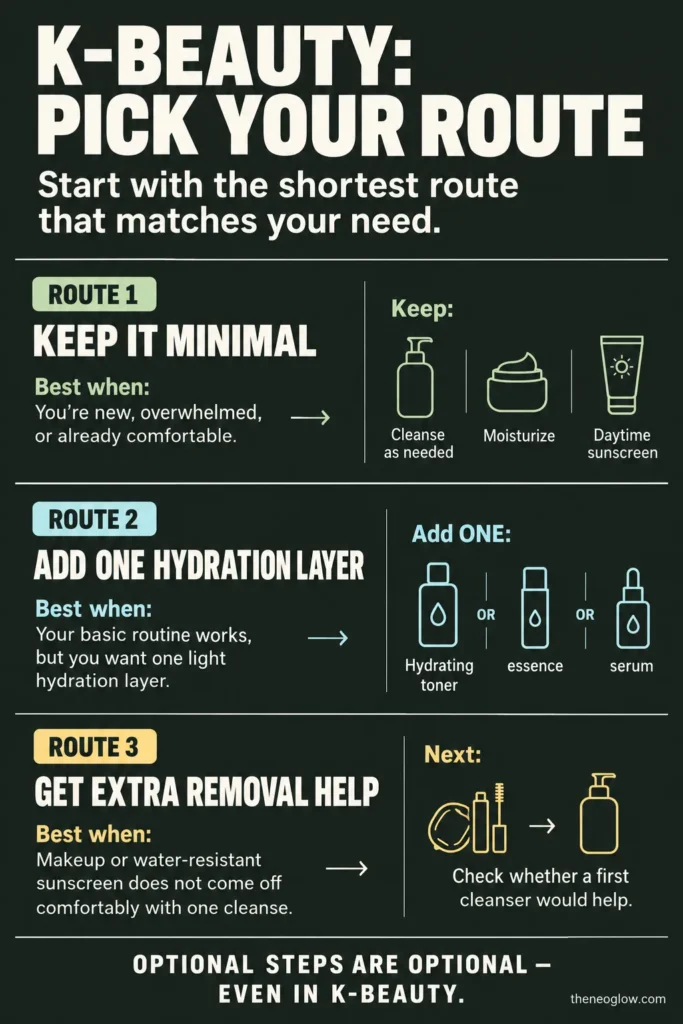
Route 1: the minimal routine
Choose this if you are overwhelmed, new to skincare, or already comfortable with a basic routine.
- Morning: cleanse as needed, moisturizer, sunscreen.
- Evening: gentle cleanser, moisturizer.
You can still use Korean products within this route. The point is that K-beauty does not require a separate toner, essence, ampoule, mask, and eye cream before the routine counts.
Route 2: the hydration-focused routine
Choose this if your basic routine works but you want one lightweight layer for comfort or a dewier cosmetic finish.
- Keep the same basic cleanser, moisturizer, and daytime sunscreen.
- Add either a hydrating toner, essence, or serum after cleansing.
- Start with one added layer, not three new products at once.
- Keep it only if it improves comfort or the finish of your routine without irritation or unnecessary heaviness.
If hydration is your main goal, the site’s hydration guide for fresher, dewier-looking skin goes deeper without turning “glow” into a promise of poreless skin.
Route 3: the makeup or water-resistant sunscreen removal routine
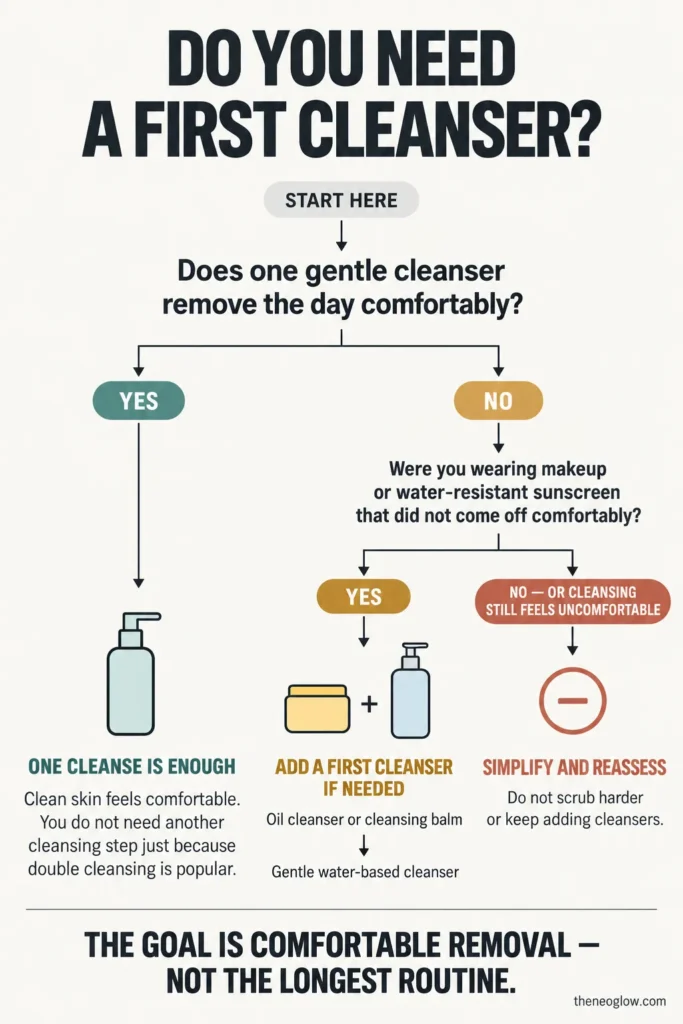
Choose this when one cleanser does not comfortably remove what you wore during the day. A first cleansing step such as an oil cleanser or balm can help loosen makeup and sunscreen, followed by a gentle water-based cleanser.
That is the basic logic behind double cleansing. It is not a rule that everyone must follow every night. If one cleanser removes the day well and your skin feels comfortable, adding a second cleanser may not add useful value.
Do you need a toner and an essence?
No. You can use one, both, or neither.
The category names can overlap because formulas vary widely. A toner may be watery and hydrating, an essence may be slightly more substantial, and either one may contain ingredients beyond hydration. Instead of assuming the label tells you exactly what the product does, read the ingredient list, directions, and claims on the specific product.
For a beginner, the cleanest decision is to choose one lightweight optional layer if you want one. If that product already gives you the hydration or targeted function you wanted, you do not need to add another category simply to make the routine look more complete.
How to add Korean skincare products without creating product overload
Add one new product at a time whenever possible. That makes it easier to tell whether the product is useful, unnecessary, or irritating.
- Name the job. Decide whether you need cleansing, hydration, moisture, sun protection, or one targeted cosmetic function.
- Check the formula and directions. Country of origin and packaging style do not replace the product label.
- Fit it into the routine. The American Academy of Dermatology’s product-order guidance uses a simple sequence of cleansing, treatment when needed, then moisturizer and/or sunscreen. If a specific product gives different directions, follow those directions.
- Change one variable. Avoid introducing several unfamiliar actives or exfoliating products at once.
- Reassess comfort. If your skin becomes unusually tight, hot, itchy, swollen, or painful, stop the suspected product rather than adding more steps to compensate.
If your shelf is already crowded or your routine frequently stings, the better next move may be subtraction. The site’s Skin Barrier Mistakes guide can help you simplify common overload patterns without treating irritation as a beauty challenge to push through.
What about “glass skin”?
Glass skin is an aesthetic idea associated with a smooth, hydrated, luminous-looking finish. It should not become a requirement for healthy skin or a reason to chase a poreless, texture-free face.
Normal skin has pores, texture, lines, oil, and changes from day to day. Hydration, moisturizer, sunscreen, makeup, lighting, and camera processing can all affect how reflective or even skin looks. This article does not turn glass skin into the goal of every Korean skincare routine; that topic deserves its own guide because the decision is different.
Sunscreen is still the daytime protection step
K-beauty may introduce you to different sunscreen textures, but the safety decision for a U.S. reader stays straightforward. The American Academy of Dermatology recommends broad-spectrum, water-resistant sunscreen with SPF 30 or higher. The FDA also advises following the sunscreen label and reapplying at least every two hours when you are outdoors, more often when swimming or sweating.
Use the sunscreen you can apply correctly and consistently rather than assuming a product is better simply because it is Korean, viral, or cosmetically elegant. You can review the FDA’s current sun-safety guidance for label and reapplication basics.
What should you realistically expect from a simpler Korean skincare routine?
A well-chosen routine should be easier to repeat and easier to understand. The realistic goal is not instant “glass skin.” It is a routine in which every product has a reason to be there, your skin feels comfortable, and you can tell what to change when something is not working.
Hydrating layers may temporarily make skin look plumper or more luminous. A moisturizer can improve comfort and reduce a dry or tight feel. Sunscreen supports daily UV protection when used correctly. Optional products can add targeted benefits, but they do not all need to be used together.
If a routine only works when you remember eight or ten separate steps, it may be more complex than you need. Consistency with a shorter routine is often more practical than owning a complete category checklist.
When to simplify, stop, or ask a professional
Routine experimentation should stay in the cosmetic lane. Stop using a suspected product if you develop significant burning, swelling, blistering, intense itching, or another strong reaction. Persistent pain, a spreading rash, signs of infection, severe or worsening symptoms, or a skin problem you cannot identify should be evaluated by a qualified health professional rather than managed by adding more skincare.
If you use prescription products or have a diagnosed skin condition, follow your clinician’s instructions instead of replacing that plan with a generic K-beauty routine from social media.
The simplest Korean skincare rule to keep
You do not need to “complete” Korean skincare. Start with cleansing, moisturizer, and daytime sun protection, then add one optional step only when you can explain what it contributes.
If your next question is about exact morning and evening order, continue with the Skin Care Routine: The Right Order for Morning and Night. Once dedicated Glass Skin and Double Cleansing guides are live and verified, those can become the deeper child pages for the aesthetic goal and cleansing technique without making this broad K-beauty guide do every job.