A skin care routine works best when every step has a clear job. You do not need ten products, and you do not need a different rule for every bottle on your shelf. The most useful order is simple: cleanse, use any necessary treatment, moisturize, then finish daytime skin care with sunscreen. Makeup comes after sunscreen.
The American Academy of Dermatology recommends this basic sequence because product order can affect how well products work. The exact routine can still change with your skin, the product directions, and whether a step is optional. American Academy of Dermatology’s product-order guidance
The simple order to remember
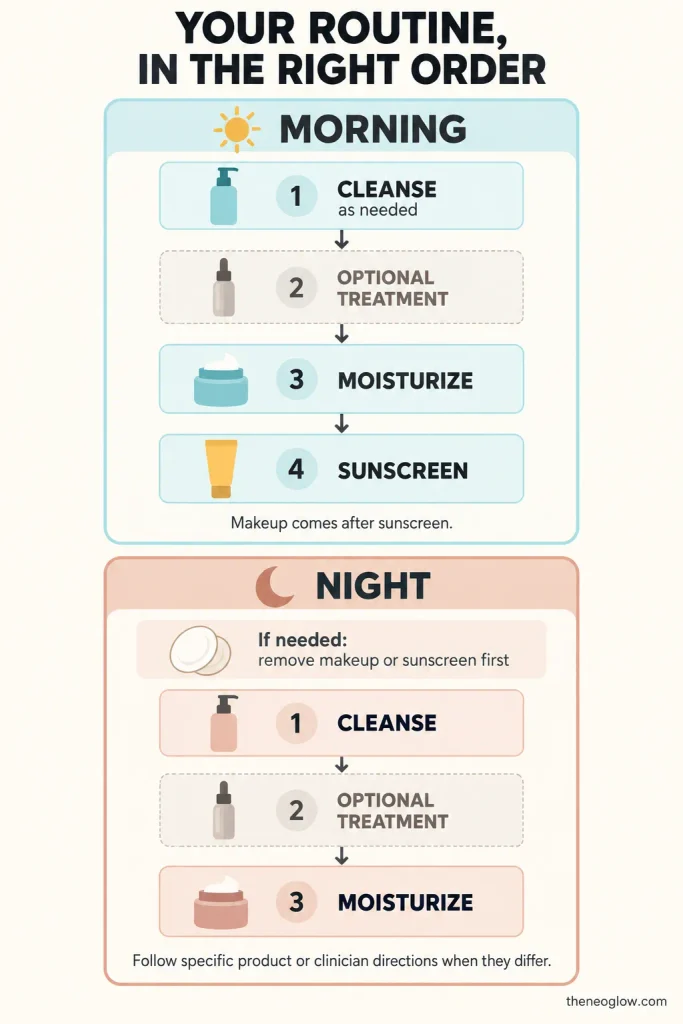
For most people, think in two lanes:
Morning: cleanse as needed → treatment or serum if you use one → moisturizer → sunscreen → makeup
Night: remove makeup or sunscreen as needed → cleanse → treatment if you use one → moisturizer
That is the framework. Toners, essences, masks, face oils, exfoliants, and extra serums are not automatically required. Add them only when they have a clear purpose and your skin tolerates them.
If you are still deciding what belongs in your routine at all, start with the broader Skin Care guide before adding more steps.
Your morning skin care routine, in order
1. Cleanse without overdoing it
Start with a gentle cleanser if your skin needs a morning wash. The AAD advises limiting face washing to twice a day and after sweating to help reduce irritation. AAD’s simple skin care guidance
Cleansing is not supposed to leave your face feeling tight or squeaky. If a cleanser repeatedly leaves you uncomfortable, the problem may be the formula or how often you are washing, not a need to add more products afterward.
Keep the morning cleanse simple. You are preparing the skin for the products that follow, not trying to strip away every trace of oil.
2. Apply a treatment or targeted serum only if you need one
A treatment step belongs after cleansing because it has a specific job. This might be a product chosen for the appearance of uneven tone, texture, dryness, or another cosmetic concern.
Do not build this step by stacking several unfamiliar actives together. If you use a prescription product, a retinoid, an exfoliant, or another irritation-prone treatment, follow the product directions or your clinician’s instructions instead of relying on a generic layering rule.
A useful filter is simple: if you cannot explain what the product is supposed to add to your routine, you may not need it.
3. Moisturize
Moisturizer helps skin hold onto water and feel comfortable. The AAD notes that moisturizer can be especially useful when applied while skin is still damp after cleansing.
Choose the texture by how your skin behaves rather than by a trend. A lighter lotion or gel may feel better for oilier skin or humid weather, while a richer cream may feel better when skin is dry or the air is less humid.
Moisturizer is not only for dry skin. People with oily skin can still use moisturizer; the useful question is whether the formula feels comfortable and suits the rest of the routine.
4. Finish with sunscreen
Sunscreen is the final skin care step in the morning, before makeup. The AAD recommends broad-spectrum, water-resistant sunscreen with SPF 30 or higher and says to apply it about 15 minutes before going outdoors.
When you are outside, reapply according to the product directions. AAD guidance recommends reapplying about every two hours outdoors and after swimming or sweating. FDA sunscreen guidance also emphasizes following the label and reapplying at least every two hours, more often with swimming or sweating.
Your night skin care routine, in order
1. Remove makeup and sunscreen as needed
At night, the goal is to take off the day’s makeup, sunscreen, oil, sweat, and buildup without turning cleansing into a harsh scrub.
If your usual cleanser removes everything comfortably, you do not need a longer ritual just because double cleansing is popular. If makeup or a water-resistant product is difficult to remove, use an appropriate removal step first, then cleanse gently.
The useful test is the result: clean, comfortable skin without aggressive rubbing.
2. Cleanse gently
The evening cleanse gives you a clean starting point before treatment or moisturizer. Use lukewarm water and gentle pressure rather than scrubbing.
If your skin already feels tight, flaky, or reactive, adding stronger cleansing usually does not solve the problem. A simpler routine may make it easier to see whether over-cleansing or another product is contributing to discomfort.
If your routine currently stings or feels overloaded, the Skin Barrier Mistakes guide is the better next step before adding more active products.
3. Use treatment only when it has a clear role
Night is a common place for targeted products, but “nighttime” does not automatically mean you need an active.
If you use a treatment, follow its label or professional instructions. Some products have specific timing, frequency, or compatibility rules. There is no single universal waiting period that should be applied to every serum, acid, retinoid, or prescription.
This is also where restraint matters most. Adding several new treatment products at once makes it harder to know what is helping and what is irritating your skin.
4. Moisturize
Finish the basic night routine with a moisturizer that leaves your skin comfortable.
If your face feels dry in selected areas, you do not have to use the same amount everywhere. You can adjust texture or amount based on how different areas of your face feel.
A night cream is optional. You do not need a separate product simply because the label says “night” if your regular moisturizer already works well for you.
Which steps are essential, optional, or easy to skip?
| Step | Morning | Night | How to think about it |
|---|---|---|---|
| Gentle cleansing | Usually useful | Usually useful | Keep frequency and strength low enough to avoid unnecessary irritation |
| Treatment or serum | Optional | Optional | Use for one defined need; follow directions |
| Moisturizer | Usually useful | Usually useful | Adjust texture and amount to your skin and climate |
| Sunscreen | Essential for daytime protection | Not needed for sleep | Final morning skin care step before makeup |
| Toner or essence | Optional | Optional | Keep only if it adds a useful job |
| Exfoliant | Optional | Optional | Frequency depends on the product, method, and tolerance |
| Face mask | Optional | Optional | Extra care, not a replacement for cleansing, moisturizing, or sun protection |
| Face oil | Optional | Optional | Use only if it improves comfort and fits the rest of the routine |
This table is deliberately short. A routine does not become better simply because it contains more categories.
How often should you use each step?
Frequency is one of the easiest places to overcomplicate skin care.
For cleansing, the AAD advises washing the face up to twice daily and after sweating. More washing is not automatically better.
For moisturizer, use it consistently when your skin benefits from it, especially after cleansing. You can adjust the amount or texture instead of dropping the step just because your skin feels oilier in one area or season.
For sunscreen, make it part of your daytime routine when you will be exposed to daylight, then follow the label for reapplication. If you are outdoors, swimming, or sweating, reapplication matters.
For treatments, exfoliants, masks, and similar extras, there is no honest one-number schedule that fits every product. The AAD notes that exfoliation frequency depends on skin type and method, and that more aggressive exfoliation generally needs to be done less often. Product directions and your tolerance should control the schedule.
Do you need to wait between skin care steps?
Usually, you do not need to invent a long waiting schedule between ordinary cosmetic steps.
The important exception is when a product label, prescription instruction, or professional recommendation gives you a specific wait time. In that case, follow the specific directions rather than a generic social-media rule.
This matters because some treatment products are more irritation-prone or have application instructions that are different from a basic serum or moisturizer. A single “wait five minutes between everything” rule is not evidence-based routine planning.
How to adjust the order for dry, oily, or easily irritated skin
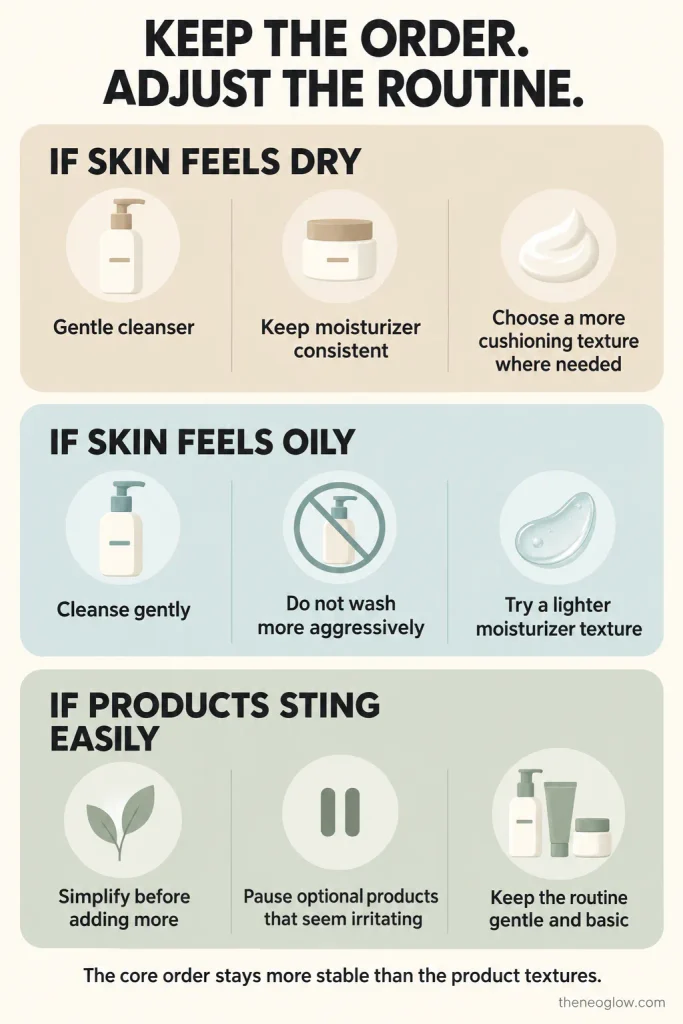
The order usually stays more stable than the product textures.
If your skin feels dry, use a gentle cleanser, keep moisturizer consistent, and consider a more cushioning texture where needed. Applying moisturizer to damp skin can also help trap water.
If your skin becomes oily easily, do not assume you need to skip moisturizer or wash more aggressively. A lighter moisturizer and a gentle cleanser may fit better. The AAD specifically advises people with oily skin to cleanse gently and still moisturize.
If products sting easily or your skin feels unusually reactive, simplify before adding. Keep the routine focused on gentle cleansing, moisturizer, and daytime sun protection, and pause optional products that appear to be causing discomfort.
Persistent burning, swelling, painful cracking, blistering, a spreading rash, signs of infection, or a concern you cannot identify is no longer just a routine-order question. Seek qualified medical care rather than trying to solve it by adding more products.
Common routine-order mistakes
One common mistake is putting every serum you own into both morning and night routines. A product should earn its place by solving a real problem, not by filling a step.
Another is treating sunscreen as optional or placing makeup before it. Sunscreen belongs after the rest of your morning skin care and before makeup.
A third mistake is copying a “thinnest to thickest” rule without checking what the product actually is. Function and label directions matter more than texture alone. Medication, treatment, moisturizer, sunscreen, and makeup have different jobs.
Finally, do not mistake irritation for proof that a routine is working. Burning, swelling, blistering, or intense itching is a reason to stop the suspected product and get appropriate advice if symptoms are significant or persistent.
The easiest routine to keep
If your shelf is crowded, return to this structure:
Morning: gentle cleanse → optional treatment → moisturizer → sunscreen
Night: cleanse → optional treatment → moisturizer
Then add only what solves a specific need.
The order should make your routine easier to repeat, not harder to manage. Once the sequence feels clear, your next step is to customize the products and textures without changing the core logic. For seasonal adjustments, the Lightweight Summer Skincare Routine for Humid Days shows how to keep the same basic jobs while changing texture and comfort for hot weather.