Body care does not need to be a long “everything shower” every day. For most people, the useful foundation is simple: cleanse without over-stripping, exfoliate only when it helps, moisturize soon after bathing, and use richer products only when your skin actually needs them.
This guide focuses on skin below the neck. It is not a treatment plan for eczema, psoriasis, persistent rashes, painful cracking, or other medical skin problems. The goal is to build a repeatable routine that leaves your body skin feeling clean, soft, and comfortable without turning every shower into a product haul.
Start with four body-care jobs
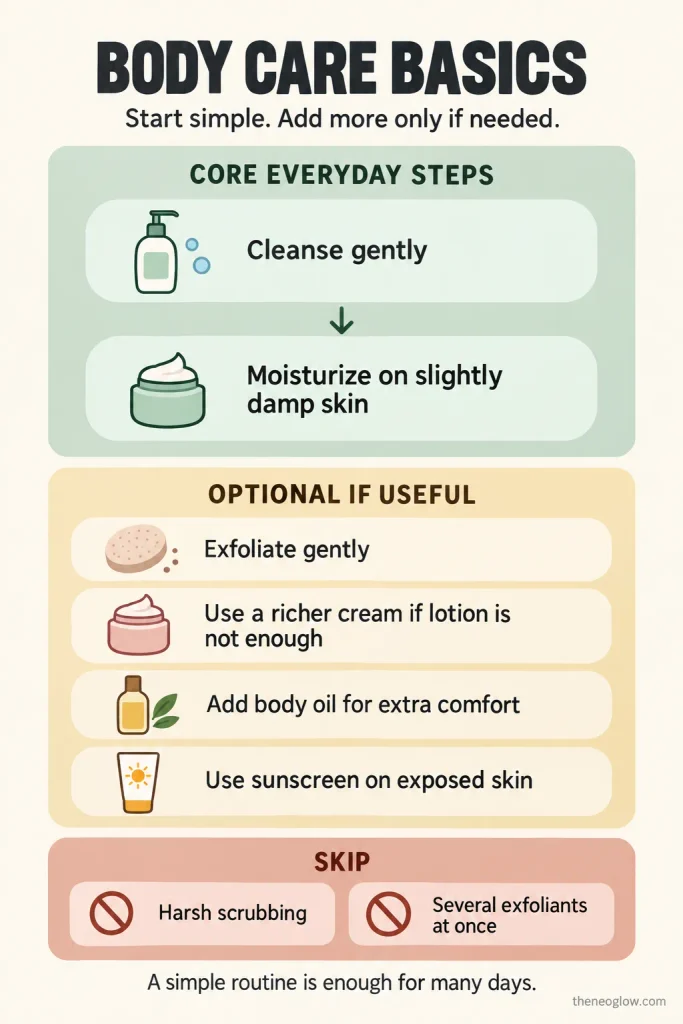
A practical body care routine has four possible jobs:
- Cleanse: remove sweat, dirt, sunscreen, excess oil, and everyday buildup.
- Smooth: use exfoliation only when rough or flaky-looking texture makes it useful and your skin tolerates it.
- Moisturize: help skin hold onto water and feel softer after bathing.
- Seal or protect: add an optional richer layer such as body oil when it improves comfort, and use sun protection on exposed skin during the day.
You do not need a separate product for every job. One gentle body cleanser and one moisturizer may be enough for much of the year.
| Body-care step | How to think about it |
|---|---|
| Gentle cleansing | Essential as needed for sweat, odor, sunscreen, and buildup |
| Moisturizer | A core step, especially if skin feels dry, tight, rough, or itchy |
| Exfoliation | Helpful for some, but optional and easy to overdo |
| Body oil | Optional; useful when you like the feel or want an extra emollient layer |
| Body butter or richer cream | Optional; useful when a lighter lotion does not feel cushioning enough |
| Scrubbing until skin feels “squeaky” | Skip |
| Using several exfoliants at once | Skip |
Cleanse without making your skin feel stripped
A body cleanser should leave skin feeling clean, not tight, hot, or squeaky. Long hot showers and aggressive washing can make dry skin feel worse, so warm water and a shorter shower are a better baseline when dryness is an issue.
You also do not have to create a thick lather from neck to ankles every time you bathe. Focus cleansing where sweat, odor, sunscreen, or visible buildup makes it useful, then rinse well. If your current body wash repeatedly leaves your skin uncomfortable, a gentler formula may be a more useful change than adding more products afterward.
If your skin is dry or easily irritated, fragrance-free products may be easier to tolerate than strongly fragranced cleansers. “Fragrance-free” and “unscented” are not always the same thing, so read the label rather than relying only on the front of the bottle.
Exfoliation is optional, not the foundation
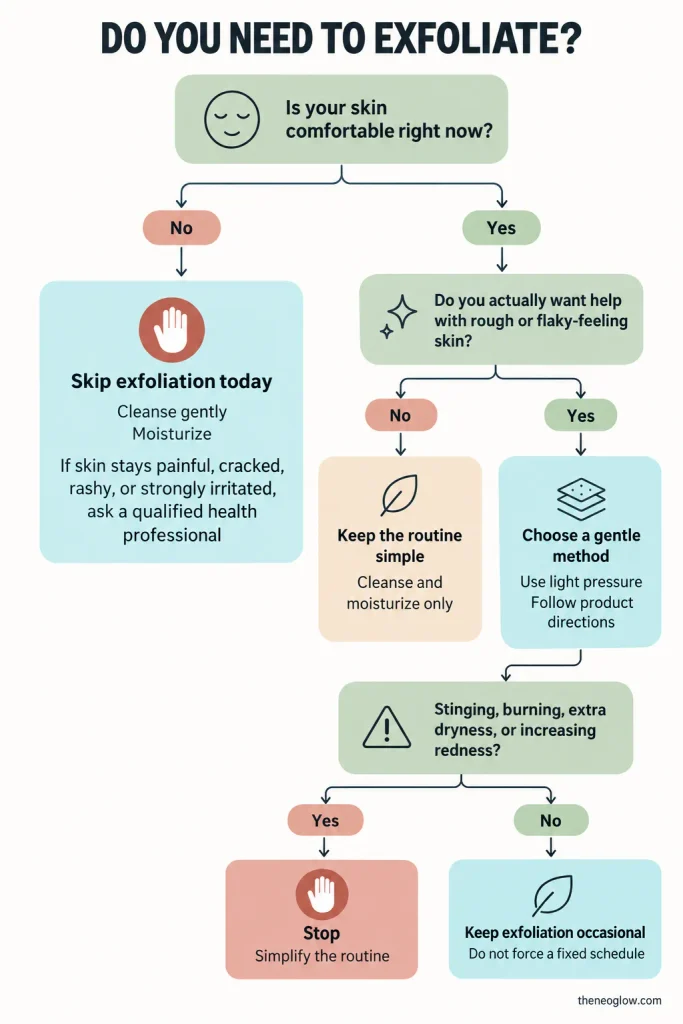
Body scrub has strong beauty appeal because smoother-feeling skin is an immediate reward, but exfoliation is not something everyone needs on a fixed schedule.
There are two broad routes: mechanical exfoliation, such as a scrub or textured tool, and chemical exfoliation, which uses exfoliating ingredients in a leave-on or rinse-off formula. Either route can irritate skin when it is too aggressive or used too often.
If you exfoliate, keep the pressure gentle and let your skin’s response control the schedule. A more aggressive method generally needs to be used less often. Do not exfoliate over sunburn, open cuts, wounds, or already irritated skin, and be cautious if you are using other products that make skin more sensitive.
There is no honest universal rule that every person should scrub two or three times a week. The right frequency depends on the method, the product directions, and how your skin tolerates it.
If your skin starts stinging, burning, looking unusually red, or feeling increasingly dry, pause the exfoliating step rather than trying to “push through” it. If your routine already feels overloaded, the site’s Skin Barrier Mistakes guide is the more useful troubleshooting destination.
Moisturize while your skin is still damp

The most useful post-shower habit is also one of the simplest: apply moisturizer soon after bathing, while your skin is still slightly damp. The American Academy of Dermatology specifically recommends moisturizing promptly after bathing to help retain water in dry skin.
You do not need to wait until every drop of water has evaporated. Pat rather than rub your skin dry, leave a little moisture behind, then apply your body moisturizer. This helps make the shower-to-moisturizer step feel like one routine instead of two separate jobs.
If your skin feels comfortable with a light lotion, you do not need to upgrade to a thick cream just because richer textures are popular. If a lotion disappears quickly and your skin still feels tight or rough, a cream or ointment-style moisturizer may hold moisture more effectively.
The useful question is not “Which texture is best?” It is “Which texture leaves my skin comfortable enough that I will use it consistently?”
Lotion, body butter, cream, or oil?
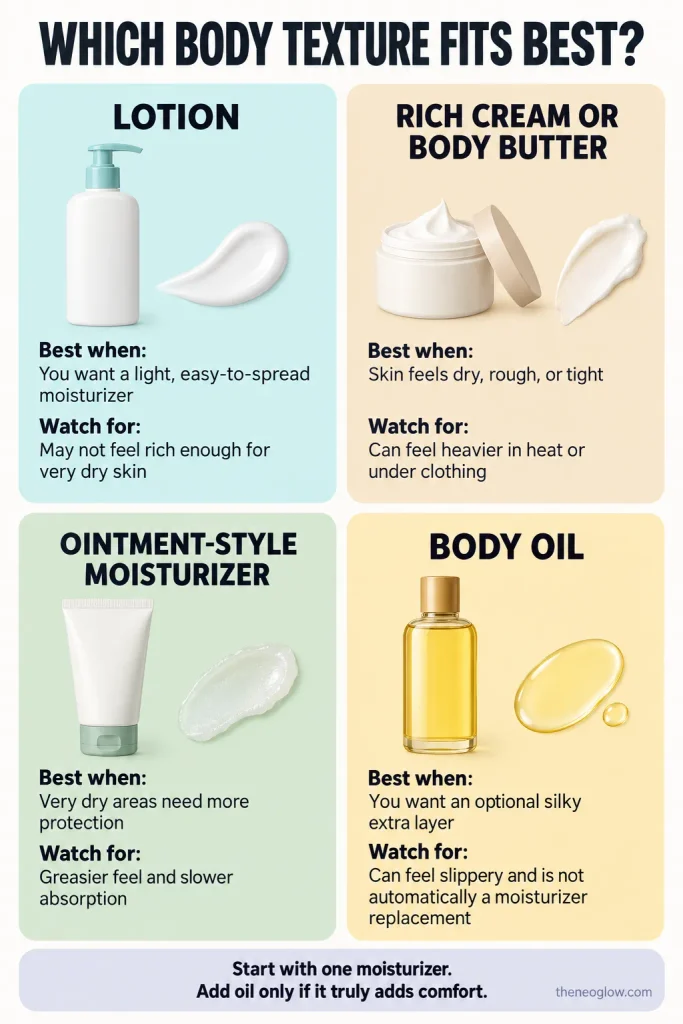
These formats overlap, so choose by skin feel, climate, and how much richness you want rather than assuming one label is automatically superior.
| Format | A practical reason to choose it | Tradeoff |
|---|---|---|
| Lotion | You want a lighter, easy-to-spread moisturizer for large areas or warm weather | May not feel rich enough for very dry skin |
| Cream or rich body butter | Your skin feels dry, rough, or tight and you want more cushioning | Can feel heavier in heat or under clothing |
| Ointment-style moisturizer | You have very dry areas and want a highly occlusive texture | Greasier feel and slower absorption |
| Body oil | You enjoy a silky finish or want an optional emollient layer after bathing | May feel slippery and is not automatically a substitute for a moisturizer that already works for you |
For very dry skin, dermatology guidance generally favors creams and ointments over lotions because they hold more moisture in the skin. That does not mean every person needs the heaviest formula every day.
Body oil can be used according to the product directions, either on slightly damp skin or over moisturizer if that combination feels comfortable. You do not need both oil and body butter simply because a routine online includes them.
Build the routine in the right order
For an ordinary shower day, keep the sequence simple:
- Shower with warm, not hot, water.
- Cleanse gently where needed.
- Exfoliate only if it is an exfoliation day and your skin is comfortable.
- Rinse thoroughly.
- Pat skin so it remains slightly damp.
- Apply lotion, cream, body butter, or ointment based on how dry your skin feels.
- Add body oil only if it gives you a useful extra layer of comfort.
- Protect exposed skin from the sun during the day.
The warm-water, gentle-cleansing, and damp-skin moisturizing parts of this sequence align with current dermatology guidance.
This is the body-care framework, not a rule that every shower must contain every step. On many days, cleansing followed by moisturizer is enough.
Adjust the routine instead of rebuilding it every season
Body skin can feel different when the weather changes.
In hot or humid conditions, you may prefer a lighter lotion, less product, or an oil only on drier areas. In colder, drier weather, a richer cream or ointment-style moisturizer may feel more comfortable, especially on shins, elbows, hands, or other areas that become rough. AAD guidance likewise favors richer creams and ointments when dryness becomes more pronounced.
You can also adjust by body area. Your shoulders may feel completely comfortable with a light lotion while your lower legs need a richer cream. A flexible routine is often more practical than forcing one texture everywhere.
Change one variable at a time. If skin becomes dry in winter, try a richer moisturizer or shorter, warmer-not-hot showers before adding multiple new scrubs, oils, masks, and tools.
Common body-care mistakes that create more work
Exfoliating because skin looks dull
Rough-looking skin does not always need more scrubbing. If your skin is dry, adding moisturizer and reducing irritation may be more useful than increasing exfoliation.
Using very hot water for a “deep clean”
Hot water can worsen dryness. A shower can still feel relaxing without being hot enough to leave your skin flushed or tight.
Waiting too long to moisturize
If you know you are prone to dryness, keep moisturizer where you will actually use it after bathing. The routine is easier to repeat when the product is already within reach.
Layering lotion, butter, and oil automatically
More layers are not automatically better. Start with one moisturizer. Add a richer texture or oil only if your skin still feels uncomfortable or you genuinely prefer the finish.
Treating irritation as proof that a scrub is working
Burning, significant stinging, increasing redness, or painful skin is not a goal. Stop the suspected exfoliant or irritating product and simplify the routine.
What smoother skin can realistically mean
Body care can improve how dry, flaky, or rough-feeling skin looks and feels, especially when consistent moisturizing replaces harsh cleansing or over-scrubbing.
It cannot promise permanently texture-free skin. Hair follicles, pores, stretch marks, scars, pigmentation differences, and natural variation in skin texture are normal. A routine can support comfort and cosmetic smoothness without erasing every visible feature.
That expectation matters because body-care marketing often turns normal texture into a problem that needs multiple products. A useful routine should reduce work, not create a new standard your skin has to meet.
When body care stops being a cosmetic question
A beauty routine is not the right tool for every skin change.
Seek qualified medical care if dryness or irritation persists despite gentle self-care, or if you have painful or deep cracks, bleeding, significant inflammation, spreading rash, open sores, signs of infection, large areas of peeling, or symptoms that interfere with sleep or daily life. Mayo Clinic lists persistent symptoms, pain/inflammation, open sores or infection, and extensive peeling among reasons to seek professional evaluation.
If a new product causes a strong reaction, stop using it. Do not keep exfoliating or layering fragranced products over painful or broken skin in an attempt to fix the problem cosmetically.
If your skin simply feels mildly dry or tight, simplify first: shorten the shower, use warm water, choose a gentle cleanser, moisturize while skin is damp, and pause optional exfoliation until your skin feels comfortable again.
Keep your body-care routine simple enough to repeat
A good body care routine does not have to look like a spa shelf. Start with gentle cleansing and moisturizer. Add exfoliation only when it has a clear purpose, choose a richer cream or body butter when lighter textures are not enough, and use body oil only if it adds comfort or a finish you enjoy.
The best routine is the one that leaves your skin feeling comfortable without giving you more steps than you need. If you also want to simplify the rest of your skincare, continue with the broader Skin Care: A Simple Guide to Building a Routine That Fits Your Skin.