Sunscreen is easier to use consistently when you stop treating it like a hunt for one perfect formula. For everyday skin care, start with the label: choose broad-spectrum protection, SPF 30 or higher, and water resistance. Then choose the texture and format you can apply generously and comfortably.
The rest is technique. Put sunscreen at the end of your morning skin care, before makeup, cover all exposed skin, and reapply when your day actually calls for it. If you are outdoors, swimming, or sweating, correct use matters more than whether the bottle is trendy, mineral, chemical, tinted, or imported.
Quick answer: choose the protection first, then the texture
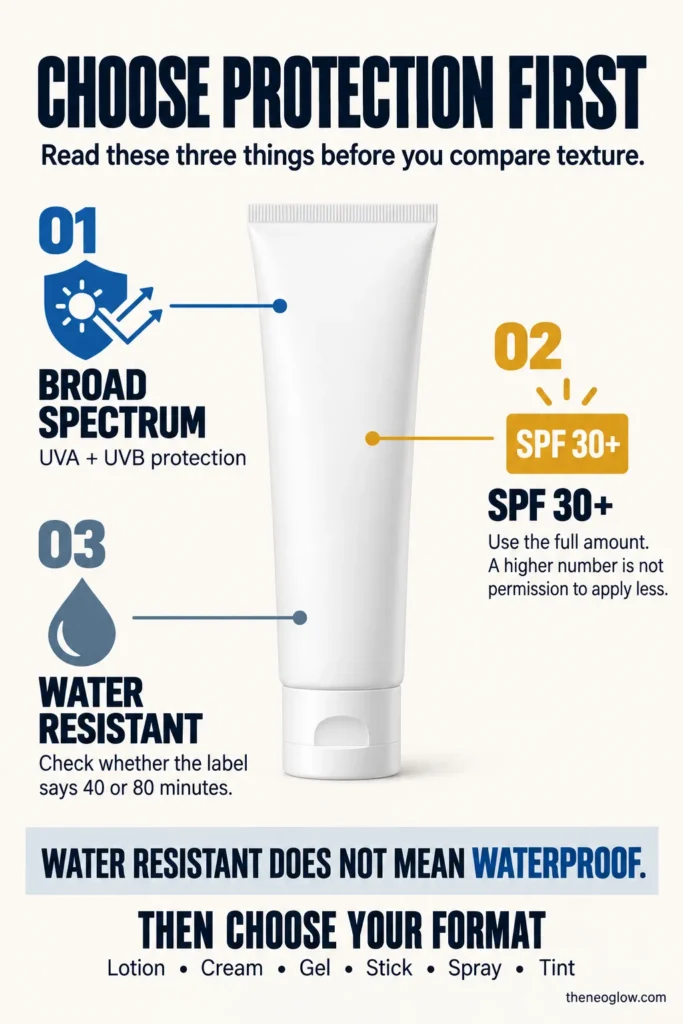
The American Academy of Dermatology recommends a sunscreen that is broad spectrum, water resistant, and SPF 30 or higher. Broad spectrum means the product protects against both UVA and UVB radiation. Water-resistant sunscreens state whether they maintain labeled protection for 40 or 80 minutes during swimming or sweating.
If you want the shortest shopping rule, check those three label points first. After that, choose the finish that makes daily use realistic for you: lotion, cream, gel, stick, spray, tinted, or another tested sunscreen format with directions you can follow.
For the current label basics, see the American Academy of Dermatology sunscreen-selection guidance. The FDA also explains how SPF, broad-spectrum labeling, water resistance, expiration, and U.S. sunscreen regulation work in its consumer sunscreen guide.
What you actually need from a daily sunscreen
| Priority | What to look for | Why it matters |
|---|---|---|
| Essential | Broad spectrum | Covers both UVA and UVB protection rather than relying on the SPF number alone. |
| Essential | SPF 30 or higher | Matches current AAD consumer guidance for everyday sun protection. |
| Essential | A format you can apply correctly | A technically good sunscreen is not useful if you routinely under-apply or avoid it because you dislike the feel. |
| Helpful for outdoor, hot, or active days | Water resistance | The label tells you whether the tested water-resistance period is 40 or 80 minutes. |
| Optional | Tint, matte finish, dewy finish, gel texture, richer cream, stick, or spray | These can improve comfort, cosmetic fit, or convenience, but they do not replace the protection criteria. |
| Skip | DIY SPF recipes or altered sunscreen mixtures | You cannot verify their SPF, water resistance, stability, or even distribution at home. |
Read the label before you compare ingredients
SPF is a measure of sunburn protection; it is not a timer that tells you how many hours you can stay in the sun. A higher SPF does not give you permission to apply less, skip areas, or ignore reapplication.
Broad spectrum is the second half of the decision because SPF mainly describes protection related to UVB-driven sunburn. A broad-spectrum product also meets requirements for UVA protection, so do not shop by the big SPF number alone.
Water resistance is also specific. Sunscreen is not waterproof. A water-resistant label tells you whether the product has been tested to maintain protection for 40 or 80 minutes while swimming or sweating. After that interval, or after towel drying, follow the product directions for reapplication.
Choose the sunscreen format by how you will actually use it
There is no single texture that everyone needs. The most useful format is the one that lets you cover the area thoroughly, feels acceptable in your routine, and has directions you can follow without shortcuts.
| If your priority is… | A practical format to consider | What to check |
|---|---|---|
| Easy face-and-neck coverage | Lotion, fluid, or cream | Comfort, finish, pilling, eye-area tolerance, and how it wears under makeup. |
| Less visible white residue | Tinted sunscreen | A tint that works with your skin tone while still meeting your protection criteria. |
| Hair-bearing areas or a very light feel | Gel or lightweight fluid | Whether the formula spreads evenly enough for the area you need to cover. |
| Targeted touch-ups | Stick | Enough passes for full coverage and any label directions about rubbing it in. |
| Large body areas | Lotion or spray | Generous, even application. Never spray sunscreen directly onto the face; follow spray-specific safety directions. |
If your skin stings with one formula, that does not mean sunscreen as a category cannot work for you. Try a different formula or texture and keep the protection criteria fixed. If you have a diagnosed skin condition, a persistent reaction, or a sunscreen allergy concern, ask a qualified health professional for individualized guidance rather than repeatedly testing products on irritated skin.
Put sunscreen at the end of your morning skin care
For a simple morning routine, sunscreen comes after your other skin care and before makeup. If you are still deciding what belongs in the routine before that step, use the Skin Care Routine guide for the full morning-and-night order.
- Cleanse as needed.
- Apply any treatment or serum you actually use.
- Apply moisturizer if your skin benefits from it.
- Finish skin care with sunscreen.
- Apply makeup after sunscreen.
You do not need a separate sunscreen “layering hack.” Give the product an even application, follow its directions, and do not improvise by blending it into moisturizer or foundation unless the sunscreen label specifically instructs that use.
Apply enough to every area that is exposed
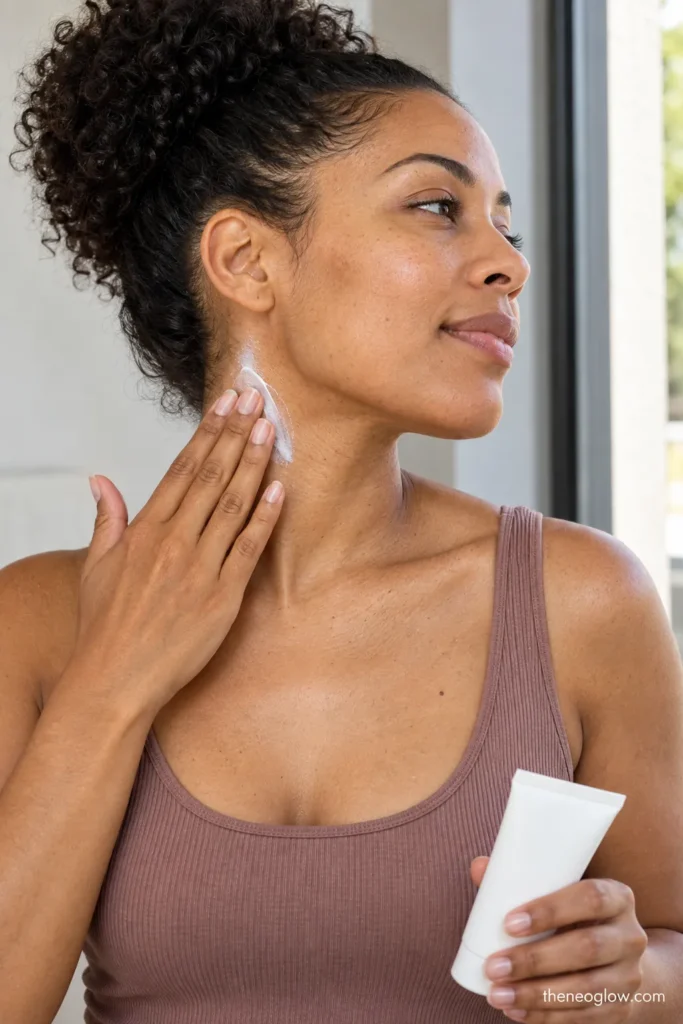
Correct coverage is one of the most important parts of sunscreen use. The FDA advises applying sunscreen about 15 minutes before sun exposure and using enough to cover exposed skin. For an average adult, its general guidance uses about one ounce for the face and body together.
The AAD’s current application guidance similarly says most adults need about one ounce for skin not covered by clothing. It also emphasizes easy-to-miss areas such as the ears, neck, tops of the feet, hairline, exposed scalp, and lips with an appropriate SPF lip product.
- Face: spread sunscreen evenly rather than concentrating it only on the center of the face.
- Neck and ears: include them when they are exposed instead of treating facial sunscreen as the whole job.
- Hairline and exposed scalp: protect exposed skin rather than stopping at the forehead.
- Hands, feet, shoulders, and legs: include any area not covered by clothing.
If the sunscreen label gives product-specific application instructions, follow those directions. For the current dermatology application checklist, use the AAD guide to applying sunscreen.
Reapply based on exposure, water, sweat, and the label
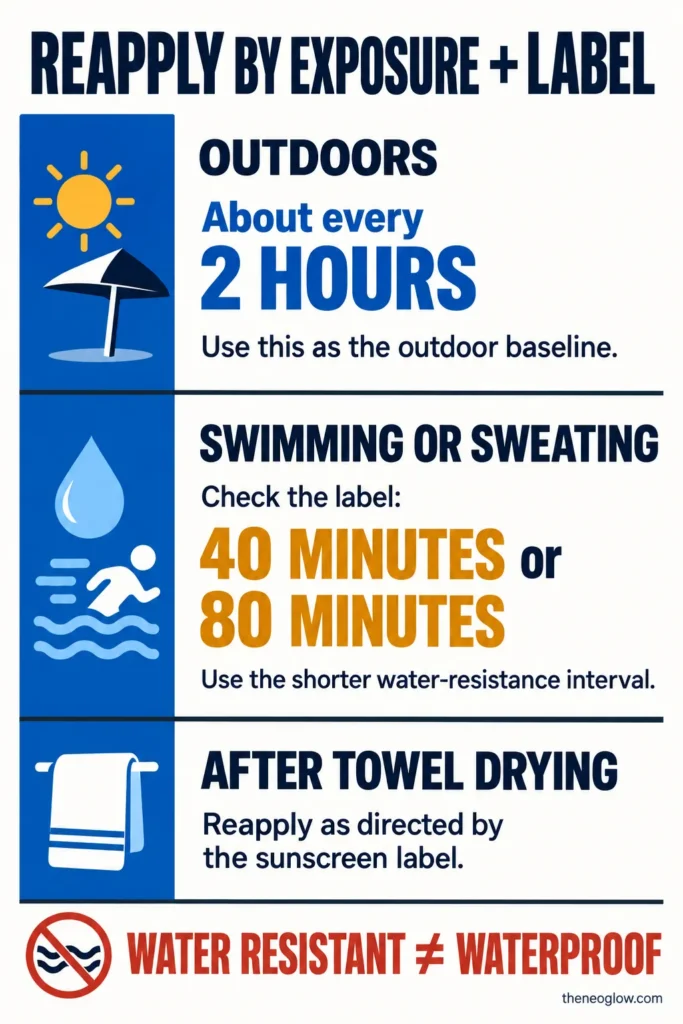
When you are outdoors, the AAD recommends reapplying sunscreen about every two hours and after swimming or sweating. FDA consumer guidance also says to reapply at least every two hours and more often when swimming or sweating.
Water-resistant products give you an additional label cue: 40 or 80 minutes of water resistance. That does not mean you can ignore the two-hour rule for a long outdoor day, and it does not make a sunscreen waterproof.
For outdoor time, use the two-hour guidance as your baseline. If you are swimming or sweating, use the shorter water-resistance interval and the product’s specific reapplication directions.
Do not let “mineral versus chemical” become the whole decision
Sunscreens can use different active ingredients, and the available U.S. ingredient landscape can change as FDA rules change. For a practical everyday purchase, you do not need to choose a universal winner by ingredient family before you have checked the protection and usability basics.
If you prefer a mineral formula, a chemical formula, or a hybrid format because of feel, white cast, eye comfort, or personal preference, that can be a reasonable filter. The product still needs to meet your protection criteria, and you still need to use it correctly.
This article is not an ingredient-safety debate or a product ranking. It is a decision guide for choosing a tested sunscreen you can use consistently.
Skip homemade sunscreen, even when the recipe sounds precise
DIY sunscreen is not a safe substitute for a tested commercial sunscreen. The American Academy of Dermatology states that homemade sunscreens are not proven effective and do not go through the testing required of commercial sunscreens, so their SPF, water resistance, shelf life, and batch-to-batch performance cannot be guaranteed.
That means the Pinterest terms “DIY sunscreen lotion” and “DIY sunscreen natural” belong here only as safety education. This article will not give a recipe, a zinc-oxide percentage, or a method for turning moisturizer, oil, butter, or another homemade mixture into SPF.
If you want the source behind that boundary, read the AAD’s homemade-sunscreen safety statement.
Common sunscreen mistakes are usually use problems, not shopping problems
- Choosing a high SPF but skipping broad-spectrum protection.
- Applying only a thin cosmetic layer because the formula feels heavy.
- Forgetting ears, neck, hairline, hands, feet, or other exposed areas.
- Treating “water resistant” as “waterproof.”
- Reapplying only after the skin already feels hot or looks red.
- Relying on a light makeup layer instead of making sunscreen the dedicated final skin care step before makeup.
- Trying to fix an unpleasant formula by diluting or mixing it into another product.
- Using an expired or very old sunscreen without checking the label or purchase date.
If your main difficulty is that your whole routine feels crowded, the broader Skin Care guide can help you return to the essential jobs before you add more products.
What to realistically expect from daily sunscreen
Sunscreen is not a promise that you will never tan, burn, develop visible aging, or have a skin problem. It is one part of sun protection, alongside measures such as shade, clothing, hats, and sunglasses when appropriate.
The practical goal is repeatable protection: a product that meets the label criteria, feels acceptable enough to use, and is applied and reapplied correctly for the situation. That is a more useful standard than chasing the newest filter, highest number, or most viral finish.
The simplest sunscreen rule to keep
Choose broad-spectrum, water-resistant SPF 30 or higher, then choose the format you can use correctly. Apply it as the final morning skin care step before makeup, cover every exposed area, and reapply according to outdoor exposure and the product label.
Skip homemade SPF and do not alter a tested sunscreen to make it feel more convenient. Once sunscreen itself is clear, your next step is simply fitting it into a routine you can repeat. If you want that full sequence, continue with the morning and night Skin Care Routine guide.