A good shower routine is mostly about order, not the number of products you use. On an ordinary day, keep it simple: use warm rather than very hot water, cleanse where you need it, add exfoliation only when your skin tolerates it, shave near the end if you shave, rinse well, then moisturize while your skin is still slightly damp.
You do not need to turn every shower into an “everything shower.” A longer routine can be useful when you want time for optional steps, but your everyday sequence should still work when you only have a few minutes.
The shower order to remember
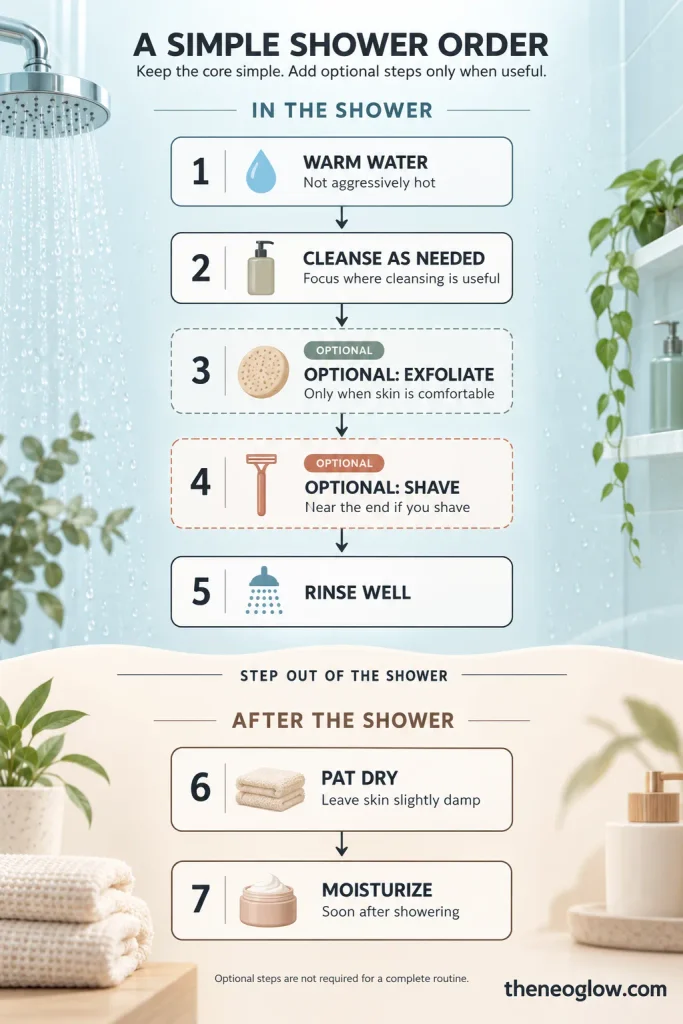
- Start with warm water.
- Cleanse gently where sweat, odor, sunscreen, or visible buildup makes it useful.
- Exfoliate only if you chose an exfoliation step that day and your skin feels comfortable.
- Shave near the end of the shower if you shave.
- Rinse thoroughly.
- Pat dry instead of rubbing, leaving skin slightly damp.
- Apply moisturizer soon after you get out.
If dry skin is a recurring problem, the American Academy of Dermatology recommends keeping showers to about five to ten minutes, using warm water, cleansing gently, and moisturizing while skin is still damp. Its dry-skin bathing and moisturizing guidance is a useful reference when your skin tends to feel tight, rough, or itchy after bathing.
This page owns the practical shower sequence. For the broader question of which body-care categories are actually useful, including lotion, cream, body butter, oil, and exfoliation, use the Body Care guide.
Step 1: Keep the water comfortable, not aggressively hot
Very hot water may feel relaxing, but it can make dry skin feel worse. You do not need a cold shower for good skin care. Warm water is the more practical baseline, especially if your skin often feels tight after bathing.
If your skin is already dry, a shorter shower is usually a better experiment than adding more products afterward. Start by reducing heat and time before building a more complicated routine.
Step 2: Cleanse for a reason
Body cleanser is there to remove sweat, dirt, sunscreen, excess oil, odor, and everyday buildup. It does not need to create a thick lather over every inch of skin to be useful.
Focus on the areas that actually need cleansing and rinse well. If your body wash repeatedly leaves your skin tight, hot, itchy, or “squeaky,” a gentler cleanser or less aggressive washing is a more useful change than trying to compensate with multiple post-shower products.
If your skin is dry or easily irritated, fragrance-free formulas may be easier to tolerate. “Fragrance-free” and “unscented” are not necessarily the same label claim, so check the package rather than choosing by scent alone.
Step 3: Treat exfoliation as optional
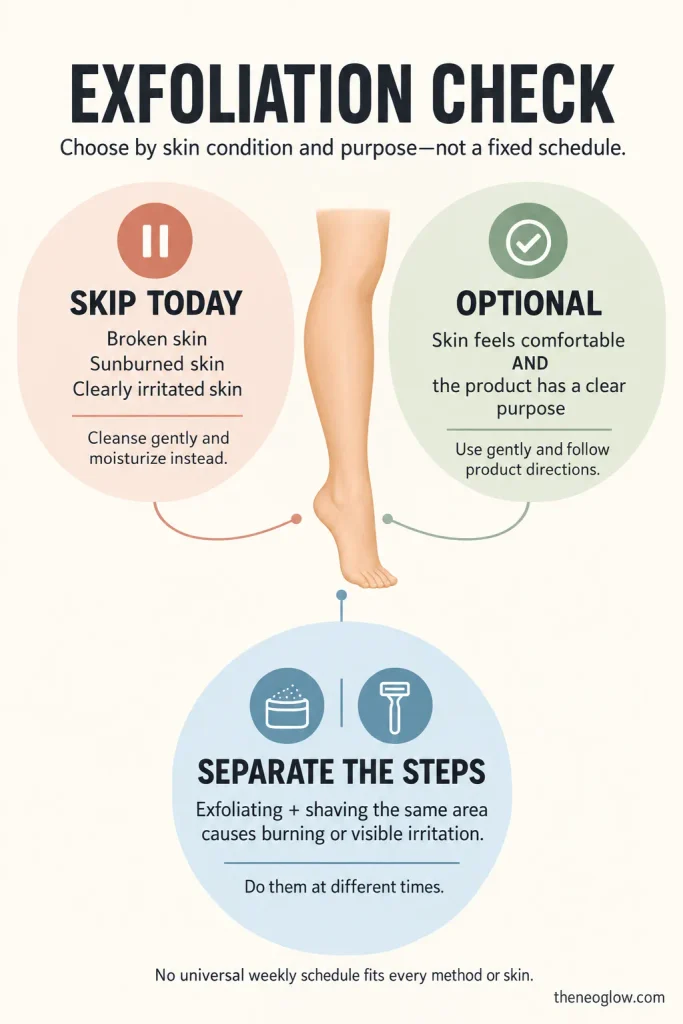
You do not need to exfoliate in every shower. Scrubs, exfoliating tools, and chemical exfoliants can all become irritating when the method is too aggressive or the schedule is too frequent.
The American Academy of Dermatology’s safe exfoliation guidance recommends choosing the method according to your skin and the products you already use. It also advises gentle pressure, lukewarm water, moisturizing afterward, and avoiding exfoliation over open cuts, wounds, or sunburned skin.
There is no universal “two or three times a week” rule that fits every scrub, acid, tool, or skin type. Follow the directions for the product you use and let your skin’s response control the schedule. If an area becomes increasingly red, dry, sore, or stingy, pause exfoliation rather than pushing through it.
If your routine already feels irritated or overloaded, the site’s Skin Barrier Mistakes guide is a better next step than adding another smoothing product.
Step 4: If you shave, place it near the end
Shaving does not have to be part of every shower, but when you do shave, placing it later in the routine gives water time to soften the hair and skin first. The AAD’s shaving guidance recommends wetting skin and hair before shaving, using a shaving cream or gel, shaving in the direction the hair grows, and storing the razor in a dry area between uses.
Keep this step separate from the idea that more exfoliation automatically creates a closer shave. If scrubbing and shaving the same area in one routine leaves it burning or visibly irritated, separate those steps instead of adding more friction.
Step 5: Rinse, pat dry, and moisturize promptly
When you finish, rinse away cleanser, scrub, shaving product, and any other rinse-off product completely. Then pat your skin dry rather than rubbing it hard with a towel.
If your skin is prone to dryness, apply moisturizer while it is still slightly damp. You do not need to wait until every trace of water has evaporated. This makes the shower and moisturizer one continuous routine instead of two unrelated tasks.
Choose the lightest texture that leaves your skin comfortable enough to use consistently. A lotion may feel practical in warm weather or on normal-feeling skin, while a richer cream or ointment-style moisturizer can feel better on drier areas. You do not need lotion, body butter, and oil at the same time just because a longer routine online uses all three.
Quick shower or full routine?
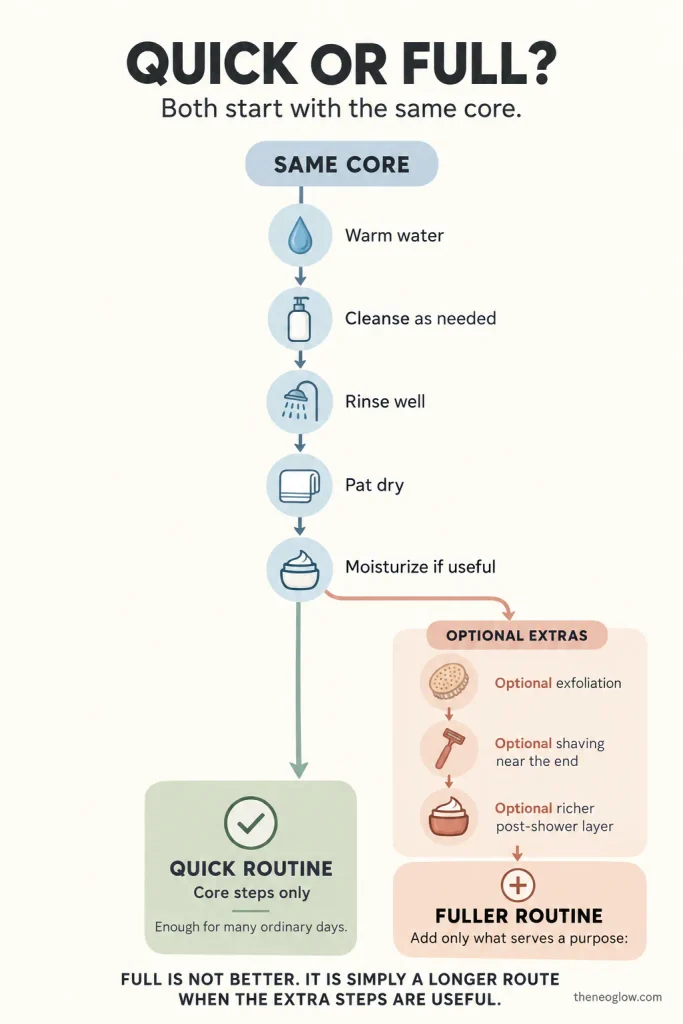
| Routine | In the shower | After the shower | Best for |
|---|---|---|---|
| Quick everyday shower | Warm water, gentle cleansing where needed, thorough rinse | Pat dry and moisturize if your skin benefits from it | Ordinary days, exercise cleanup, busy mornings or evenings |
| Full shower routine | Warm water, cleansing, optional exfoliation, shaving near the end if desired, thorough rinse | Pat dry, moisturize while skin is slightly damp, add a richer layer only if useful | Days when you want optional grooming or smoothing steps without making them daily requirements |
A full routine should still have a reason for each step. “More” is not the goal. If your skin feels better with cleansing and moisturizer alone, that is a complete shower routine.
What to skip when your skin feels irritated
When skin feels unusually tight, raw, stingy, or visibly irritated, simplify before adding. Skip optional scrubs and exfoliating tools, avoid very hot water, use a gentler cleanser, and moisturize promptly after bathing.
Do not exfoliate over broken or sunburned skin. Stop using a product that causes significant burning, swelling, blistering, or worsening irritation. Persistent dryness despite gentle self-care, or products that repeatedly cause burning or stinging, deserves professional evaluation rather than a more complicated shower routine. Mayo Clinic also advises seeking medical care when dry skin becomes inflamed or painful, disrupts sleep or daily life, develops open sores or infection, or causes large areas of peeling; its dry-skin guidance explains those thresholds in more detail.
Where an “everything shower” fits
An everything shower is best treated as an occasional longer version of the same basic framework, not a separate standard you have to meet. The useful foundation does not change: cleanse gently, keep optional irritation-prone steps truly optional, rinse well, and moisturize after.
If a longer routine includes hair care, shaving, exfoliation, masks, or other grooming steps, add them because they serve a clear purpose, not because every category has to appear in one session. Your regular shower should still be easy to repeat when you skip all of the extras.
The easiest shower routine to keep
For most ordinary days, remember one line: warm water, gentle cleansing, optional exfoliation, shaving near the end if needed, rinse, pat dry, moisturize.
If you want to decide which body-care products are worth adding beyond that sequence, continue with the Body Care guide. If you want to simplify your wider face-and-body approach, the broader Skin Care guide explains how to give every product a clear job before adding it to your routine.