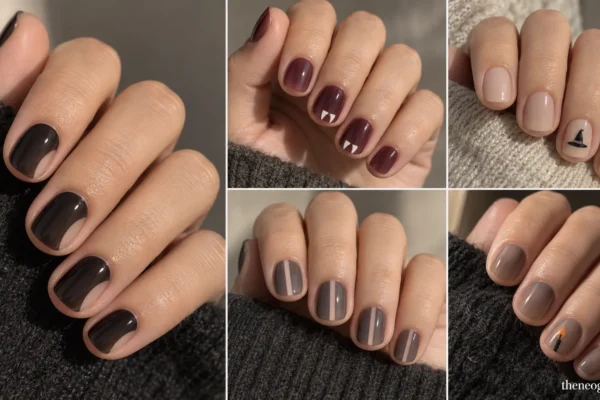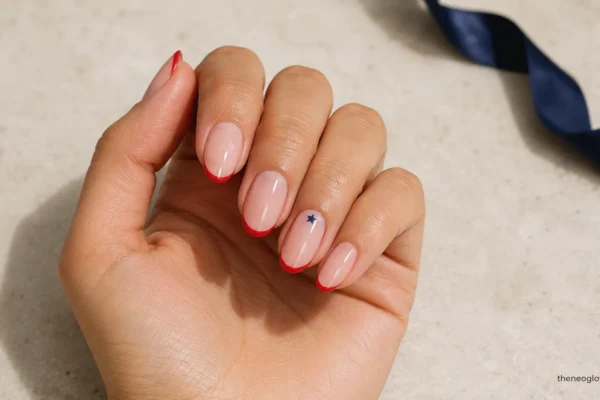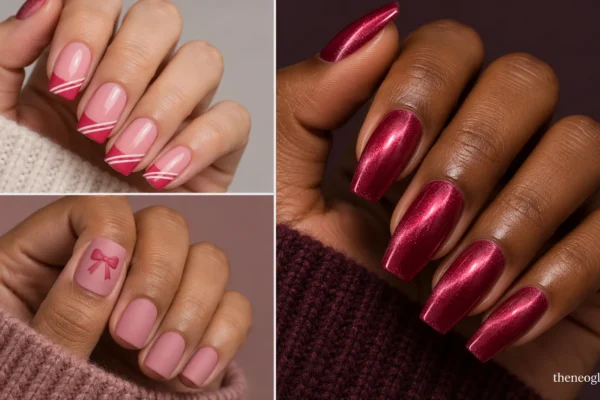
Almond nail designs only work when the shape underneath them is believable. A true almond needs enough free edge to narrow toward a rounded center peak; if the nail is too short to taper without removing supported width, the better answer may be oval for now or an appropriately fitted extension. This guide puts structure before decoration. You’ll compare soft and tapered almond shapes, short and medium lengths, natural nails and extensions, French-tip scaling, and design placement so you can save a reference that matches the nails you can actually wear.
What Makes an Almond Nail Actually Almond?
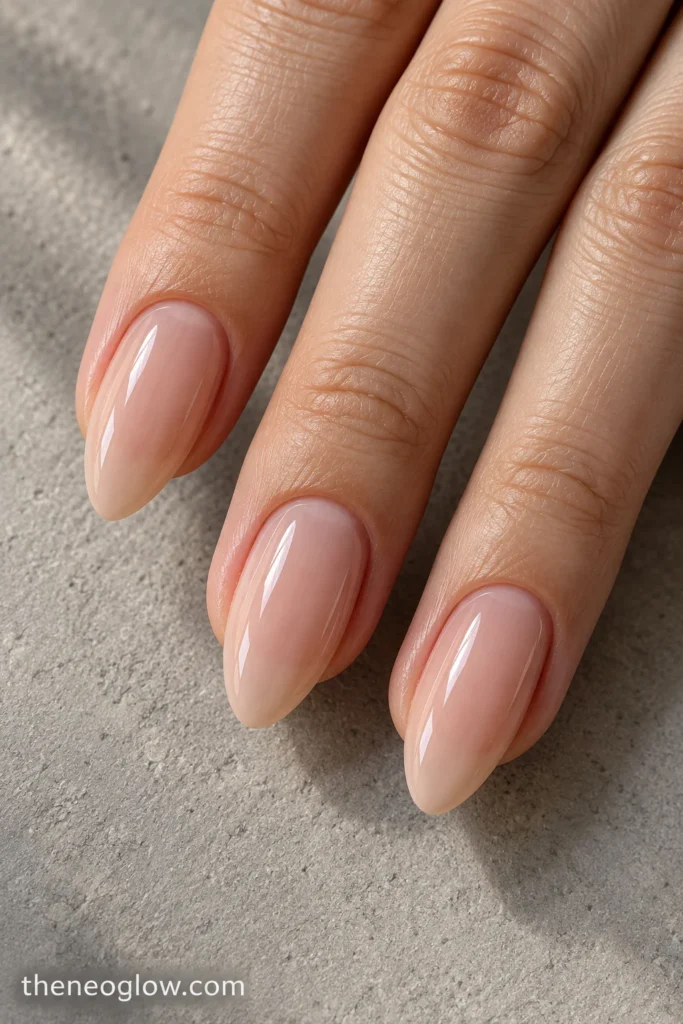
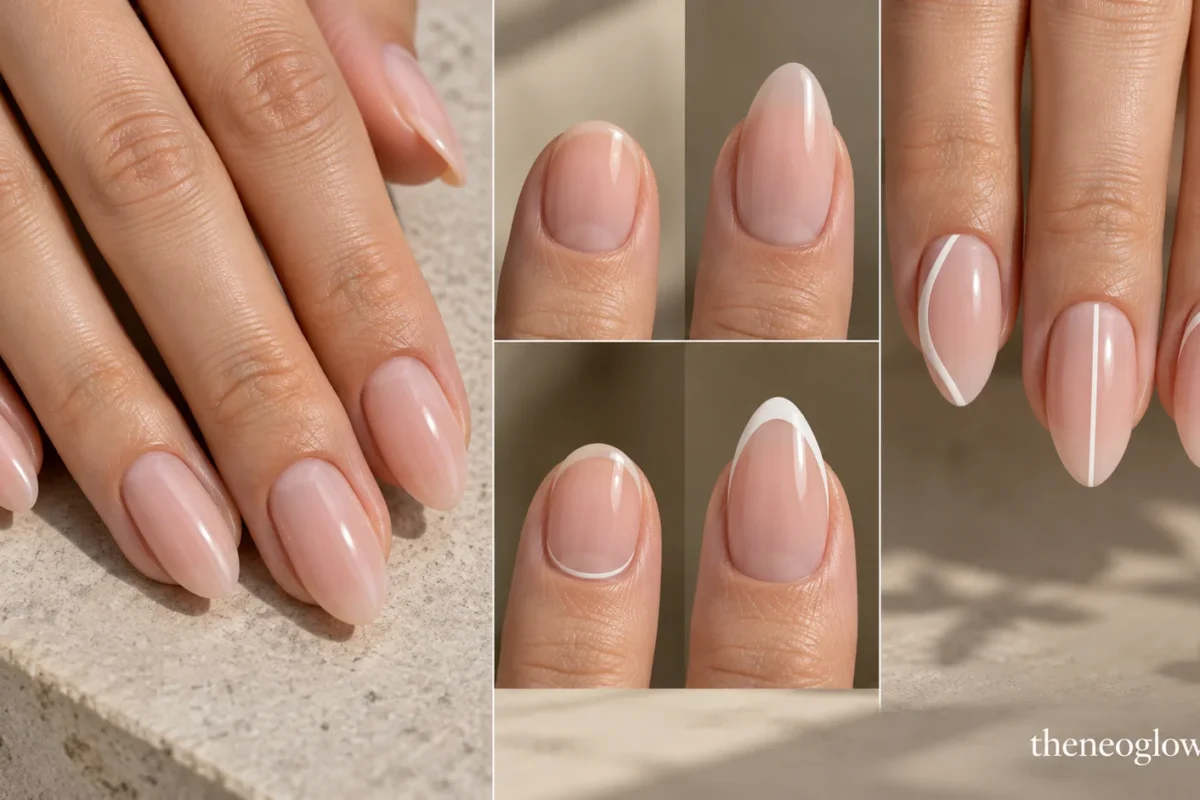
An almond nail is narrower through the free edge than it is through the nail bed, with both sides moving toward a centered, rounded peak. The point should be softened. If the tip becomes needle-like, the silhouette is moving toward stiletto; if the sides barely narrow and the end stays fully rounded, it reads closer to oval.
That distinction matters because “almond” is not just a decorative label. The taper needs physical space. OPI’s professional shaping guide describes almond as a shape suited to medium-to-long nails and shows the sides being angled before the free edge is narrowed and rounded into a peak.
If you are deciding among several shapes rather than committed to almond, NeoGlow’s Best Nail Shape for Short Nails guide compares square, squoval, oval, and almond based on free edge and nail structure. Use that comparison first when your main question is which outline is realistic, not how to design an almond once you have it.
Soft almond vs. tapered almond
A soft almond keeps more width through the upper sidewalls and finishes with a broader rounded peak. It is the more realistic natural-nail route when your free edge is visible but still compact.
A tapered almond narrows more noticeably and ends in a slimmer rounded peak. It usually needs more length because the transition from full nail-bed width to a narrow tip has farther to travel. The goal is not to make every almond as thin as possible; it is to create an even taper without turning the result into a point.
Choose the Length Before You Choose the Design
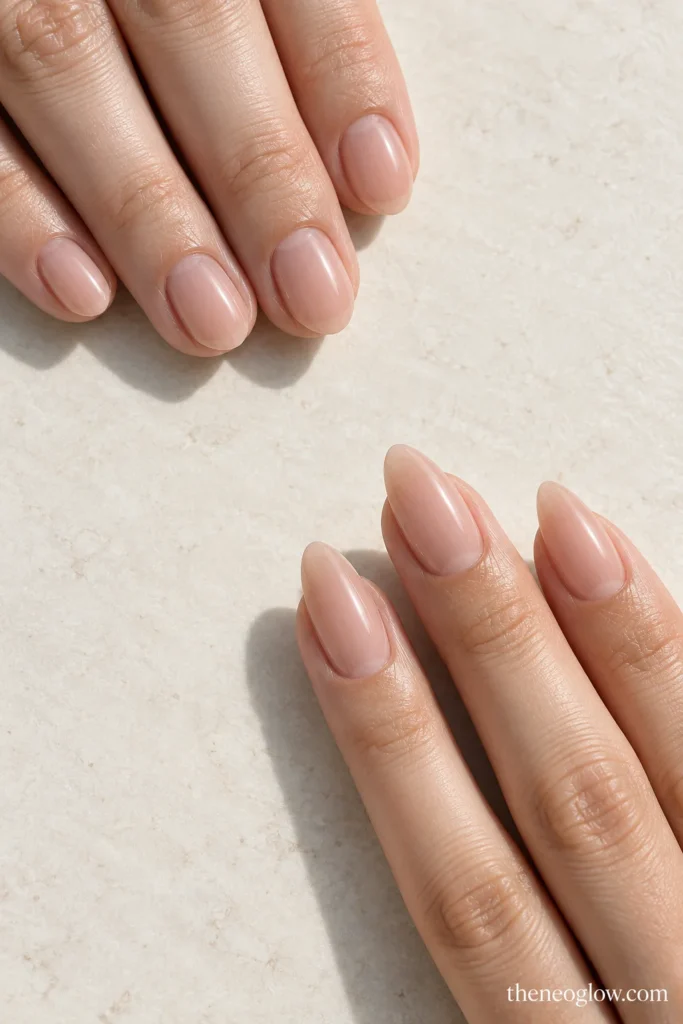
Length controls how much taper and artwork an almond can carry. It also changes how much nail extends beyond the fingertip, which affects how the manicure feels in daily use.
| Almond route | What the shape needs | Design space | Practical decision |
|---|---|---|---|
| Short natural soft almond | A visible free edge and enough width to taper only near the tip | Micro French, side detail, cuticle accents, simple solids or sheers | Best when you want the almond effect without much projection beyond the fingertip |
| Medium natural almond | More free edge for a clear, symmetrical taper | Classic or deeper French, gradients, chrome, larger negative space, flowing linework | Best when you can maintain length and want the design to follow a stronger almond silhouette |
| Almond extension | A correctly chosen and professionally or manufacturer-applied system that creates the needed length | The most freedom for deep French, layered art, and stronger taper | Best when your natural nail is too short for the silhouette and you accept the added application, maintenance, and removal commitment |
Do not treat “short almond” as a fixed measurement. Nail beds vary. One person can create a restrained almond with a modest free edge, while another nail may still read oval at the same visible length because there is not enough room to narrow both sides evenly.
How Short Can Almond Nails Be?
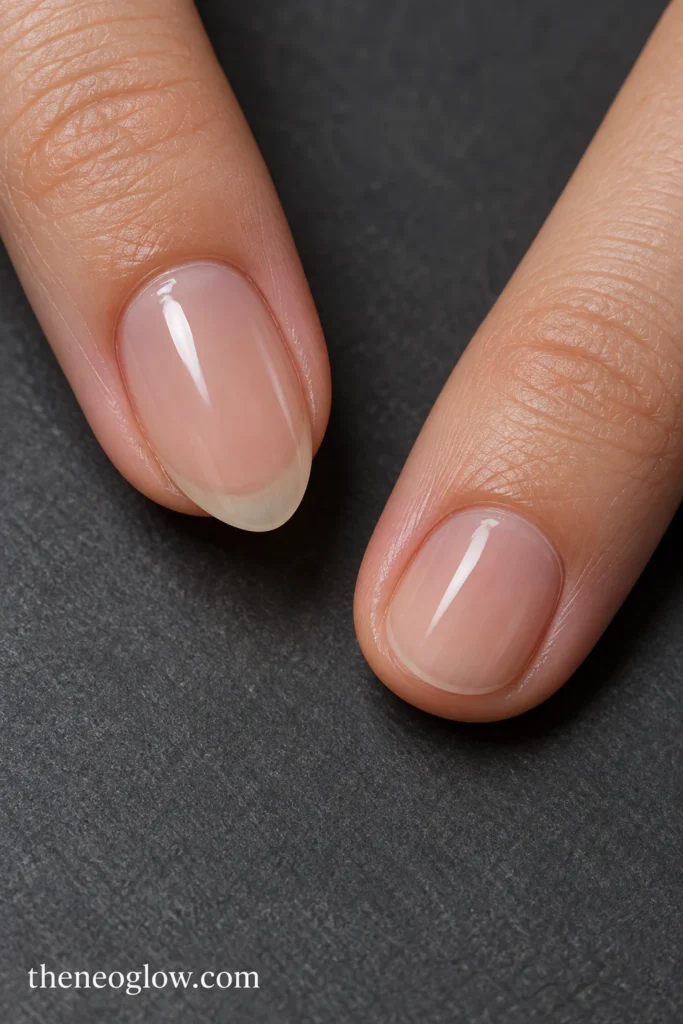
Short almond nails are possible when the taper begins in the free edge rather than by carving inward through the attached sides of the nail. Look straight down at the nail and ask whether both edges can move toward the center after they pass the fingertip.
If the nail ends almost flush with the fingertip, a rounded or oval shape is usually more honest. Forcing a sharp “almond” at that stage can leave the tip pinched or remove width from areas that are still supporting the nail.
A useful test is to imagine the centerline first. The rounded peak should sit on that line, and each side should approach it at a similar angle. If reaching that center would require deep filing into one or both supported sides, stop and keep a softer outline while the nail grows.
Technical nail education from NailKnowledge cautions against over-filing the sidewalls because reducing supported plate width can compromise strength and excessive filing can abrade nearby skin. That is another reason to let available free edge—not a saved photo—set the limit.
Natural Almond Nails vs. Extensions
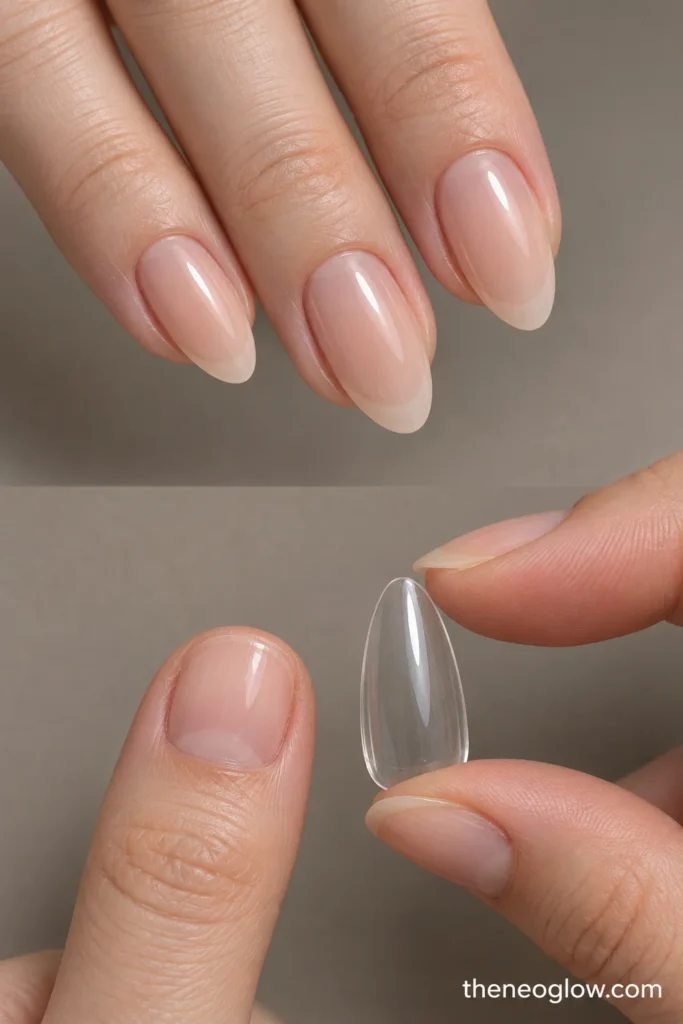
Natural almond nails make sense when you already have enough free edge for a taper and prefer to work with your own length. The tradeoff is that your shortest nail can limit the full set, and a chipped corner may require shortening or softening the shape rather than chasing the original taper.
Extensions can create an almond silhouette when the natural nail is too short to support one. They also add system-specific preparation, upkeep, and removal. The American Academy of Dermatology notes that artificial nails can involve surface preparation and removal methods that may leave natural nails thinner or more brittle, and repeated maintenance can add further stress.
That does not make extensions automatically wrong. It means “I want almond” and “I want natural nails only” are separate decisions. If shape is the priority, discuss the shortest extension that gives you a real taper. If preserving natural length is the priority, accept a softer oval or soft-almond stage until there is enough free edge.
For deeper health-focused guidance before choosing an artificial-nail route, the AAD’s artificial-nail guidance is a useful reader resource.
Match French Tips to Almond Length
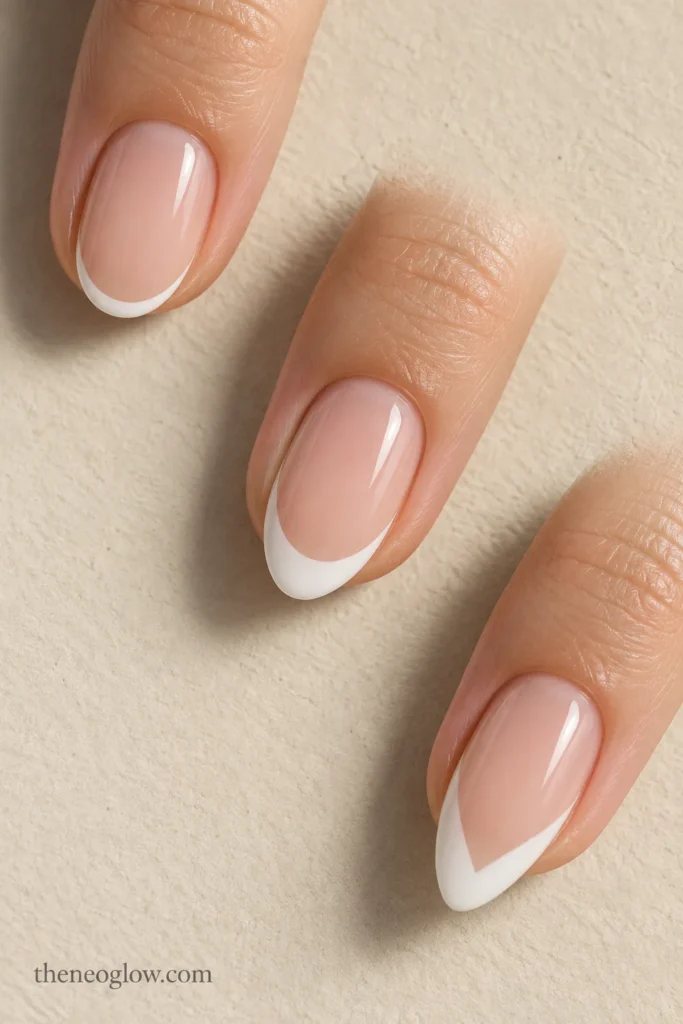
Almond French tip nails look most convincing when the smile line supports the taper instead of fighting it. The shorter the almond, the less room there is for a deep band.
Short soft almond
Use a micro or shallow classic French. Keep enough sheer or base color visible that the tip does not consume the small free edge. A gentle curve that follows the rounded peak usually reads cleaner than an exaggerated V.
Medium almond
You have room for a classic, deep, side, double, diagonal, or chrome French without crowding the nail. A deeper smile line can travel farther down the sides because the nail has enough length to preserve visible base above it.
More tapered almond
Directional French structures can emphasize the centerline, but keep the actual nail peak rounded. A V-like or diagonal design can look sharp without requiring the nail itself to become stiletto-shaped.
NeoGlow’s French Tip Nails guide owns the full comparison of micro, classic, deep, side, double, diagonal, chrome, and negative-space French structures. Use that page once you know your almond length and want to choose the tip architecture.
Place the Design Where the Shape Has Room
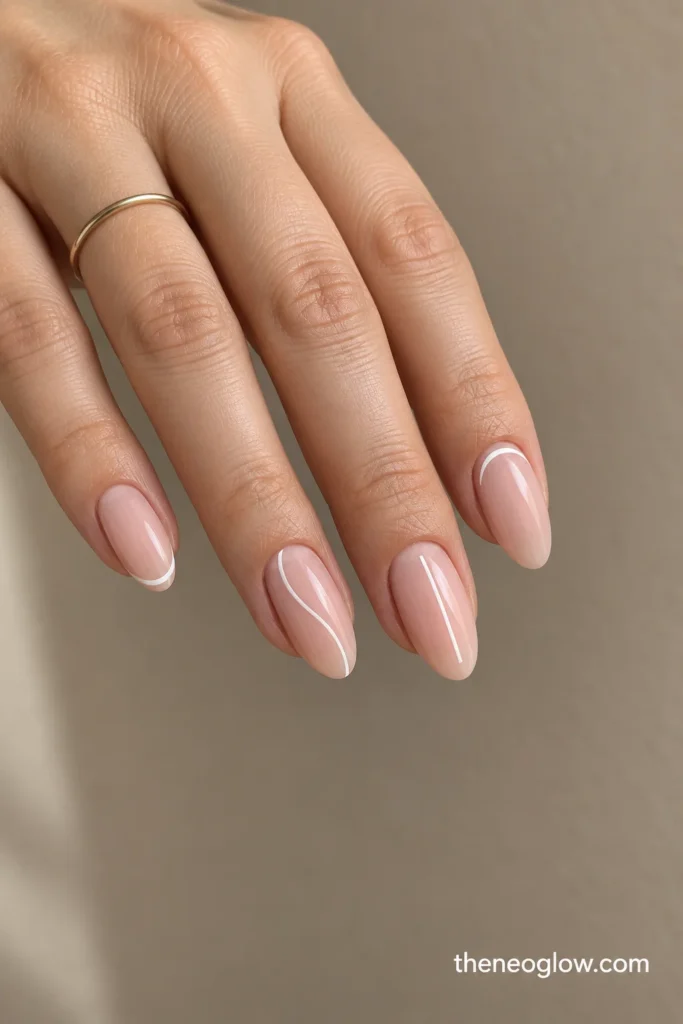
The strongest almond nail designs use the taper as part of the composition. Instead of asking which color is “best” for almond nails, decide where the design should sit.
| Design placement | Short soft almond | Medium almond | Why it fits |
|---|---|---|---|
| Tip-led | Micro French, narrow outline, shallow color edge | Classic or deep French, double edge, chrome tip | The tip naturally follows the narrowing silhouette |
| Side-led | One slim side curve or partial French | Layered side lines, diagonal sweep, asymmetric negative space | The outer edge can echo the taper without crowding the center |
| Center-led | Fine vertical line or small centered accent | Aura, gradient, reflective center, longer linework | A centered composition reinforces the almond’s long axis |
| Cuticle-led | Small arc, cuff, dot cluster, low half-moon | Larger curved base detail with open tip | It preserves the free edge when the almond is short |
| Full-surface | Solid color, sheer, jelly, restrained shimmer | Chrome, cat-eye, ombré, larger pattern fields | More length gives reflective or blended finishes room to develop |
If you want low-detail artwork after choosing the shape, keep the same placement logic: one clear focal zone, enough open space for the taper to remain visible, and detail scaled to the length you actually wear. For color-first decisions, NeoGlow’s Nail Colors 2026 guide compares shade families and finishes without turning shape into the main topic.
Use Shape to Edit the Design, Not Just Hold It
Short almond nails need editing. A flower that fills half of a medium almond may need to become one cropped petal cluster on a shorter nail. A deep French may need to become a micro tip. A three-color gradient may work better as two colors if the transition area is too small.
Medium almond nails give you more vertical distance, but that does not mean every design should become busier. Leaving some base visible can make the taper easier to read. Long lines, side sweeps, and gradients often look more deliberate when they move with the centerline instead of cutting straight across the widest part of the nail.
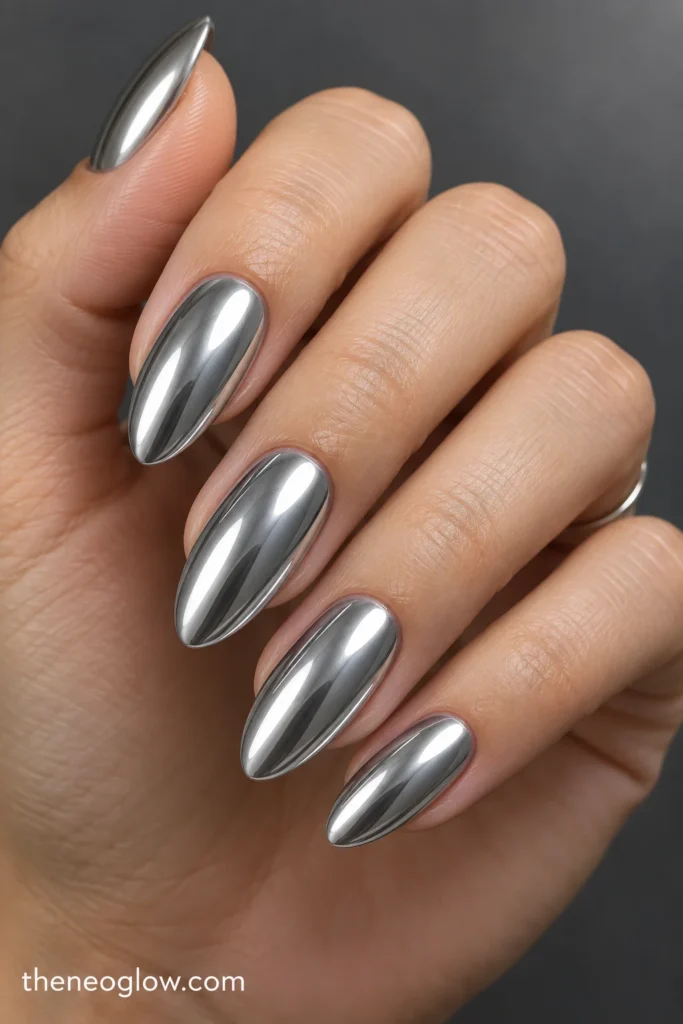
Reflective finishes also change with surface area. Chrome, magnetic effects, pearl, and shimmer can become the design by themselves, which is useful when you want the shape to stay visually clear instead of hiding it under motifs.
A Better Salon Request for Almond Nails
Describe the structure first, then the decoration.
For a short natural soft almond, try: “Keep the free edge compact. Start the taper only where the nail is unsupported, keep both sides even, and finish with a broad rounded center peak rather than a point.”
For a medium almond, try: “I want a balanced almond with the centerline aligned to each finger, an even taper on both sides, and a rounded peak. Keep the nails medium rather than extending them into a long stiletto shape.”
If you need an extension, ask for the shortest almond length that creates a clear taper, then confirm the exact product system and its maintenance and removal requirements before the service.
When shaping at home, use a visual method rather than guessing from one angle. OPI’s professional nail-shaping tutorial shows almond from the side edges through the final rounded peak and reminds you to check symmetry from multiple views.
Choose Your Almond Route in the Right Order
Start with free edge and structure. If you have enough natural length, decide whether you want a soft or more tapered almond. If you do not, choose between growing into the shape and using an appropriate extension rather than forcing the sides inward.
Then choose length, French depth or another design placement, and finish. Color can come last because it changes the mood, not the geometry.
The most useful almond reference is not necessarily the prettiest photo in your saved board. It is the one whose length, taper, and design scale match the nails you plan to wear. Save one realistic shape reference first, then add a separate French, color, or seasonal reference only after the structure is settled.