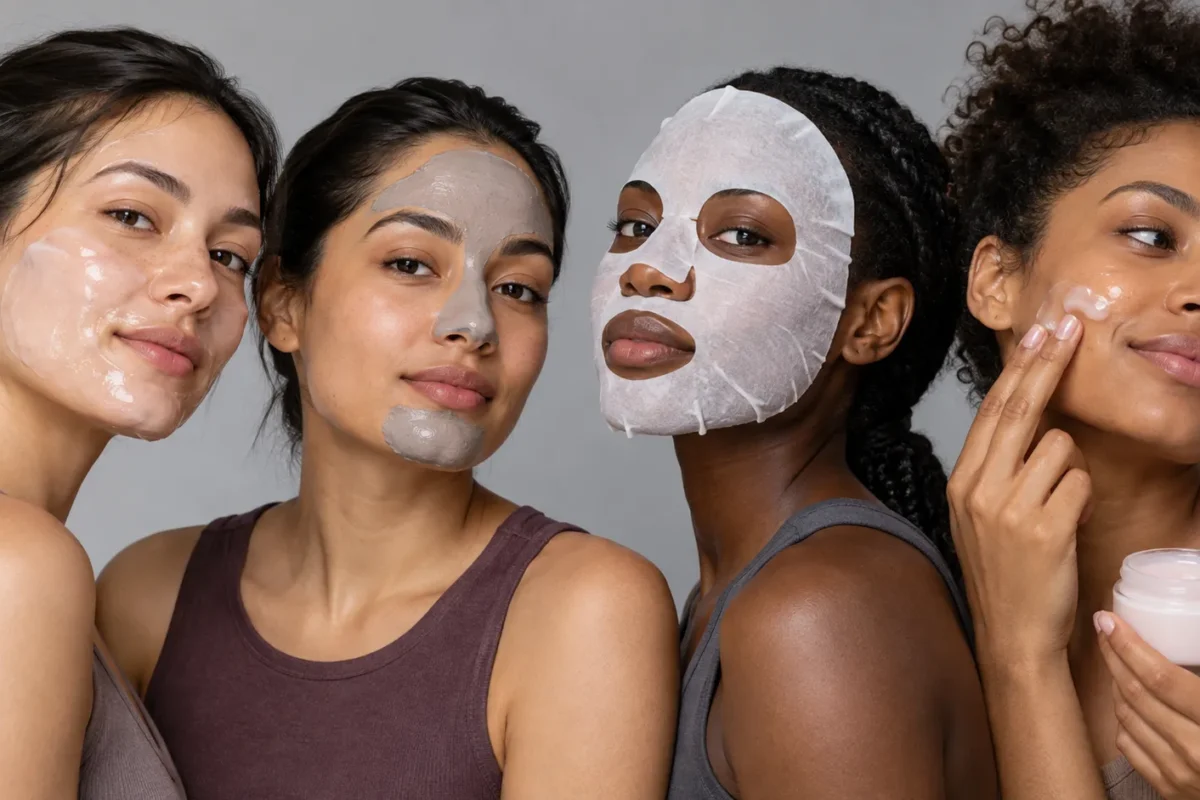
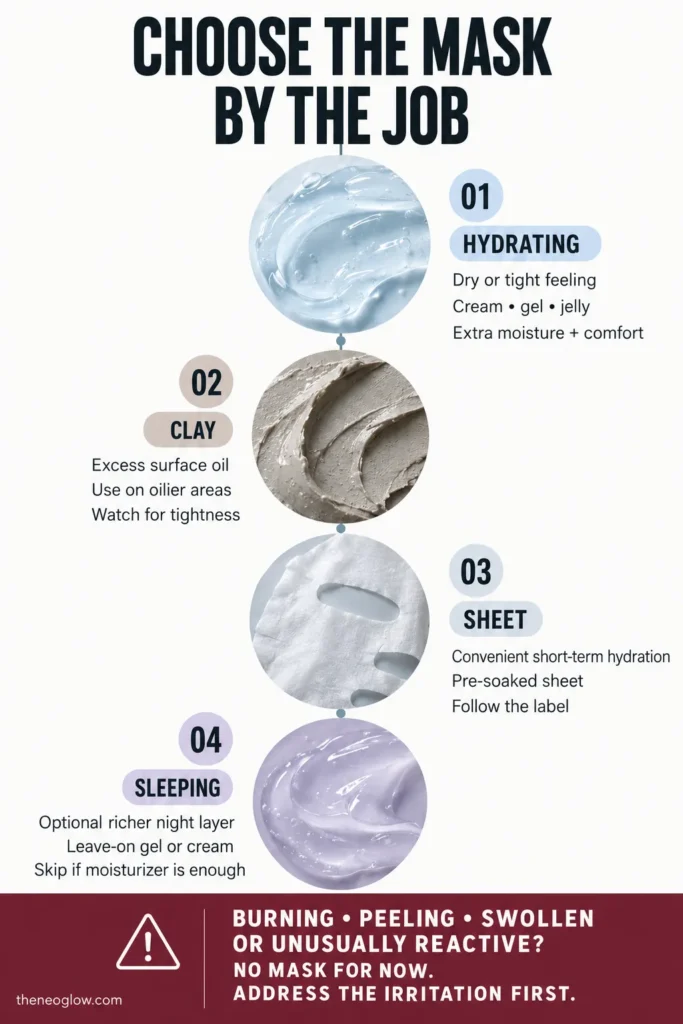
A face mask is an optional skin care extra, not a step everyone needs. The useful question is not “Which mask is best?” but “What job do I want this mask to do right now?” Hydrating masks are mainly about temporary comfort and moisture, clay masks are better suited to managing surface oil, sheet masks give short-term hydration through a pre-soaked layer, and sleeping masks are leave-on night products that can add a richer final layer.
If your basic routine already keeps your skin comfortable, you can skip masks entirely. If you do want one, choose the format and ingredients around your current need, then follow the product directions instead of copying a universal mask schedule.
Quick answer: choose the mask by the job
| If your main goal is… | Start with… | Watch for… |
|---|---|---|
| Dry, tight, or temporarily dehydrated-feeling skin | Hydrating cream or gel mask | Fragrance, strong exfoliating acids, or a formula that stings |
| Excess surface oil or shine | Clay mask, especially on oilier areas | Over-drying, tightness, or “detox” and pore-erasing claims |
| A convenient short-term hydration step | Sheet mask | Leaving it on longer than directed or layering it with irritating actives |
| A richer final step at night | Sleeping mask | Using it when your normal moisturizer already feels heavy enough |
| Skin that is burning, peeling, swollen, or unusually reactive | No mask for now | Simplify the routine and address the irritation first |
The American Academy of Dermatology’s facial-mask guidance makes the same basic point: masks can be useful for selected concerns, but they do not replace cleansing, moisturizing, sun protection, or medical treatment when a skin condition needs care.
Hydrating masks are the simplest place to start for dryness or tightness
A hydrating mask usually comes as a cream, gel, jelly, or similar formula designed to sit on the skin for a short period before rinsing or removing it. This family makes the most sense when your skin feels dry, tight, or temporarily less comfortable and you want an extra moisture-focused step.
Look first at the ingredient list rather than the front-label promise. Humectant and barrier-supporting ingredients commonly used in hydrating masks include glycerin, hyaluronic acid, ceramides, and colloidal oatmeal. A mask does not need to contain all of them to be useful.
If your skin is easily irritated, a simpler formula may be a better fit than a mask that combines hydration with strong acids, retinoid-like claims, fragrance, essential oils, or multiple exfoliating ingredients. If your main issue is ongoing dryness rather than an occasional mask decision, the site’s hydration guide is the more useful next step.
Clay masks are for oil control, not “detoxing” your skin
Clay masks commonly use ingredients such as kaolin or bentonite and are marketed toward oily or combination skin. Their practical cosmetic role is to absorb some surface oil and reduce the greasy feel or shine that bothers you for a time.
That does not mean clay can pull “toxins” from skin, permanently shrink pores, or treat acne by itself. Those claims go beyond what this article should promise. Research on individual clay-mask formulas has reported changes in sebum and other skin measurements, but results from one formula do not prove that every clay mask performs the same way.
Use clay more cautiously if your skin already feels dry, tight, stingy, or over-exfoliated. Combination skin also does not require full-face clay. Applying a clay mask only to oilier areas can be a more comfortable option than drying out the whole face.
Sheet masks are mostly a delivery format for short-term hydration
A sheet mask is a fabric, cellulose, hydrogel, or similar sheet saturated with a liquid formula. The sheet keeps that formula in close contact with the skin, which is why sheet masks often feel especially hydrating while they are on.
The biggest mistake is assuming that longer wear must mean better results. In a randomized study of different sheet-mask formulas and wear times, longer application was associated with more dryness and redness in some participants. The useful takeaway is not a universal timer for every product; it is to follow the label and remove the mask when directed. You can read the sheet-mask duration study on PubMed.
After removing a sheet mask, gently pat or spread any remaining product only if the label supports that use. Do not assume the leftover essence needs to be layered with more actives. If your routine already includes retinoids, exfoliating acids, or other irritation-prone products, avoid doubling up on similar ingredients just because they also appear in the mask.
Sleeping masks are optional leave-on night products
A sleeping mask, sometimes called an overnight mask, is designed to stay on longer than a rinse-off mask. In practical routine terms, it often behaves like an optional richer final layer rather than a completely separate skin care requirement.
Choose one when you want a leave-on night format and your skin feels comfortable with the texture. Skip it when your regular moisturizer already gives you enough comfort or when the extra layer makes you feel greasy, congested, or irritated.
Because sleeping-mask formulas vary widely, do not assume they all belong on top of every treatment. Follow the product directions and keep prescription products or irritation-prone actives on their own instructions.
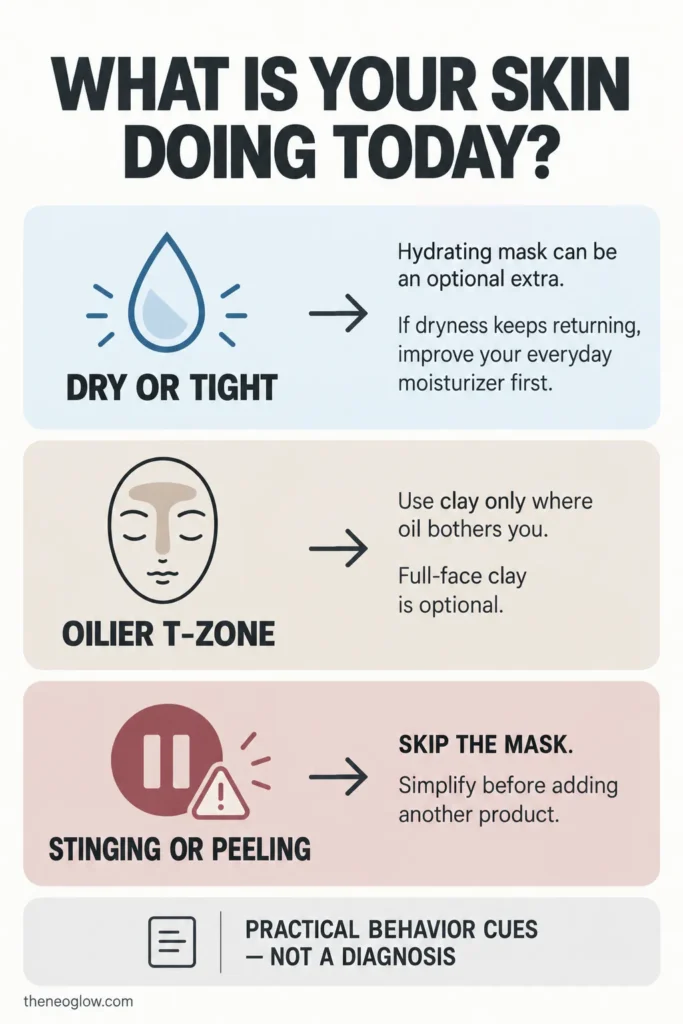
Use your skin’s current behavior to choose between formats
Broad skin-type labels can help, but what your skin is doing today is often more useful.
- If your skin feels dry or tight: start with a simple hydrating mask or skip the mask and improve your everyday moisturizer first.
- If your T-zone gets oily but your cheeks feel comfortable or dry: consider clay only on the oilier areas instead of using it full-face.
- If your skin is usually tolerant and you want a convenient hydration step: a sheet mask can be an easy occasional option.
- If your skin likes richer night textures: a sleeping mask may fit as an optional final layer.
- If products are suddenly stinging or your skin is peeling: skip masks and simplify. The skin barrier mistakes guide is a better troubleshooting path than adding another product.
How to fit a face mask into your routine
There is no single mask order that applies to every formula, so start with the label. For many rinse-off masks, the practical sequence is cleanse, use the mask as directed, rinse, then moisturize. Sheet masks and sleeping masks may have different instructions because they are leave-on formats.
Do not create a fixed weekly schedule unless the product directions support it. Some masks are gentle enough for more regular use, while others contain exfoliating or irritation-prone ingredients that need more restraint. Your tolerance matters too.
If you are unsure where a mask belongs beside your other products, use the site’s morning and night skin care routine guide to place the optional step without turning it into a requirement.
What to skip when shopping for a mask
- “Detox” claims that imply a mask is removing toxins from your body.
- Promises to erase pores or make skin permanently poreless.
- Claims that a mask can cure acne, eczema, rosacea, or another medical skin condition.
- Very strong exfoliating formulas when your skin is already dry, reactive, or using similar actives elsewhere.
- A mask that burns, stings, or causes significant itching just because the packaging says tingling is normal.
If you react easily to new products, the AAD recommends testing a small area before full use. Its skin care product testing guidance explains a cautious home test method and when a reaction deserves professional help.
A safe DIY note: keep recipes separate from mask-format selection
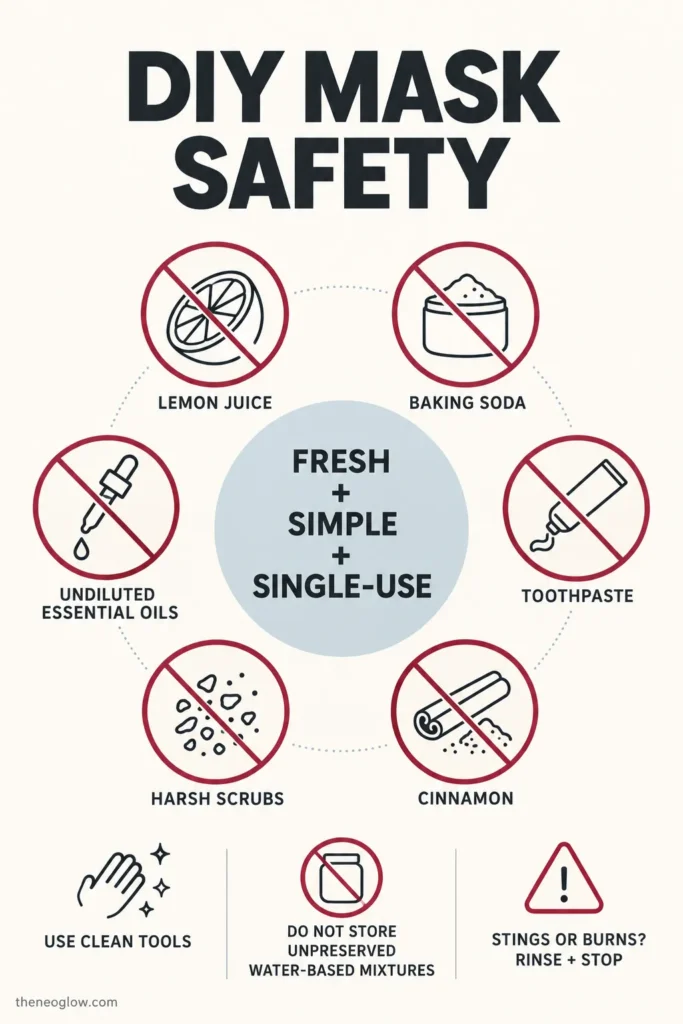
DIY masks are a different reader decision from choosing a commercial mask format, so this guide does not turn into a recipe list. If you want homemade options, use the dedicated DIY face mask guide instead.
Keep the safety boundary clear: avoid lemon juice, baking soda, toothpaste, cinnamon, harsh abrasive scrubs, undiluted essential oils, and other mixtures that sting or burn. Do not store unpreserved water-based homemade mixtures for later use. Make only what you need, use clean tools, and stop if the mixture causes discomfort.
When to stop masking and get help
Wash a mask off if you develop itching, burning, stinging, or rapidly increasing discomfort. Do not keep a mask on longer to “push through” a reaction.
Persistent or worsening redness, swelling, blistering, painful cracking, a spreading rash, signs of infection, or a skin problem you cannot identify is no longer a mask-selection question. Stop experimenting and seek qualified medical care.
The simplest face mask decision
Choose a mask only when it adds a clear job to your routine. Pick hydrating masks for extra moisture-focused comfort, clay for surface oil, sheet masks for a convenient short-term hydration format, and sleeping masks for an optional richer night layer. Skip the category completely when your normal routine already does what you need.
Once you choose a format, check the ingredient list, follow the label for application and frequency, and keep the rest of your routine simple. If you need help deciding where that optional step belongs, continue with the skin care routine order guide.