Plum nails can look almost black in dim light, glow purple in the sun, or turn soft and smoky with the right finish. The challenge is making sure the manicure you save actually reads as plum—not red burgundy, bright violet, or plain black—once it is on your own nails.
These 19 designs keep that wine-purple family at the center, but change the opacity, reflection, shape, and placement enough to give you real choices. You will find quick short-nail options, more expressive French tips, and reflective effects that still preserve the base color. The shade-and-finish comparison below helps you decide which direction fits your daily routine before you commit to a reference photo.
Find the Plum Shade and Finish That Match Your Plan
| Plum route | What it looks like | Good starting ideas | Visual upkeep tradeoff |
|---|---|---|---|
| Opaque cream or patent gloss | Clear purple-red pigment without visible nail underneath | 1–3 | Dark edges show light chips |
| Satin or matte | Muted reflection; pigment and shape become more noticeable | 3–5 | Rubbing can leave shinier patches |
| Jelly or syrup | Translucent layers with depth and some natural nail showing | 6–7 | Transparency varies with the underlying nail |
| Tonal art or French | Plum covers most of the nail or forms a deliberate high-contrast tip | 8–14 | Thin lines and tip edges need precision |
| Chrome or magnetic | Light moves across a visibly plum-colored surface | 15–18 | Reflective breaks and placement changes show in photos |
| Patterned plum | A plum base with restrained marks in related shades | 19 | More detail to maintain or recreate |
A plum swatch should show violet or blue-purple alongside its red component. Burgundy typically reads redder; aubergine is darker and often grayer. Test the reference in daylight, because a near-black screen photo can conceal the undertone. If brown rather than purple is what you keep gravitating toward, NeoGlow’s brown nails guide covers that neighboring color family without turning it into a second focus here.
Solid Plum Nails: From Patent Gloss to Matte
1. Black-Plum Patent Rounds
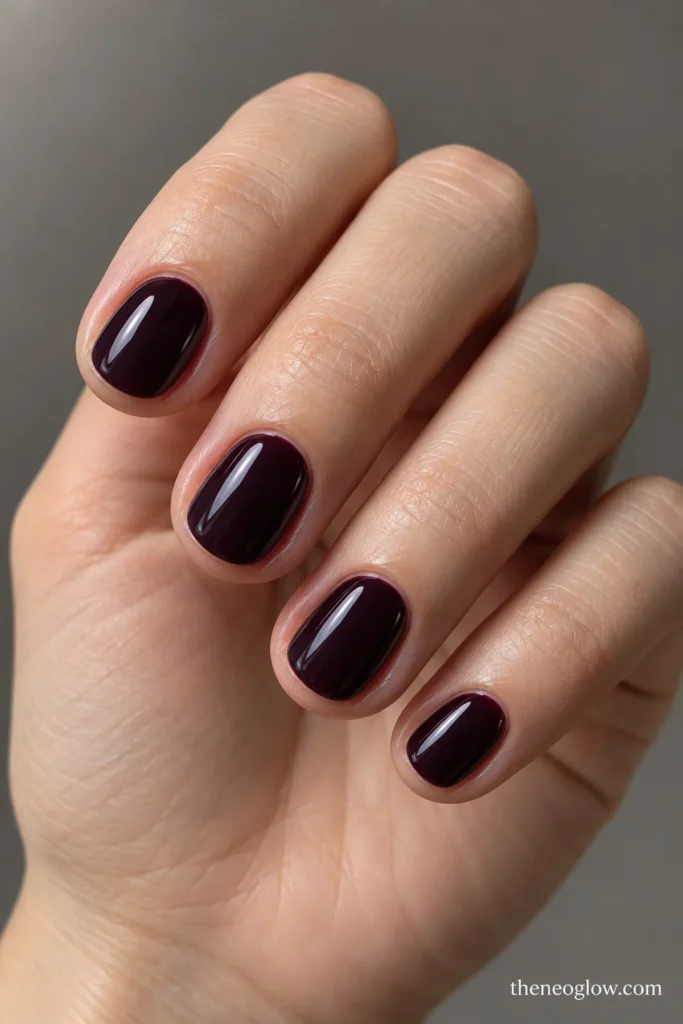
Extra-short rounded nails carry an opaque blackened-plum cream under a glassy, almost lacquered shine. In ordinary indoor light, they look nearly ink-dark; in daylight, the purple-red edge of the shade should become visible. The small rounded outline keeps this dramatic color manageable without extensions or artwork. Skip a true black polish—this design depends on plum revealing itself when light hits.
2. Reddish Mulberry Cream Squares
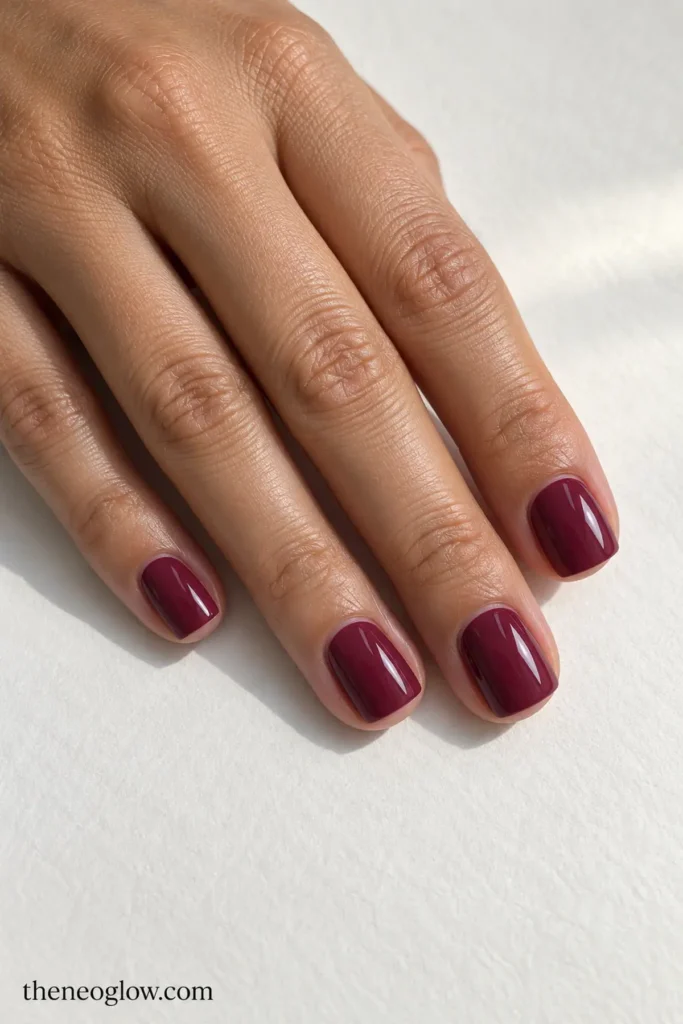
Paint short, straight-edged squares in a full-coverage mulberry with a noticeable red-violet cast. This shade looks lighter and fruitier than idea 1, but it must stay purple enough to avoid reading as cranberry red. A simple cream gloss makes the nail shape and smooth color the point. It is a clear everyday choice if almost-black polish feels too severe.
3. Violet-Prune Satin Tapered Squares
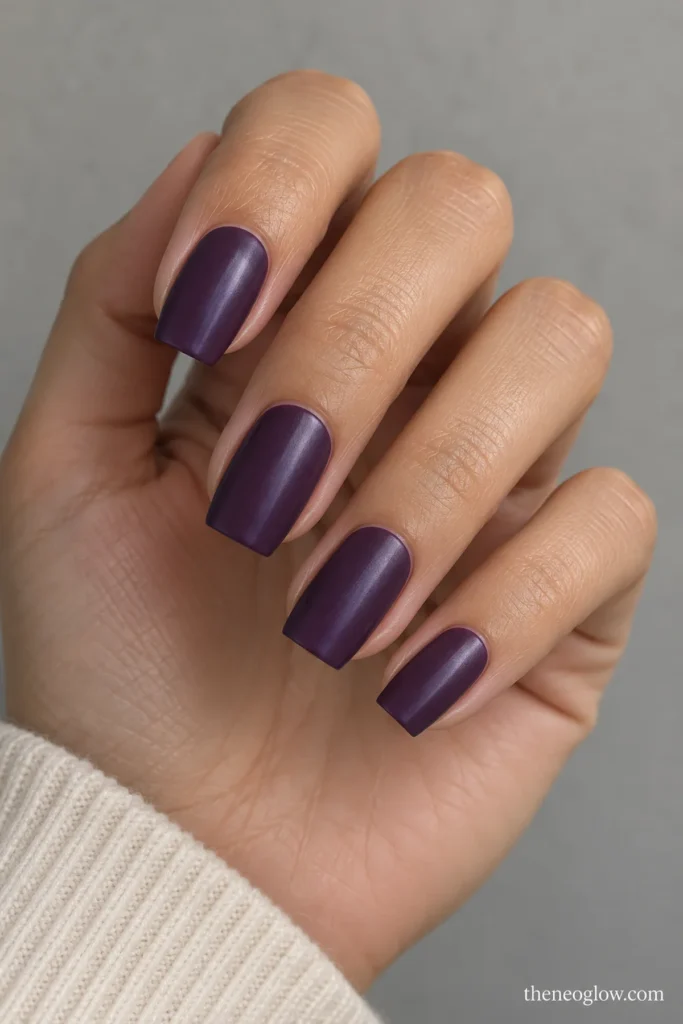
Medium tapered-square nails take an opaque cool prune with more blue-violet than berry red. A low-luster satin finish softens the glare without erasing the color. Keep every nail identical and avoid reflective powder; against the glossy mulberry squares, the squarer silhouette and quieter finish create a genuinely different result. This is one to compare beside gray, navy, or charcoal clothing.
4. Dusty Plum With Fine Lilac Shimmer
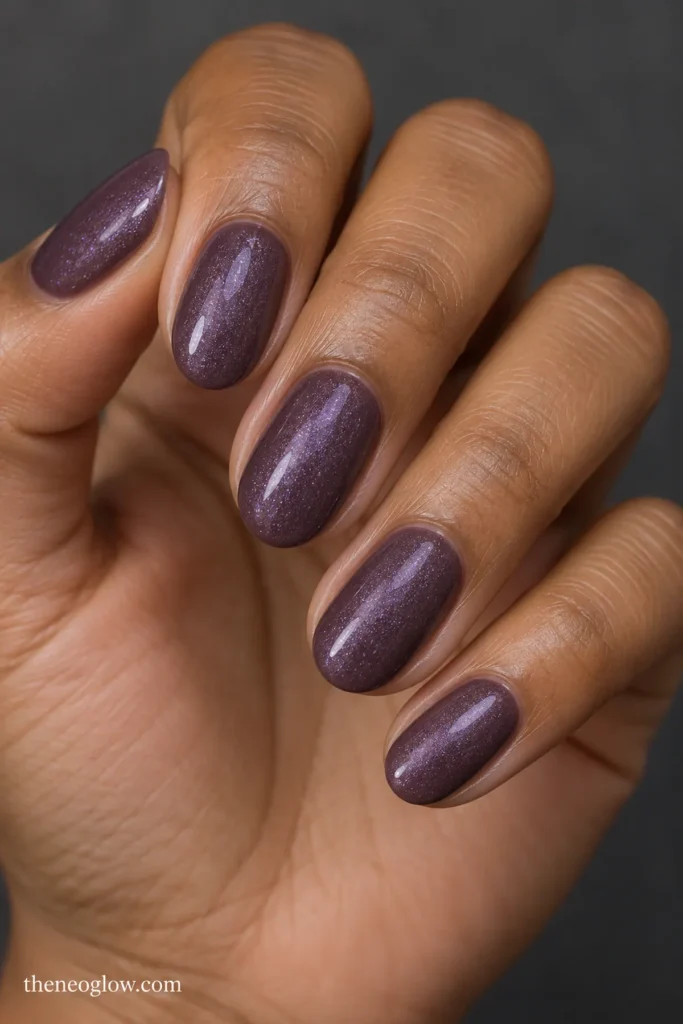
On short-to-medium ovals, use a grayed plum base scattered with very fine lavender microshimmer. The base stays muted and opaque; individual reflective specks should look suspended in polish rather than like chunky glitter. The violet glints are easiest to see when the hand turns, so this works for someone who wants movement without a metallic surface or strong cat-eye line.
5. Aubergine Matte Coffins
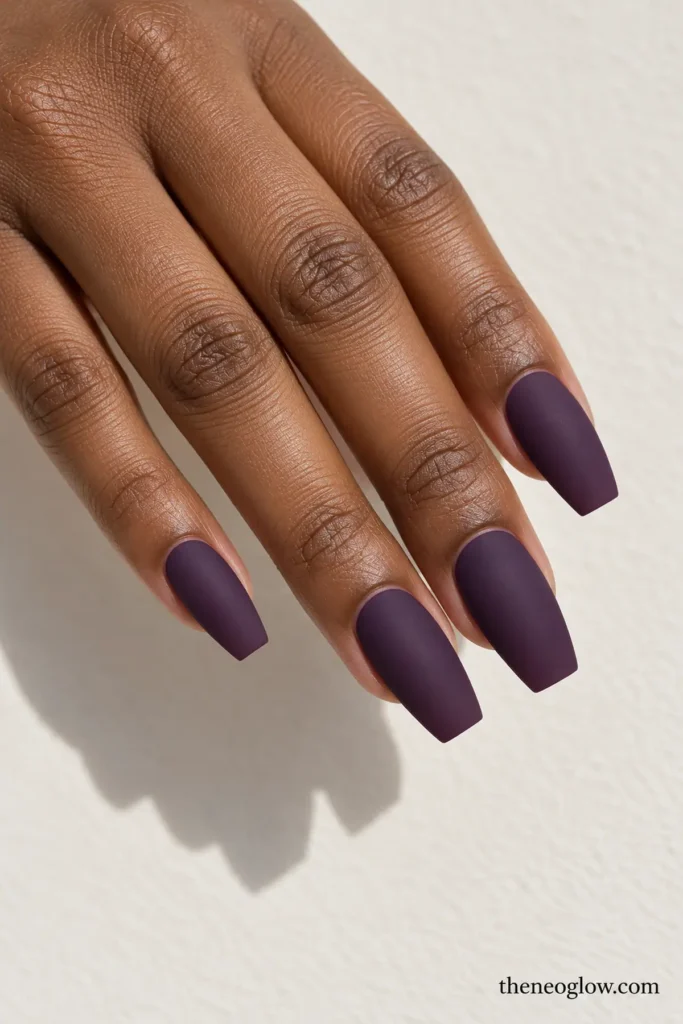
Medium-length coffin nails give deep, desaturated eggplant-purple enough space to read cleanly. Cover them with a completely opaque matte topcoat and leave the free edges sharp but not exaggerated. Unlike satin prune, this is a deliberately flat, velvety-looking color block. For shorter natural nails, borrow the matte aubergine color on squovals instead of adding length just to imitate the photo.
Translucent Plum and Small Tonal Details
6. Clear Plum-Jam Jelly Ovals
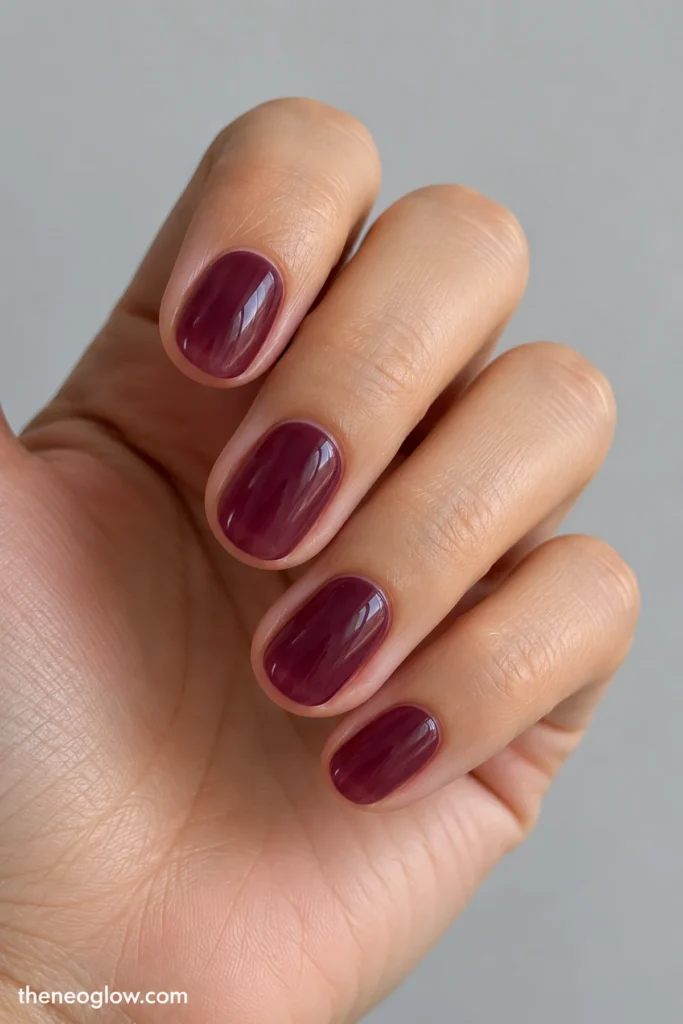
Short ovals receive a transparent juicy-purple jelly, with the natural nail still faintly visible through the finish. Keep the color even from cuticle to edge, like tinted glass, rather than painting a French line or a gradient. The lighter transmission of color makes this easier to distinguish from a full-coverage crème, especially in a daylight reference.
7. Mulberry Syrup-Dipped Ends
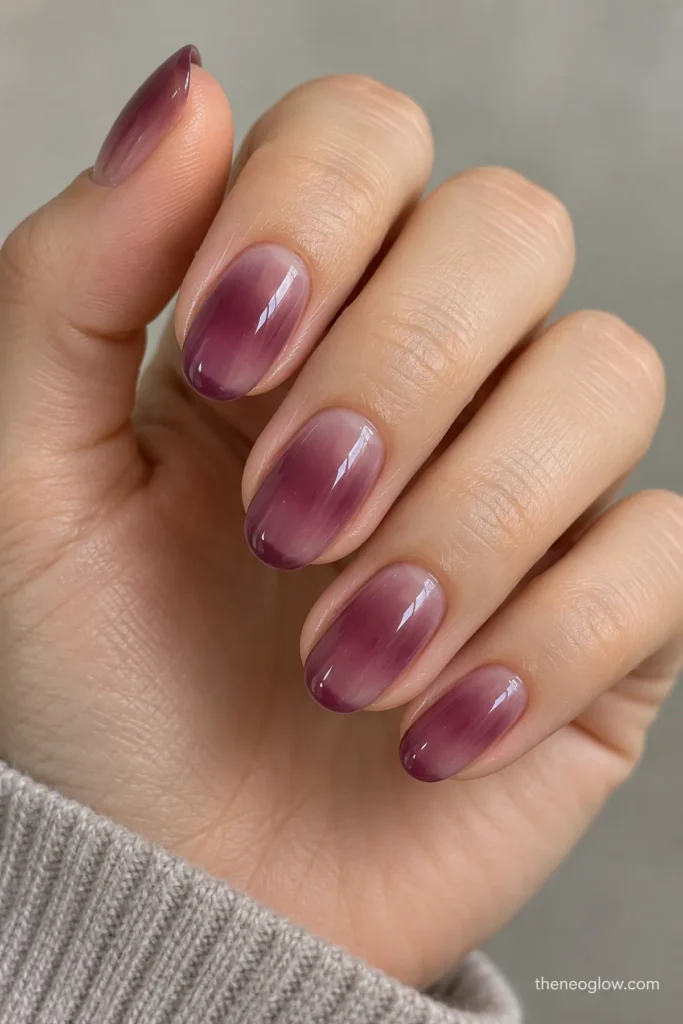
Start with a pale translucent plum wash over medium rounded nails. Build another transparent berry-purple layer only across the upper third so the free ends appear dipped into deeper syrup, with a blurred transition but no opaque tip border. This is a tip-weighted translucent treatment, not the violet-to-black full-nail ombré seen in broad winter galleries. Ask for visibly layered jelly rather than a painted solid-color French tip.
8. Plum Cuticle Windows
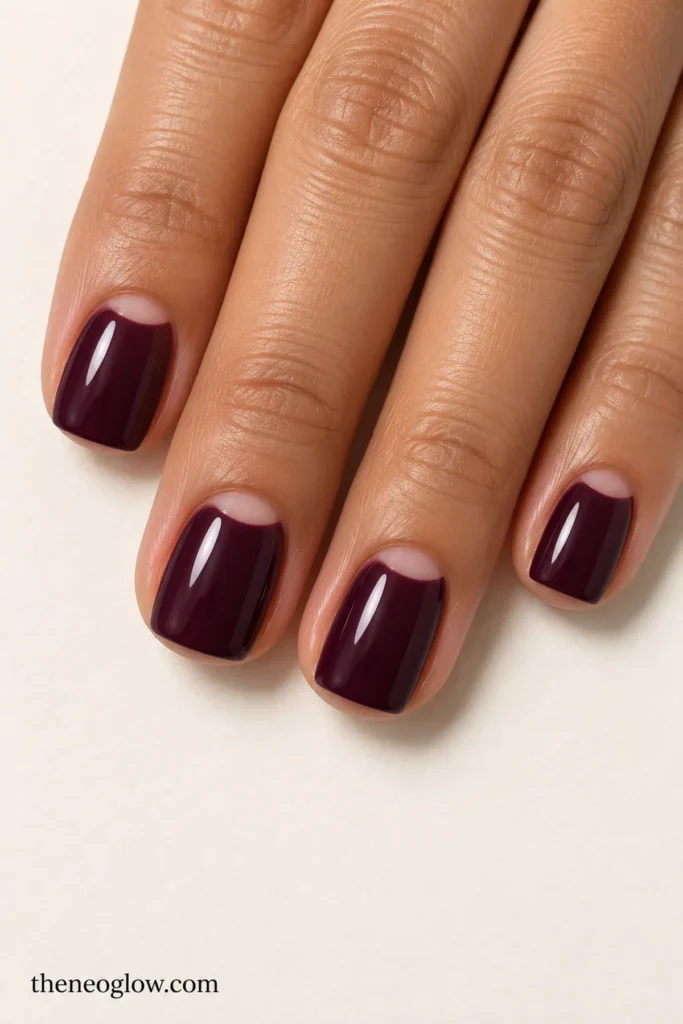
Fill short soft-square nails with glossy, opaque dark plum, but leave one small, clean semicircle of natural-looking nail exposed at each cuticle. The untouched crescent should be large enough to read as an intentional window without swallowing the plum field. This reverses the usual French arrangement: almost the whole nail stays saturated, while the negative space is confined to the root.
9. Eggplant Edges With Lavender Contours
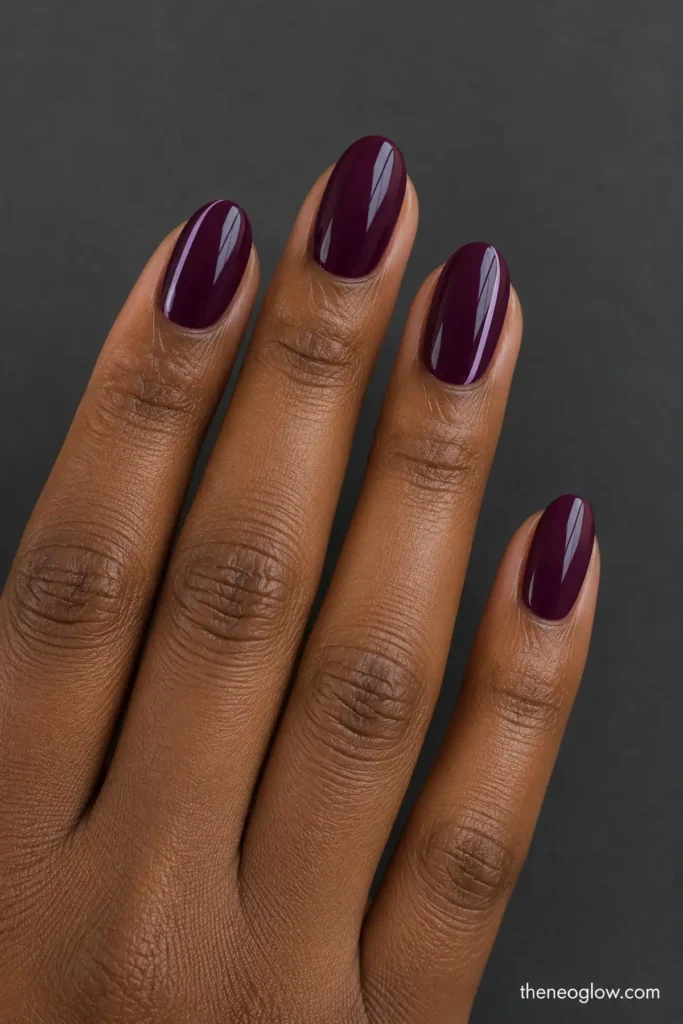
Medium ovals are painted uniform, glossy eggplant-purple. On the index and ring fingers only, draw a fine muted-lavender line running parallel to one sidewall, stopping before it reaches the cuticle and tip. The remaining nails stay solid. It is an understated way to wear plum nails with design without resorting to nude bases or a tiny symbol that gets lost on the nail plate.
10. Gloss-on-Matte Plum Arches
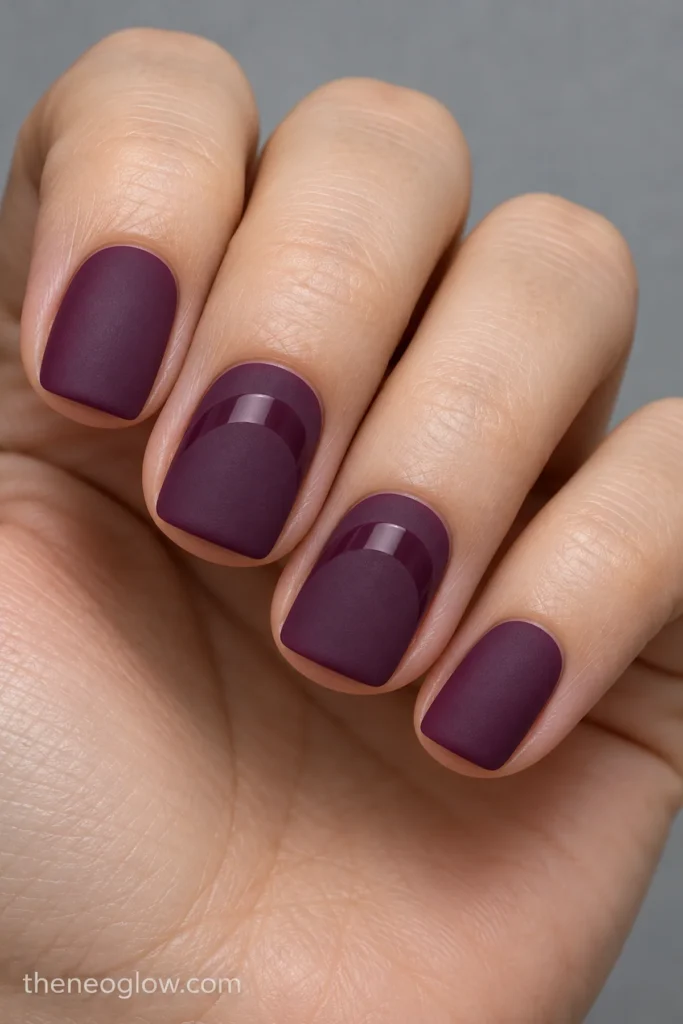
Use short squovals in opaque matte plum. Across the middle and ring nails, add one broad curved arch in the same plum shade but a glossy finish; leave the other nails fully matte. The pattern becomes visible through light contrast rather than another pigment. Unlike the satin solid above, this manicure contains a specific, inspectable shape and two surface finishes.
Plum French Tips and Graphic Placement
11. Wide Damson French Almonds
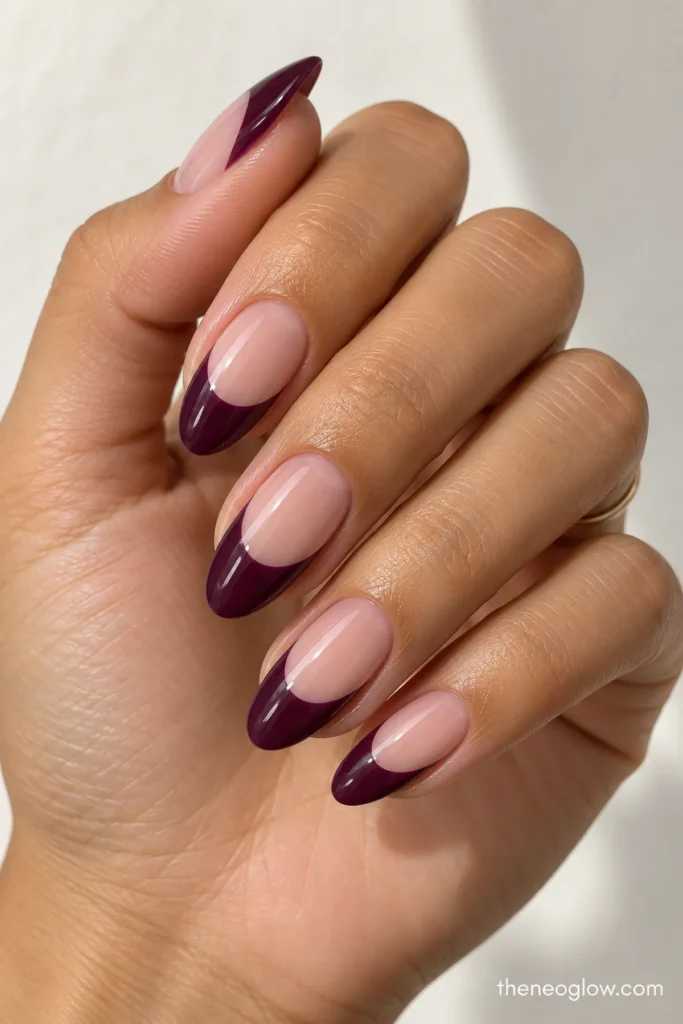
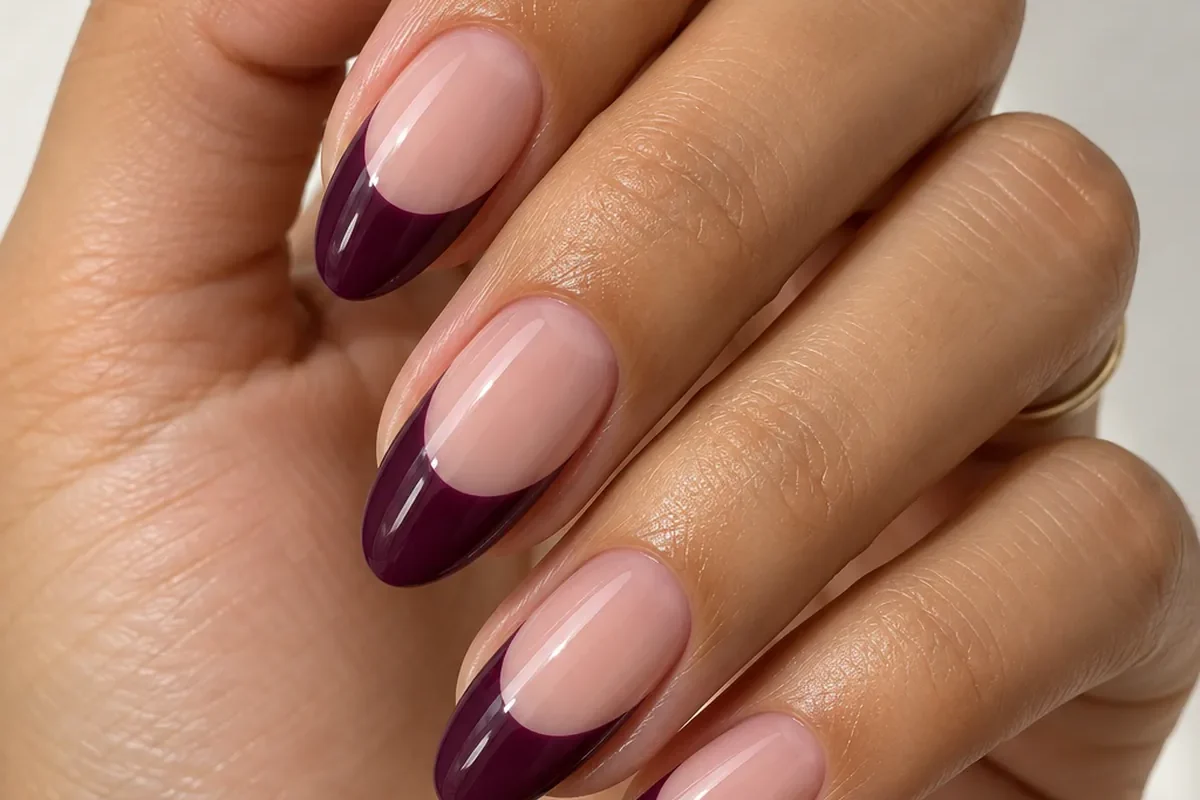
Medium soft-almond nails have a translucent neutral-pink base and generous opaque damson-purple French caps extending down roughly the outer third of the nail. The purple should look substantial, not like a barely visible burgundy hairline. Keep the smile line evenly curved and the tips glossy. This gives classic French structure while making the plum shade the main visible feature.
12. Open-Edge Plum French
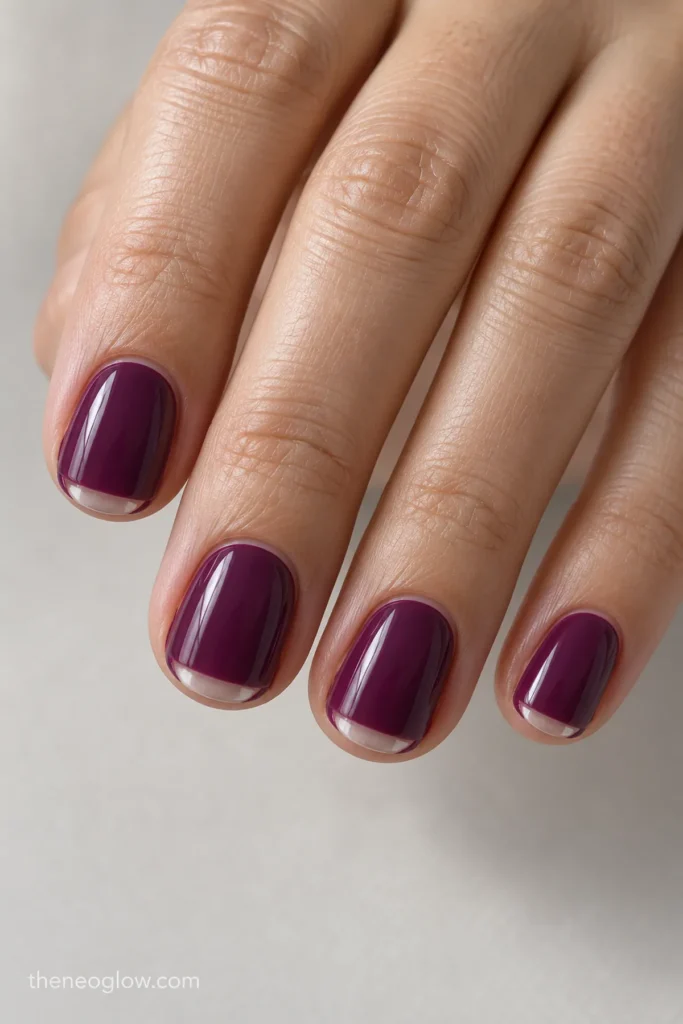
Short rounded nails stay opaque cool plum from cuticle through most of the plate, but each free edge has a narrow, translucent curved gap surrounded by plum at both side corners. The exposed tip crescent is the opposite of a traditional colored French band, and far from idea 8’s root window. It looks graphic in close-up while keeping nearly the entire nail unmistakably plum.
13. Two-Shade Plum Chevron Tips
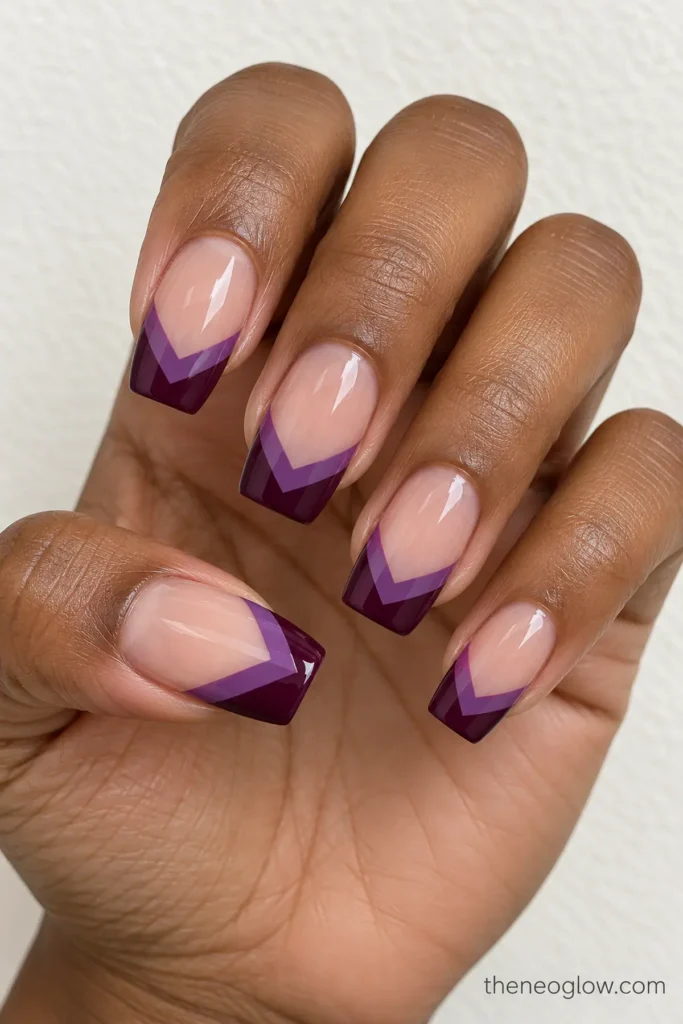
On medium tapered squares, build angular, broad V-shaped French tips in deep wine-plum, then place a thinner, lighter violet-plum chevron directly inside each V. Keep the underlying nail translucent and the two plum tones clearly different. This is a sharply geometric option rather than the soft curve in idea 11; it needs enough tip width for both colored bands to remain separate.
14. Offset Prune Color Blocks
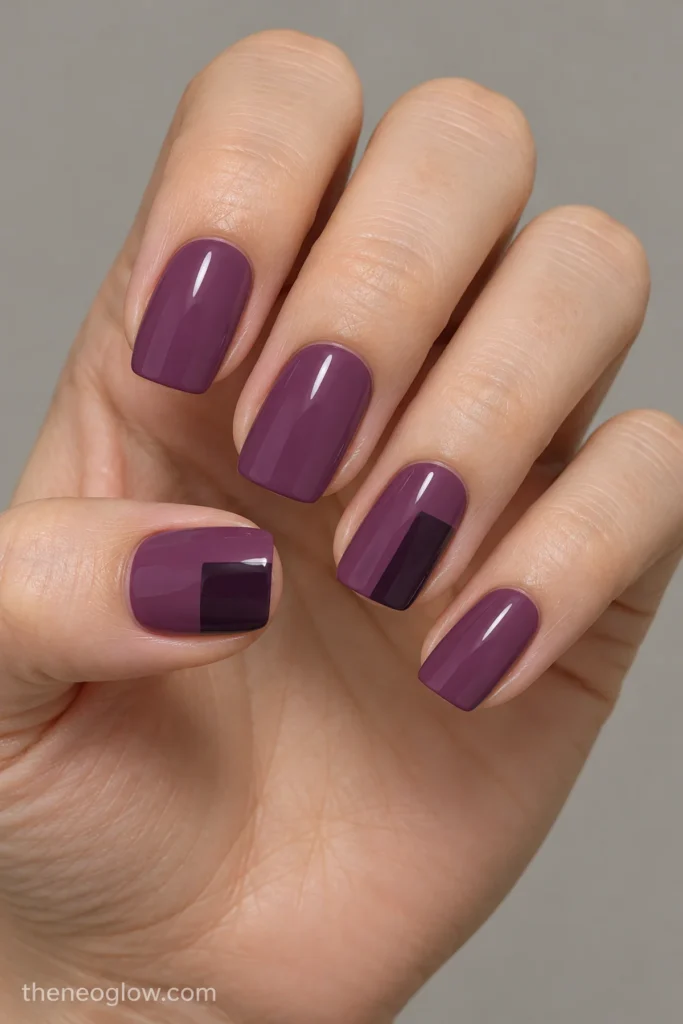
Cover medium squovals in glossy medium plum. On the thumb and ring nails, overlay one large opaque near-black prune rectangle along the right side, extending from mid-nail to just short of the free edge. A narrow strip of the original plum must remain visible around the block. This reads as architectural tonal color blocking, not a stripe, side French, or negative-space design.
Plum Chrome, Cat-Eye, and Reflective Effects
15. Mulberry-Tinted Mirror Chrome
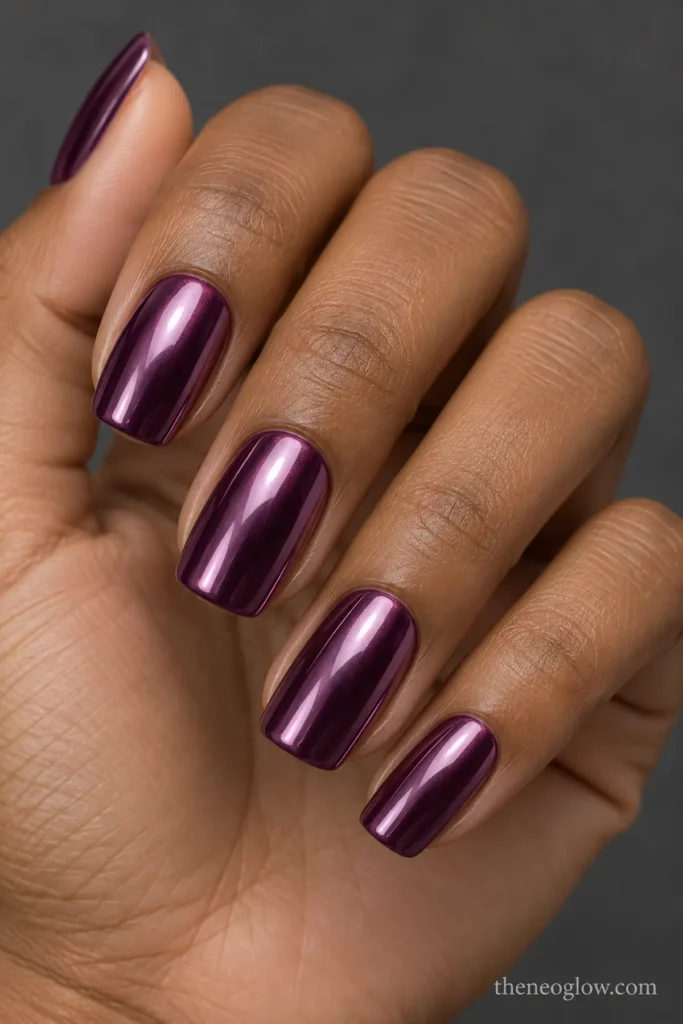
Medium rounded-square nails start with a saturated mulberry-purple base and receive a coordinated colored-chrome reflection that looks metallic violet-wine, not silver or pink. The finish covers every nail uniformly. If the reflection is so pale that the manicure stops reading plum, go deeper with the base or use a less opaque chrome effect. NeoGlow’s chrome nails guide explains the wider technique choices; here the requirement is specifically a recognizable plum result.
16. Plum Chrome Side Shields
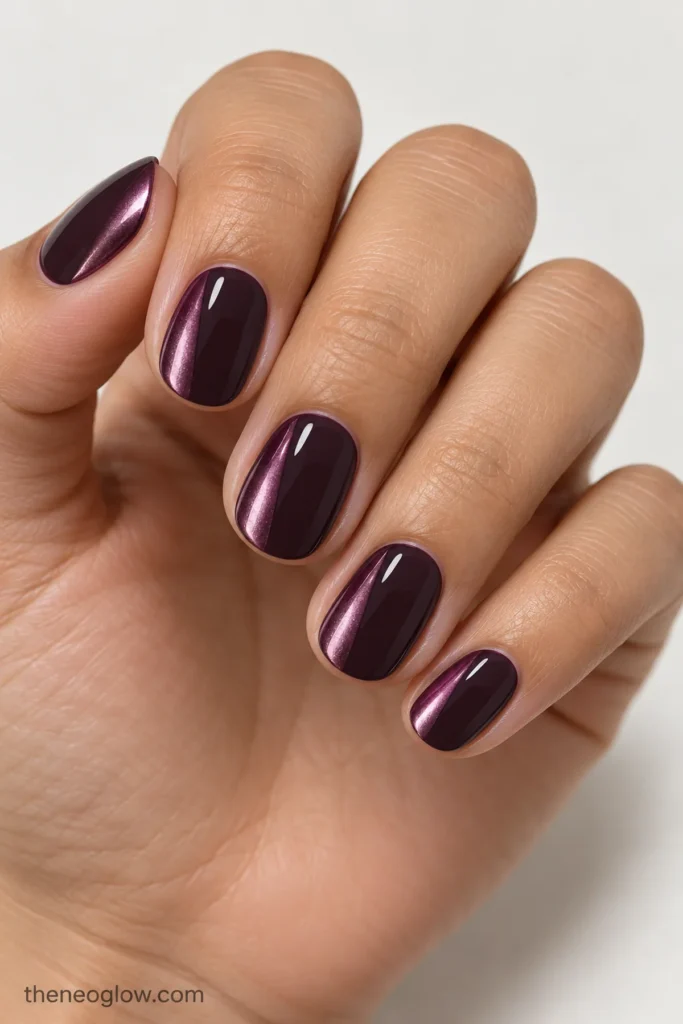
Keep short oval nails glossy dark plum. Along the left edge of each nail, add one broad curved panel of reflective plum-metallic chrome, covering roughly a quarter of the plate and stopping before the cuticle. The rest remains ordinary plum gloss. Unlike full mirror chrome, the contrast between stationary glossy color and reflective partial coverage is the design.
17. Diffused Blackberry Velvet
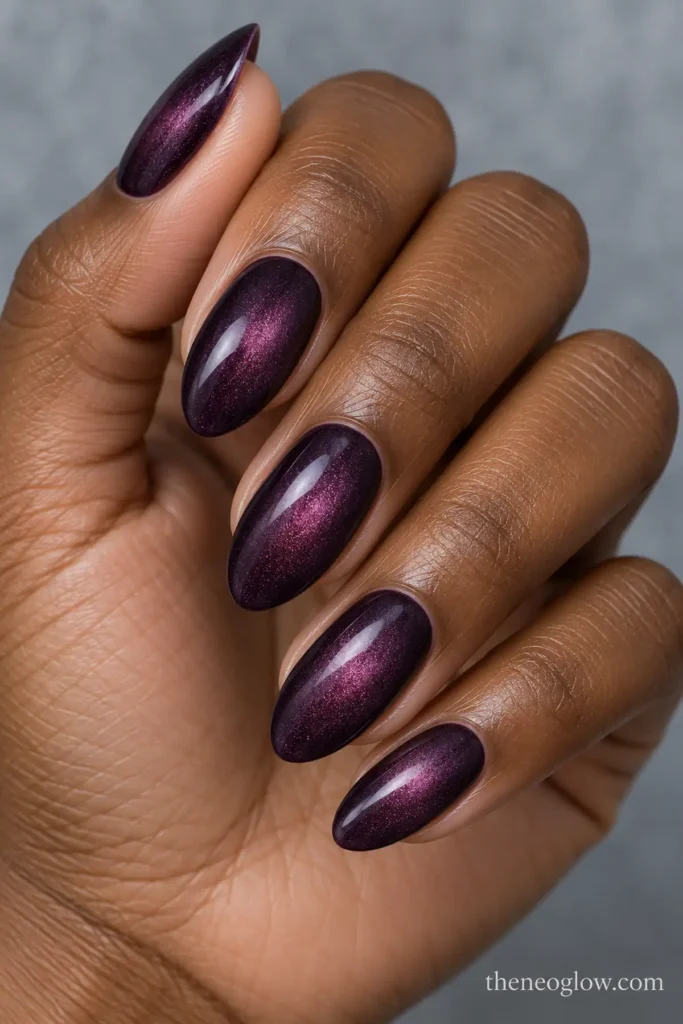
Use medium soft-almond nails in deep purple-black magnetic polish, with a broad blackberry-colored velvet reflection spread across each plate. There should be no hard diagonal beam or silver stripe; the light appears softly pooled throughout the dark color. Keep the reflected hue purple so the set does not turn charcoal. For more on magnetic placement types, see NeoGlow’s cat-eye nails comparison.
18. Plum Cat-Eye With an Off-Center Magenta Flash
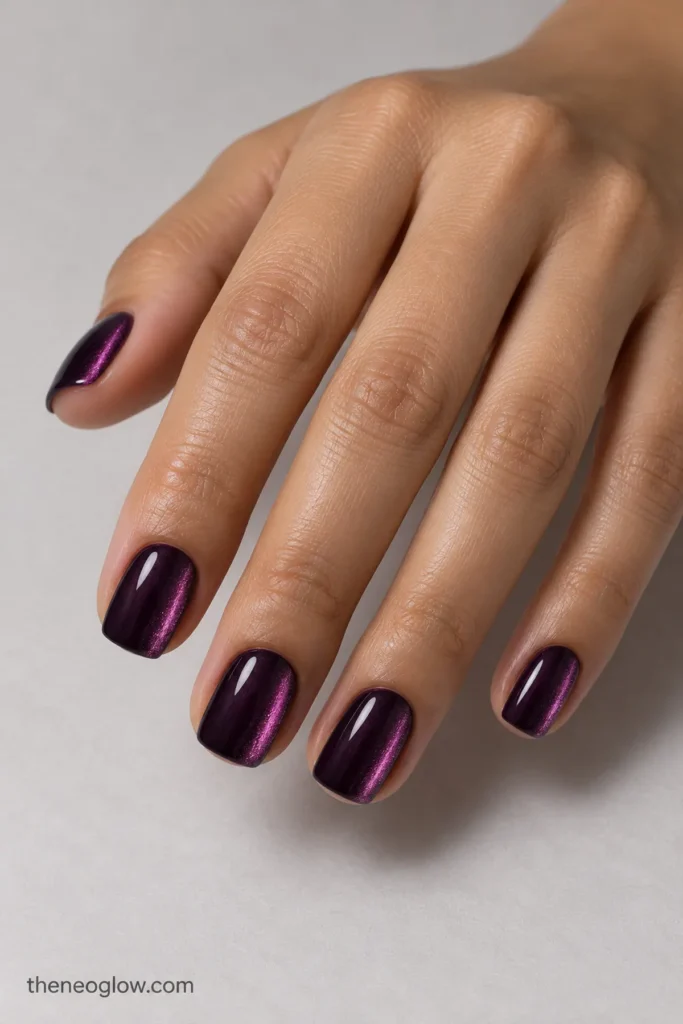
Choose short soft-square nails with a dense deep-plum magnetic base. Pull a slim magenta-purple flash close to the outer side of every nail, leaving a large dark plum area on the opposite side. This is a narrow, directional beam rather than the diffuse velvet wash of idea 17 or the two-accent arrangement used in broader cat-eye collections. The dark-to-bright contrast must remain visible in a normal-light photo.
A Patterned Plum Finish That Still Looks Plum
19. Tonal Plum Windowpane Plaid
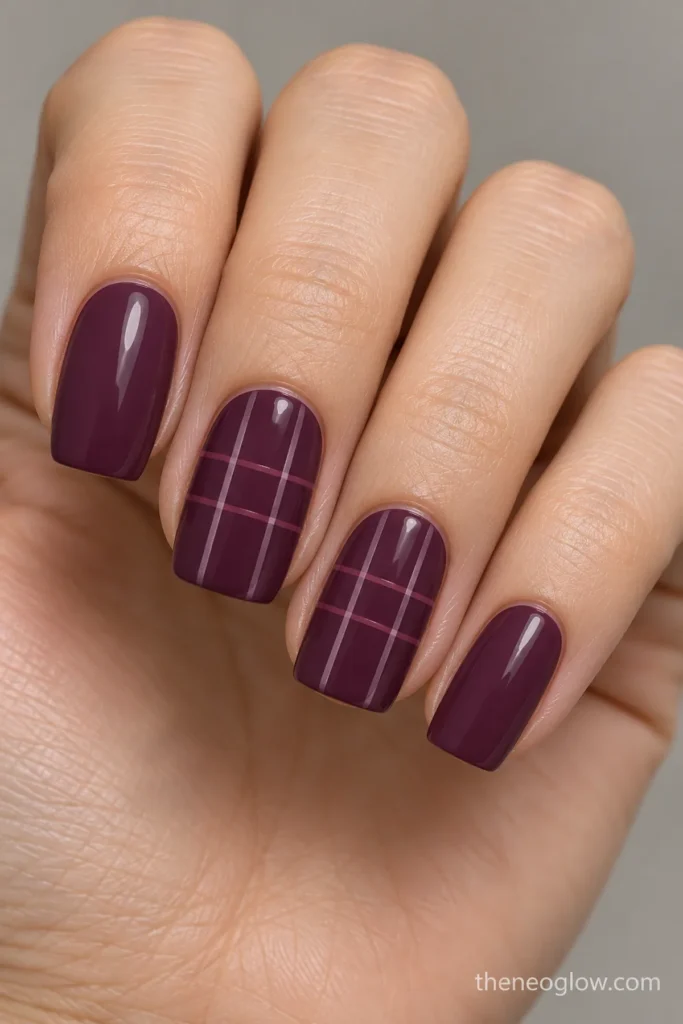
On medium squovals, paint every nail an opaque medium-dark plum. Add a small, widely spaced windowpane grid on the middle and ring fingers: two thin vertical dusty-lilac lines crossed by two even finer berry-plum horizontal lines. All other nails stay solid. Let the saturated background occupy most of the surface; oversized white checks would pull this away from the plum color family.
Make the Look Work With Your Length and Routine
The easiest way to compare these photos is to separate appearance from service. Cream, jelly, and ordinary shimmer can be available in traditional polish formulas; chrome powder and many magnetic looks require more specific products and application steps. If a salon proposes gel, ask which exact product system it uses and how the finish will be removed. Do not assume a reflective photograph proves that regular lacquer or gel was used.
Dark full-coverage shades show exposed free edges and pale chips more readily than a sheer base. Matte finishes may acquire shiny spots with friction, while chrome highlights interruptions in reflection. If you type frequently or dislike managing extra length, the short rounds, squares, and squovals in ideas 1, 2, 6, 8, 10, and 18 are reasonable references. For an extended coffin or tapered-square design, check the actual finished length rather than treating the shape name as a size.
If you want plum nails acrylic, remember that the color is not the extension material. You can request plum on an enhancement or wear a similar color on natural nails. The American Academy of Dermatology’s guidance on artificial nails and damage reduction explains preparation, upkeep, and reasons not to cover nail problems with an enhancement.
For gel-based chrome or magnetic designs, follow the specific product system for application and removal; never peel or pry off lifting material. The AAD’s gel manicure care advice also covers UV-protection options and nail care between appointments. If skin or nails become persistently irritated or painful, seek professional advice rather than concealing the problem under fresh polish.
Your Next Plum Manicure
For the simplest dark manicure, compare patent black-plum with warmer mulberry. If you want less visual weight, start with clear plum jelly or an exposed root detail. Choose a wide French for deliberate tip contrast, matte arches for subtle texture, or magnetic plum when the movement of light matters most.
Save a single numbered reference together with its nail length, base opacity, plum undertone, and exact finish. If you would rather compare plum with other cold-season colors, the winter nail colors guide keeps those broader palette decisions in one place.