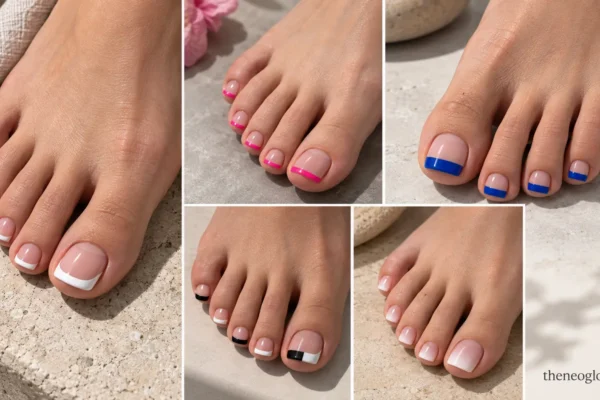
Matching best friend nails do not need to be exact copies. The most polished pairs share one visual rule—such as a palette, motif, finish, or placement—while leaving room for different nail lengths, undertones, and personal styles. That approach works for a birthday, weekend trip, shared salon visit, or friendship celebration without making either person wear a design that feels wrong.
The United Nations International Day of Friendship is observed on July 30, making late July a useful promotional moment. The ideas below are evergreen, however, and can be adapted for any party or meaningful day together.
Choose What Will Match Before Choosing the Artwork
| Matching method | Keep shared | Let each person change |
|---|---|---|
| Palette | Two or three related colors | Shade depth, warmth, and opacity |
| Motif | One flower, heart, star, fruit, or line style | Size, placement, and number of accents |
| Finish | Gloss, jelly, pearl, chrome, or matte | Base color and nail shape |
| Structure | French tip, half-moon, side curve, or negative space | Tip width, length, and contrast |
For a shared salon appointment, agree on the matching rule before you arrive and save one reference that shows the important detail clearly. You can still choose different shapes and lengths. The American Academy of Dermatology’s manicure and pedicure safety guidance also recommends paying attention to clean stations and tools and avoiding forceful cuticle cutting or pushing.
16 Best Friend Nail Ideas With Coordinated Differences
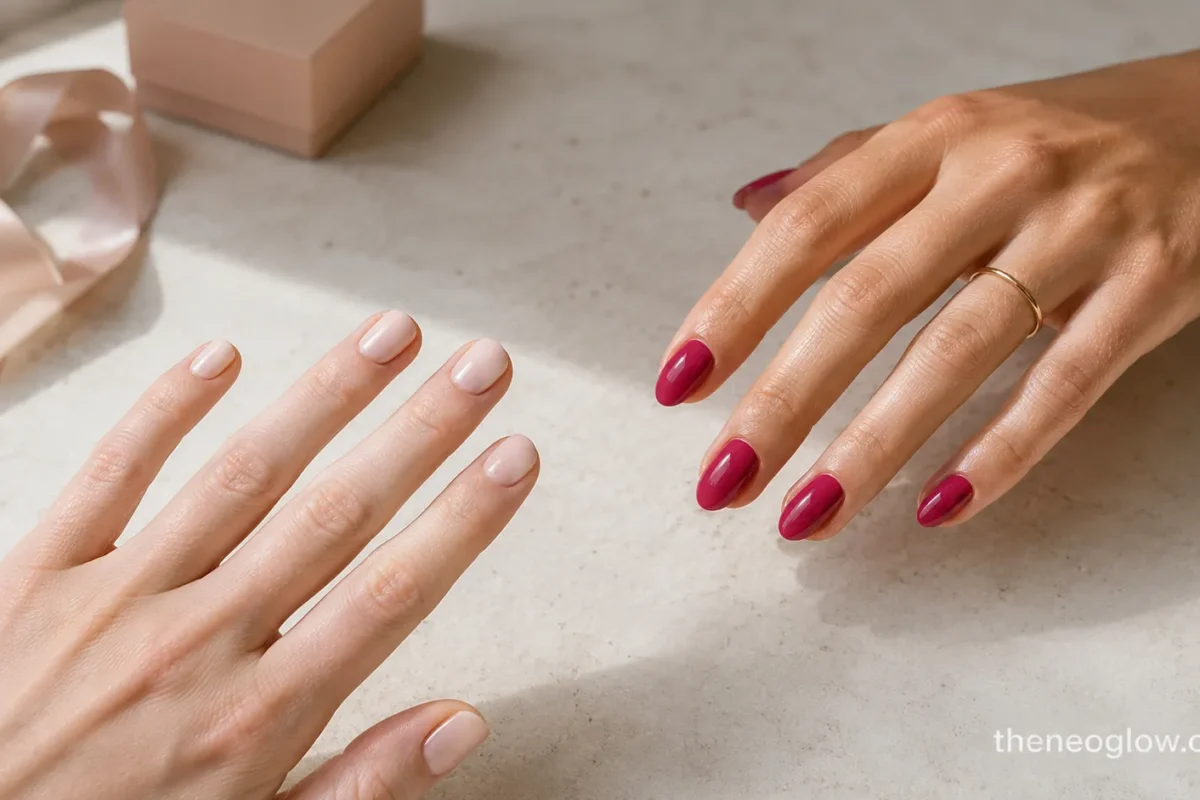
1. Blush and Berry Tonal Pair
Shared: Use the same rosy color family and glossy cream finish. Changes: One person wears pale blush on short squovals, while the other chooses deeper raspberry on medium almonds. A neutral blush can bridge different undertones; select a peachier version for warm skin or a cooler mauve-rose for cool skin. The pair looks connected in photos without appearing copied.
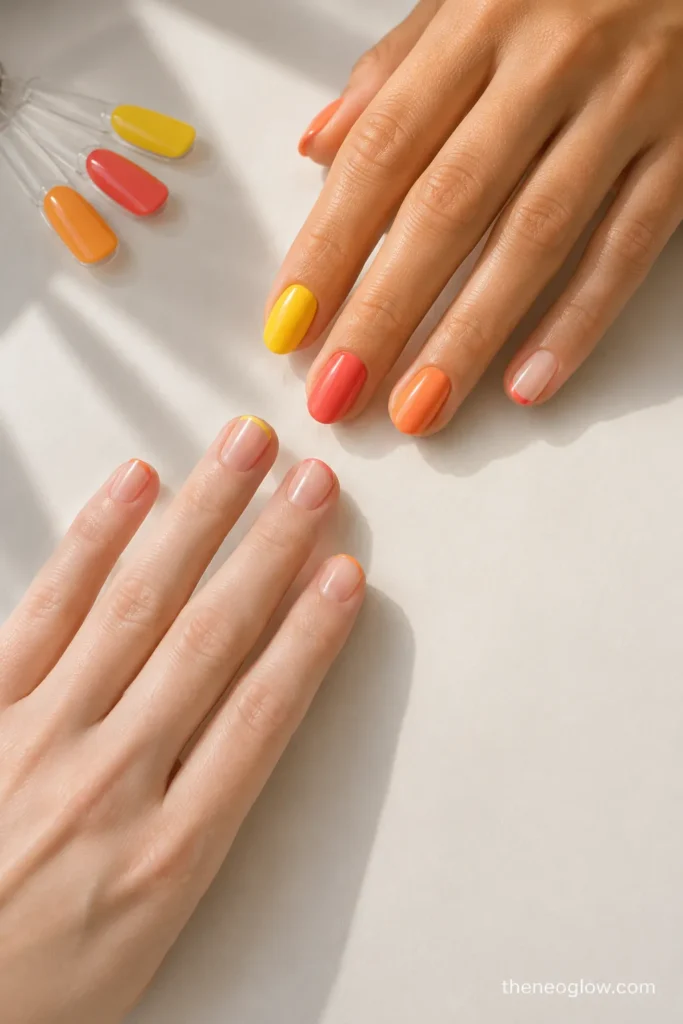
2. Citrus Palette in Two Intensities
Shared: Repeat lemon, coral, and tangerine across both manicures. Changes: The minimalist friend uses narrow multicolor French tips, while the bolder friend wears solid citrus shades with one sheer accent. Keep the color order consistent to strengthen the connection. For more palette inspiration beyond this pair, compare the broader summer nails 2026 ideas.
3. Ocean Blues, Different Depths
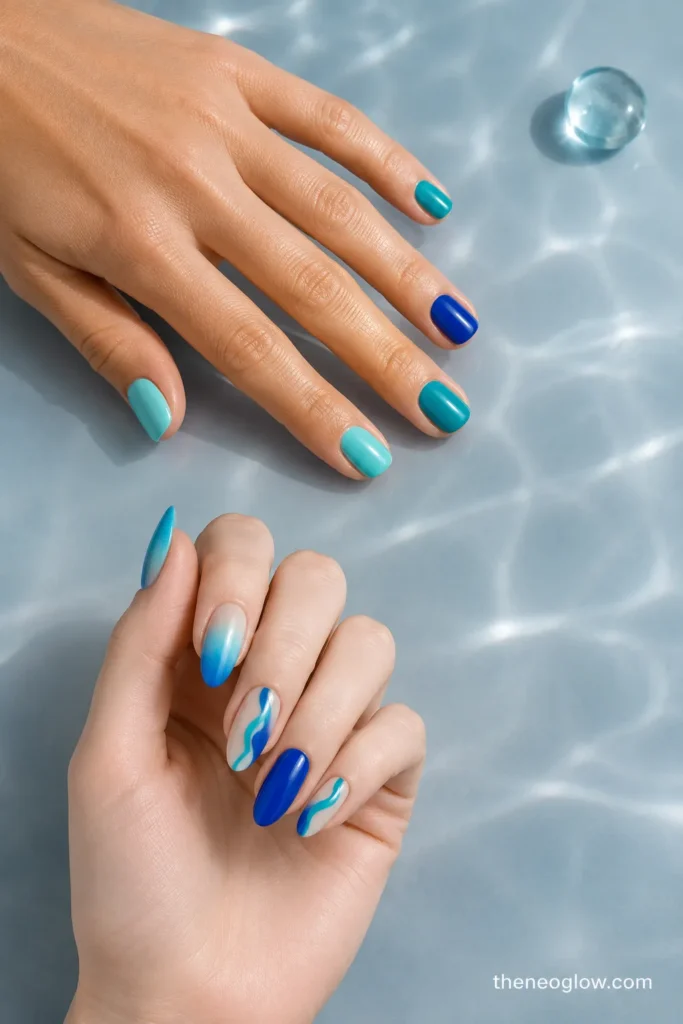
Shared: Build both sets from aqua, teal, and cobalt with a glassy finish. Changes: Short nails can alternate clean solid colors; longer nails can use a soft blue gradient or side swirl. Choose greener teal for warm or olive undertones and clearer cobalt or icy aqua for cooler undertones. The shared water palette does the matching work, so no literal beach art is required.
4. Nude and Metallic Split
Shared: Use a translucent nude base and one fine metallic detail. Changes: One manicure gets a gold cuticle cuff, while the other uses silver micro French tips. This is useful when one friend prefers warm jewelry and the other wears cool metals. Keep the line thickness equally delicate so the two sets still feel like one restrained concept.
5. Cherry Red and Black Cherry
Shared: Choose the same red family, high gloss, and simple full-coverage placement. Changes: One person wears bright cherry red on very short rounded nails; the other selects wine-toned black cherry on oval or almond nails. Match the undertone rather than the exact bottle—orange-red suits warmer preferences, while blue-red creates a cooler, sharper result.
6. One Flower, Two Placements
Shared: Repeat the same miniature five-petal flower and center color. Changes: Place one flower near the cuticle on short nails, but use a small side cluster on longer nails. The person who likes quieter art can keep the remaining nails sheer; the other can add a coordinating solid. Consistent petal size and outline weight make the pair recognizable.
7. Tiny Heart and Micro French Pair
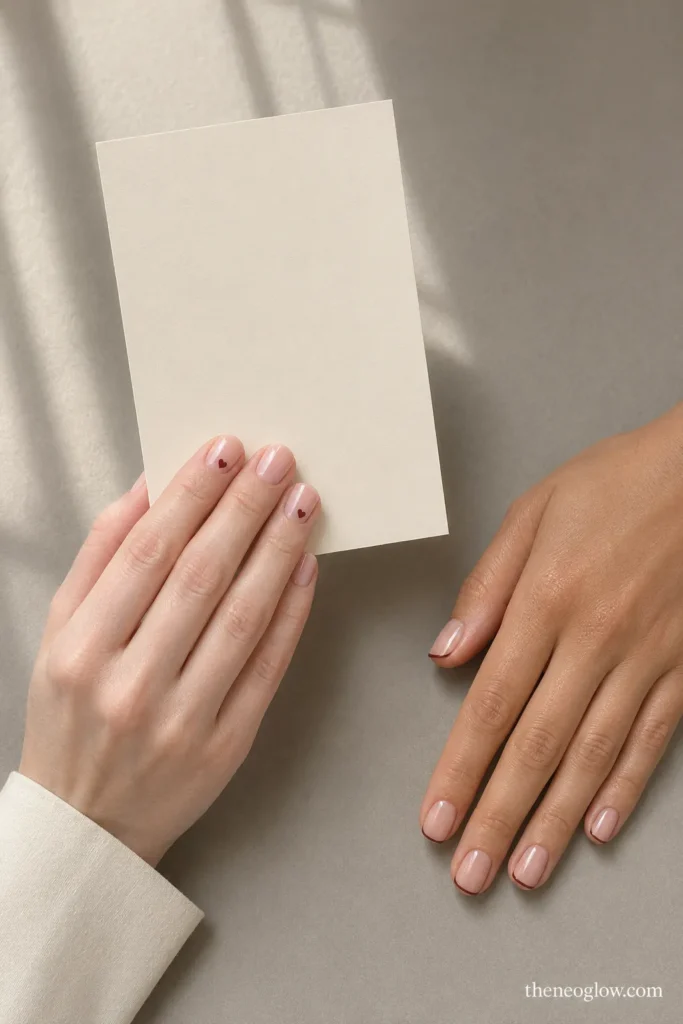
Shared: Use one accent color over a sheer pink or beige base. Changes: One friend wears a tiny heart near the cuticle, while the other uses the same color as a micro French tip. Choose dusty rose or burgundy for a subtle BFF manicure, or hot pink for a party-ready version. The symbol stays small, avoiding text-heavy or childish friendship art.
8. Crescent Moon and Single Star
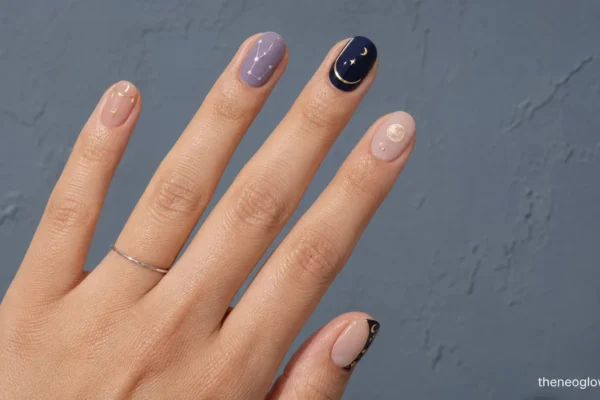
Shared: Keep the same navy, silver, and sheer-nude palette. Changes: One set features a tiny crescent on two accent nails; the other uses one slim star with two micro dots. Short nails need one symbol and plenty of open base, while medium nails can hold a short constellation line. Match the metallic finish so the different celestial motifs still belong together.
9. Checkerboard and Pinstripe Duo
Shared: Select the same two colors and crisp glossy finish. Changes: The graphic-style friend wears two checkerboard accents, while the minimalist friend uses one or two vertical pinstripes. Short square nails suit both patterns, but narrow nails should use fewer squares and a single stripe. This pair coordinates through geometry rather than identical artwork.
10. Mini Fruit Accent Pair
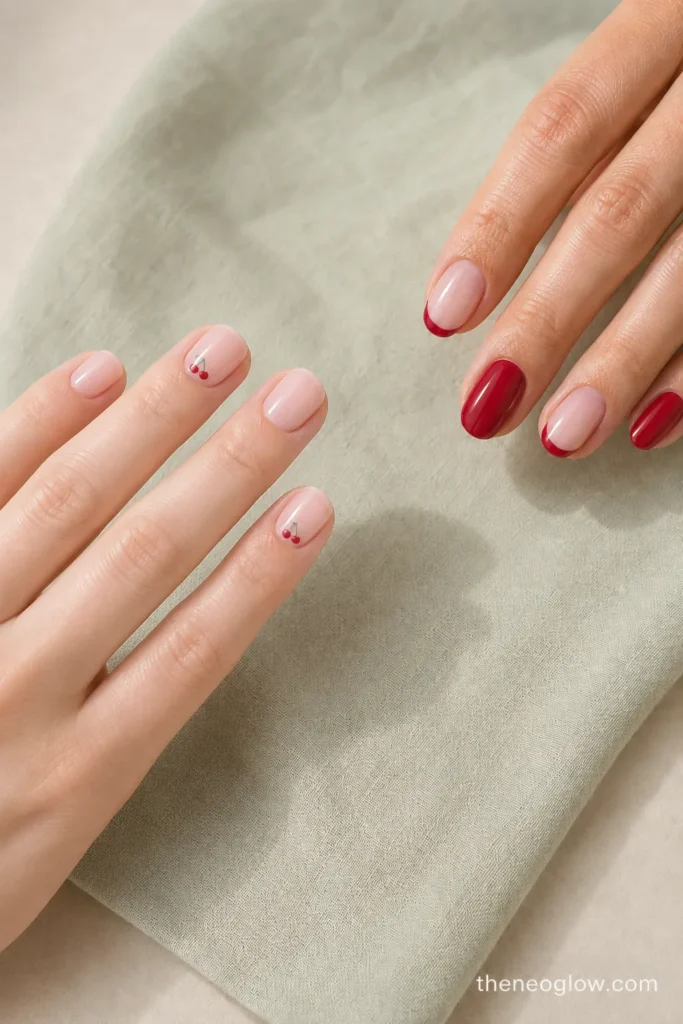
Shared: Choose one fruit family and repeat a limited color palette. Changes: One person wears a cropped lemon or cherry accent on a sheer base; the other uses the same colors in French tips or solid nails. Keep the fruit miniature and reserve it for one or two fingers. More playful motif options appear in these cute summer nails.
11. Birthday Confetti and Chrome
Shared: Repeat one party color, such as raspberry, cobalt, or rose gold. Changes: One manicure uses sparse flat confetti inside a jelly base, while the other wears a smooth pearl or chrome finish in the same shade family. For a specific birthday palette, the July birthday nails guide offers dinner, pool-party, and short-nail directions that can be adapted into pairs.
12. Pearl Glaze and Satin Chrome
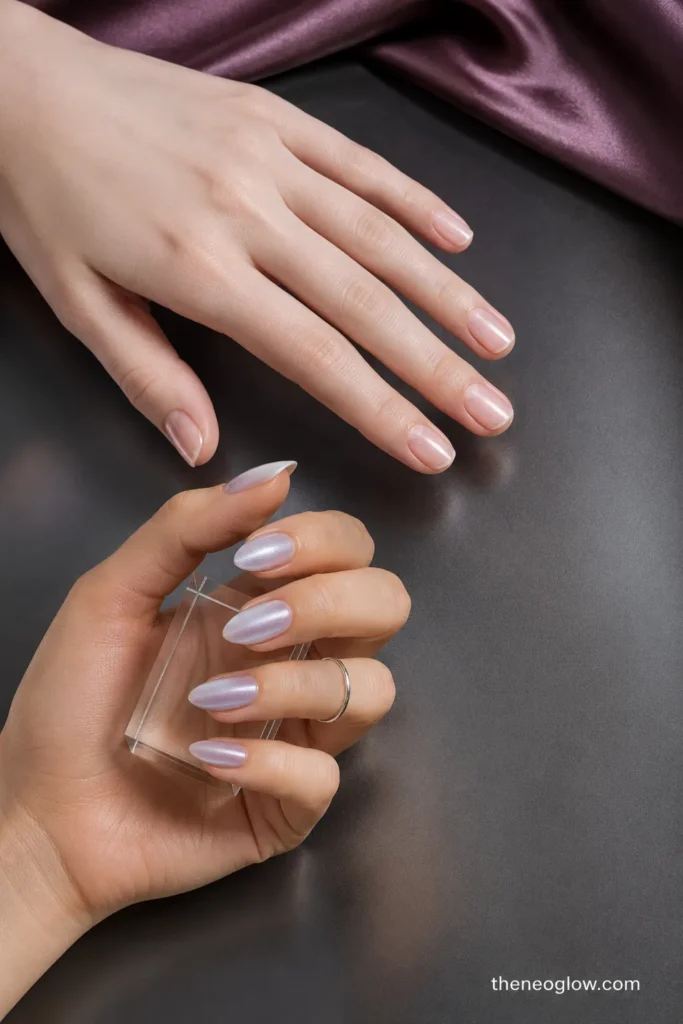
Shared: Give both manicures a soft reflective finish rather than a sharp mirror effect. Changes: One person chooses translucent milky pink with a pearl veil; the other uses opaque beige, lavender, or blue beneath satin chrome. Adjust the base depth to remain visible on each skin tone. This is an elegant option when friends want coordination without obvious motifs.
13. Two Jelly Shades, One Transparency Level
Shared: Use equally translucent jelly polish and the same rounded shape. Changes: One friend chooses peach or coral, while the other wears raspberry, grape, or aqua. Keep the number of coats visually similar so both sets have matching depth. Jelly color looks especially cohesive when one person has short natural nails and the other prefers a slightly longer oval.
14. Same French Outline, Different Colors
Shared: Match the French-tip width, curve, and sheer base. Changes: Each person selects a color that suits her wardrobe and undertone. Warm coral, butter yellow, and tomato red create a sunny direction; lavender, cobalt, and cool pink feel crisper. This is one of the easiest coordinating friend manicures to adapt when nail shapes or skin tones differ.
15. Negative-Space Side Curves
Shared: Place one slim curve along the same side of each nail and leave most of the base visible. Changes: The subtle set uses one muted color, while the expressive set layers two brighter curves. On very short nails, reduce the line to a single sweep; on almonds, extend it diagonally. Shared placement keeps the pair connected even when color intensity differs.
16. Opposite Accent Hands
Shared: Use the same three-color palette, finish, and two accent designs. Changes: Place the statement design on one friend’s left hand and the other friend’s right hand, then reverse the supporting solids. This creates a stronger reveal when the two hands are photographed together. It also lets each person keep a mostly wearable manicure while sharing one intentional photo moment.
How to Adapt the Pair for Two Nail Lengths or Skin Tones
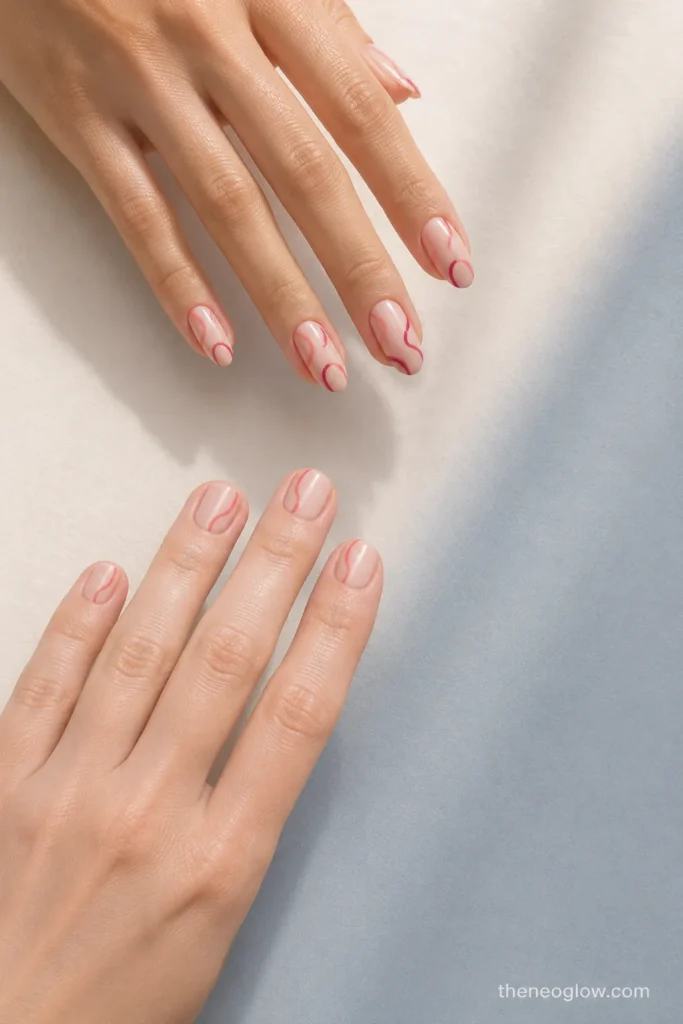
Scale the artwork, not the friendship concept. A short nail can carry one dot, flower, star, side curve, or micro tip; a longer nail can repeat the same element with more spacing or a second line. Keep motif proportions similar rather than stretching one design to fill extra space.
For different skin tones, preserve the color relationship while adjusting depth or undertone. Two nudes do not need to be identical; they need to play the same role. One can be peach-beige and the other rose-brown. Likewise, one blue can lean aqua while the other moves toward cobalt, provided the finish and placement remain shared.
Frequently Asked Questions
Do best friend nails have to match exactly?
No. Complementary nail designs often look more personal because each manicure keeps one shared feature while changing another. Matching the palette and finish is enough even when the shape, length, or accent placement differs.
What is the most subtle way to coordinate friend manicures?
Use the same sheer base and one repeated micro detail, such as a colored tip, metallic line, tiny heart, or single flower. Each person can choose a different shade depth while keeping the placement identical.
Can matching best friend nails work on short natural nails?
Yes. Choose small-scale art, slim French tips, solid colors, jelly finishes, or one accent per hand. The second person can wear a longer version using the same palette and motif without forcing the short nails to hold extra detail.
Choose One Rule and Personalize the Rest
The strongest matching best friend nails share a clear visual connection without erasing individual taste. Decide whether your anchor will be color, motif, finish, or placement, then let each person adjust length, shape, contrast, and undertone. Save the pair that feels most natural, bring both references to the salon, and photograph the two manicures together when the celebration begins.
![Pin number: 5. Selected click job / creative role: MINIMAL LIFESTYLE HERO. Exact article title: “24 October Nails 2026 for Fall Color, Halloween, and Moody Finishes.” Exact Pin angle: Use one refined article-supported late-October manicure to communicate the page’s “dark but not full-theme” lane. The image should feel aspirational and seasonal while remaining clearly wearable rather than costume-like. Matching Pinterest title for semantic reference only — DO NOT render: “Late October Nails With a Dark, Polished Edge” Matching Pinterest description angle for semantic reference only — DO NOT render: The article offers late-October ideas that use dark color, negative space and small seasonal cues without requiring overt ghost, web or character art. Selected Pinterest Board for semantic reference only — DO NOT render: Fall Nails Destination URL metadata only — DO NOT render: [ADD FINAL ARTICLE URL] Exact overlay headline with exact line breaks: LATE OCTOBER NAILS Exact supporting line: Dark, polished, not full-theme Selected layout family: FULL-BLEED MACRO HERO. Use one large manicure as the dominant full-canvas beauty image. Protect a quiet upper-left typography zone with a subtle tonal veil only if needed for contrast. Keep the manicure large enough to carry the image without supplementary panels. FINAL CANVAS: Exactly 1000 x 1500 pixels, strict vertical 2:3. SINGLE-HERO SUBJECT: Article Idea #18, Blackberry Eclipse Half-Moons. Show one anatomically correct adult feminine hand with medium to medium-deep neutral or warm-neutral skin. Use a relaxed curved close-up or elegant diagonal manicure display. Four nails should be clearly readable, with the thumb optional if anatomically natural. NAIL DESIGN: Use deep blackberry polish around a rounded negative-space half-moon close to the cuticle on each visible nail. The half-moon should read as clean bare or sheer negative space rather than a painted silver moon. Use a smooth glossy finish so the dark blackberry shade retains visible berry depth instead of turning flat black. Keep the design restrained and consistent across the hand. Use short-to-medium natural oval or gently rounded nails; do not exaggerate into long almond or stiletto. CROP AND FOCAL HIERARCHY: The hand should occupy roughly 68–82% of the canvas. Place the manicure center-right or diagonally through the center. Protect upper-left negative space for headline and supporting line. Keep all important nail detail above the bottom signature zone. TYPOGRAPHY ZONES: Headline: approximately x=80–680, y=90–260. Supporting line: approximately x=85–690, y=270–350. Do not place text directly across the darkest blackberry nails unless a quiet tonal veil preserves readability. Signature: y=1410–1500. BACKGROUND / PALETTE / MATERIAL: Use restrained warm ivory, muted taupe or soft stone-gray so the dark blackberry manicure separates clearly. A small plain black, charcoal or camel sleeve edge may appear below the wrist if it supports the late-October mood. Optional jewelry: one simple thin metallic ring, no logos or gemstones. No pumpkins, leaves, drinks, candles, flowers, bags, branded clothing or Halloween props. VISUAL-PROOF TYPE: Single Hero. MACRO CLARITY: The blackberry color must retain visible berry/plum undertone. Negative-space half-moons must remain clean and rounded. Do not mistake them for painted moon motifs or standard French half-moons. Gloss highlights must not obscure the negative-space edge. PHOTOGRAPHY AND ANATOMY: Realistic adult hand. Visible pores, fine lines, knuckles, believable cuticles, natural nail curvature and subtle asymmetry. No airbrushed plastic skin. No extra fingers, fused joints, duplicated nails or impossible grip. Use soft controlled side daylight with enough exposure to separate dark polish from the background. MOBILE 200 x 300 VALIDATION: “LATE OCTOBER NAILS” must remain immediately readable. At least three nails and their negative-space half-moons must remain clearly visible. The manicure should read dark, elegant and seasonal without depending on the supporting line. RENDERED TEXT ALLOWLIST LATE OCTOBER NAILS Dark, polished, not full-theme SnapLuxe by theneoglow.com INTENTIONAL-OVERLAY-TEXT-ONLY RULE: No other readable text anywhere. Do not render article title, Pinterest title, Pinterest description, board name, URL, Pin number, dimensions, layout name or metadata. UNBRANDED PROP RULE: Any sleeve, ring or background object must be plain, unbranded and text-free. SIGNATURE SYSTEM: Render exactly: SnapLuxe by theneoglow.com Bottom-center in the standardized approximately 90-pixel signature zone with high contrast and safe crop margins. COMPETITOR-ORIGINALITY LOCK: Do not imitate a competitor dark-nails Pin, an existing SnapLuxe composition, NeoGlow article image, footer, badge, watermark or trade dress. Use an original crop, typography relationship and background treatment. BEFORE/AFTER: Not applicable. NEGATIVE CONSTRAINTS: No ghosts. No spiderwebs. No bats. No character art. No literal moon illustrations. No orange Halloween props. No rhinestones. No chrome. No glitter. No black polish that erases the blackberry undertone. No long stiletto nails. No distorted fingers. No extra text. No Pinterest branding. No “trending,” “viral,” “best” or performance claims. SEMANTIC ALIGNMENT: The visible manicure, overlay, Pinterest title, description angle, Fall Nails board and destination article must all communicate one truthful late-October promise: darker seasonal styling with a controlled graphic cue, not a full themed Halloween manicure. Generate or assemble the image, then inspect the actual final output. Confirm exact 1000 x 1500 dimensions, exact allowlisted spelling and line breaks, correct anatomy, crisp nail detail, faithful polish color and finish, safe margins, readable signature, and readability at a 200 x 300 thumbnail. If any check fails, revise or regenerate. If actual-file inspection is unavailable, state QA NOT PERFORMED; do not call the asset publish-ready.](https://theneoglow.com/wp-content/uploads/2026/09/october-nails-fall-to-halloween-collage-600x400.webp)